
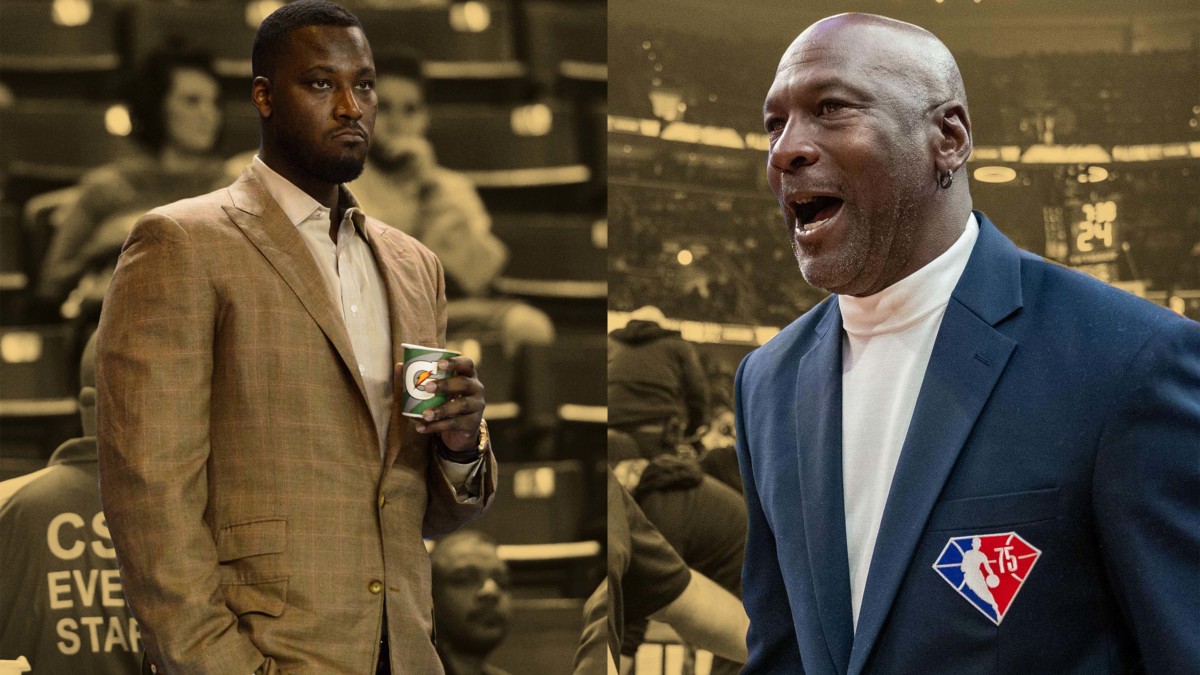
For years, Kwame Brown’s name has been treated like a punchline, a shorthand for failure in NBA circles. Drafted straight out of high school as the No. 1 overall pick in the 2001 NBA Draft by Michael Jordan and the Washington Wizards, the expectations were seismic.
Yet, the career that followed was marred by scrutiny, ridicule and an unrelenting spotlight that refused to blink. Brown stood alone as a teenage giant trying to survive in a grown man’s league — often under the weight of ridicule from fans, media and sometimes, the very legends who drafted him.
Thrown into a storm
Coming into the NBA at age 19, South Carolina native had more eyes on him than perhaps any player in his class. He wasn’t just a top pick. He was Jordan’s top pick, brought in as part of his role as president of basketball operations for the Wizards.
Advertisement
The bar was sky-high. But behind closed doors, what awaited was a culture that seemed built for veterans, not for nurturing a teenager still growing into his frame and confidence.
“You have a coach in Doug Collins who doesn’t believe in playing young players,” Brown said. “And Michael doesn’t either. Michael’s last hurrah, Michael wanted to win a championship and in his mind, he felt that if he can get to the playoffs at 39 years old, he could win a championship.”
Over the years, most of the narrative around Brown focused on what he didn’t become. Few took the time to consider the complexity of the situation he was thrust into — becoming the first high schooler ever drafted with the top pick — entering a Wizards locker room filled with veterans and answering to a 38-year-old Jordan in the twilight of his second comeback.
Advertisement
Behind the stats and headlines existed a young man facing pressure that went far beyond basketball. Brown was dealing with the pressure of learning the NBA game under a coach who didn’t trust rookies and a basketball icon chasing one last ring.
That combination left little room for mistakes and in turn, little room for growth. In his rookie season, the 6’11” big man averaged just 4.5 points and 3.5 rebounds in under 15 minutes per game, and his confidence took early hits.
It didn’t help that Jordan, known for his unabated competitive fire, often held Brown to near-impossible standards. Reports of verbal lashings and high-pressure moments behind the scenes became common whispers, yet the young big man remained mostly silent.
Publicly, he never lashed out or asked for sympathy. However, years later, Brown began sharing how deeply the constant belittling affected his sense of self-worth.
Advertisement
Brown’s bust
Kwame’s early years with Washington weren’t the end of his turbulent NBA ride. After a few seasons, he was traded to the Los Angeles Lakers in a deal that helped land Pau Gasol — essentially changing the course of Kobe Bryant’s career and bringing more success to L.A.
But even in that move, Brown became a symbol for what was lacking rather than what he could offer.
Years later, his second stint with the Wizards revealed how little had changed in terms of his being seen as a tool in the larger game of trades and team-building rather than a player with potential and humanity.
Advertisement
“I was supposed to be traded,” he said. “The reason why I was brought in the second time, from what I heard, was because what team wanted me or Tyson [Chandler] the most… [Jordan] wanted a team full of North Carolina players, and he believed in Elton Brand. Elton Brand was averaging a double-double.”
In essence, Brown was caught in a tug-of-war between GM politics and Jordan’s personal vision for the franchise. His career wasn’t guided by what would develop him best — but by who he could help acquire or what school he played for. The business of basketball had little interest in his mental state, only in the chessboard he occupied.
Elton Brand, at the time, was producing 20 points and 10 rebounds per game and had the pedigree of a college star. Tyson Chandler, like Brown, was a high school-to-pros talent. Kwame had shown glimpses — he had a season in 2003–04 where he averaged 10.9 points and 7.4 rebounds — but the inconsistency, combined with injuries and off-court pressures, made him a constant trade chip rather than a long-term investment.