
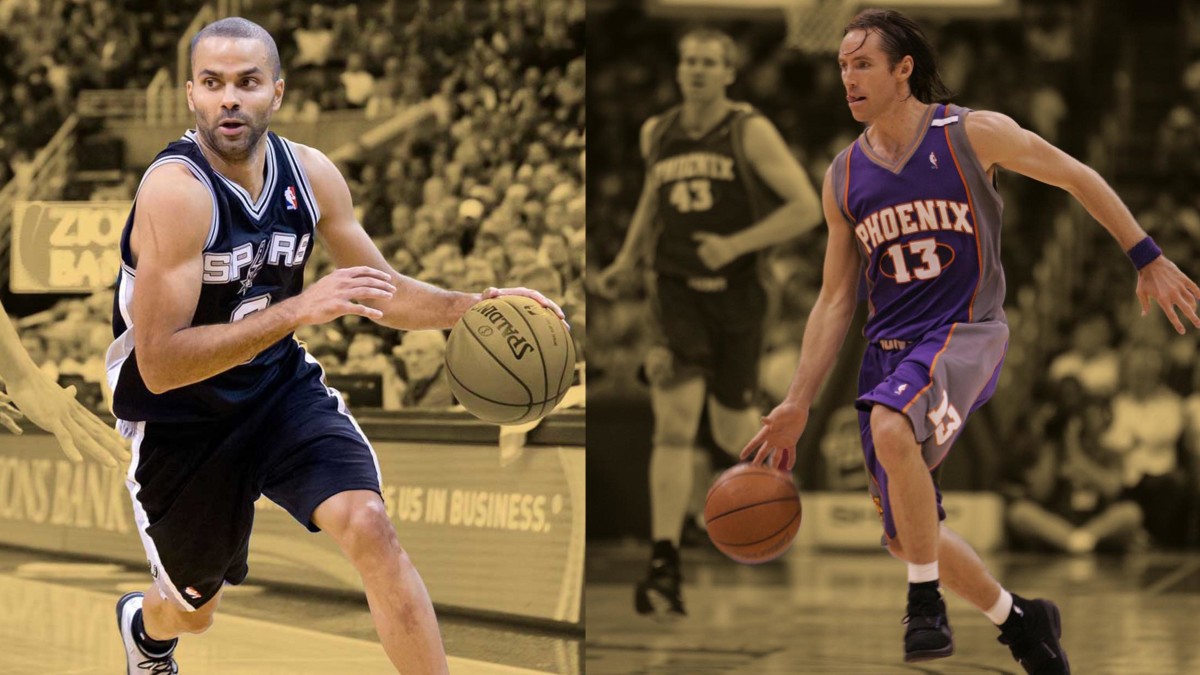
In his third year in the NBA, Boris Diaw joined the Phoenix Suns and became teammates with the great Steve Nash. The Mike D’Antoni-coached squad featured a high-octane offense that vowed to score in seven seconds or less. It taught Diaw valuable lessons on how to orchestrate a visionary offense and the French big man fit right in with his unique combination of size, strength, mobility, and vision.
In the second half of his career, Boris found himself with the San Antonio Spurs, whose offense wasn’t as flashy or potent as the Suns. Despite this, the Greg Popovich playbook got things done, as evidenced by their 2014 NBA Finals win. Their point guard was Diaw’s fellow Frenchman Tony Parker, who carried the massive responsibility of guiding a contender to the promised land.
Pure point guards
“Bobo’s” stints under the two legendary point guards taught him a thing or two about running a team. Though their playstyles and offensive systems were vastly different, the two shared several similarities.
Advertisement
“Both of these guys have a way of being in control, of organizing the whole team,” Diaw said, per the Legends of Sport podcast. “They have an aura, controlling the tempo of how we’re playing and what we’re doing. It was so great to be with them.”
“They were pure point guards,” he continued. “They were really making sure the team was playing well. They really cared about their teammates and everybody on the court as well. That’s definitely the similarity I see in those two guys.”
The point guard is often seen as the extension of the head coach. Before the era of positionless basketball, players like Nash and Parker had to master not only the Xs and Os of their respective playbooks but also their teammates’ egos.
Impossible to guard
Diaw was very lucky to have been teammates with both of the iconic floor generals during their primes. Others were not fortunate enough. Mike Bibby, for example, tried his best to keep up with the Spurs guard’s blinding speed. This made up for Parker’s lack of a smooth stroke.
Advertisement
“He wasn’t that great of a shooter, but he could get to the basket whenever he wanted to get his little floater,” Bibby said. “I mean, he was tough. He was fast, too.”
In his prime, Tony got to the hoop with seeming ease. His teardrop layup was on target most of the time. In fast-break opportunities, the four-time NBA Champion remained in control, even as he accelerated past his defenders. He became even more lethal when he developed a decent midrange game.
Nash didn’t necessarily have Parker’s speed, but the Canadian did well with what he was given. Steve was also a gifted three-level scorer and a member of the exclusive 50-40-90 club. Interestingly, the two-time MVP didn’t always do his damage by scoring in bunches. According to Puerto Rican basketball legend, Nash broke defenses with his passing.
“There’s some players that, to me, it was difficult to guard,” Carlos Arroyo said. “Steve Nash because Steve might end the night with 12 points, but he had fricking 22 assists. So, he had total control of the game.”
Advertisement
The fact that Steve never won a championship doesn’t make him any less great than Tony, just like Parker never captured a regular-season MVP. Both were the premier point guards of the 2000s, redefining the position in completely different ways.
Nash’s wizardry and tempo control turned Phoenix into a blur, while TP’s speed and precision became the engine behind San Antonio’s dynasty. They influenced an entire generation of guards that followed. And Boris had the front row seats while that history was being written.