
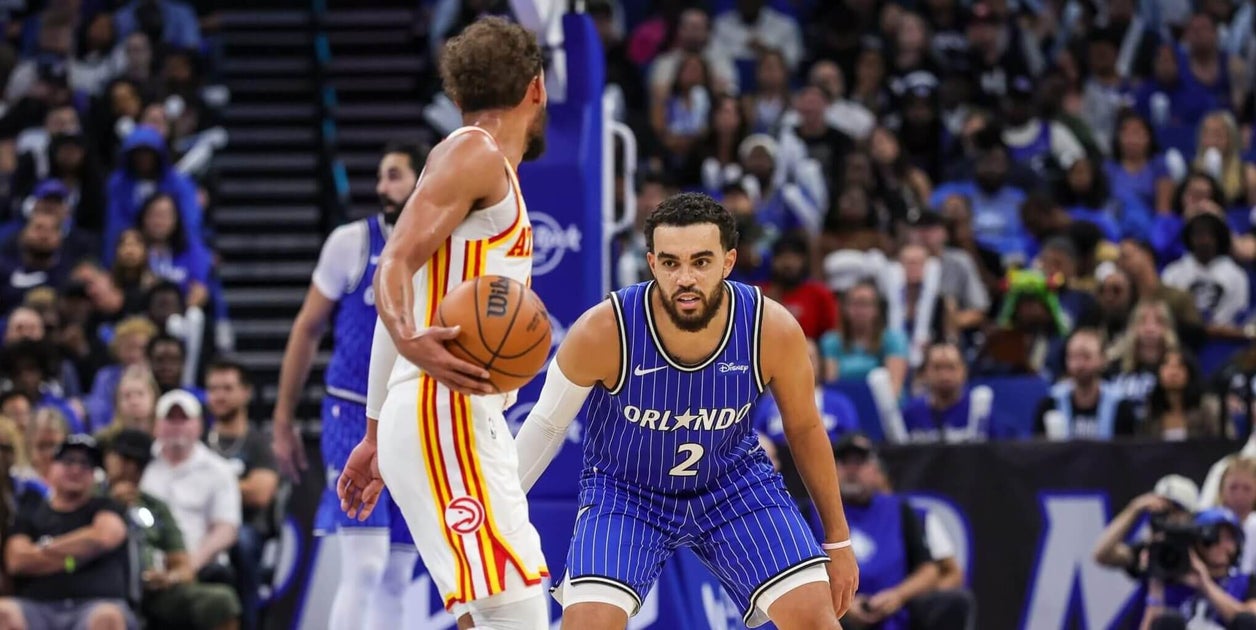
Ninety-four. You’re going to be hearing that number a lot this year. A basketball court is 94 feet long, and the new trend for 2025-26 is that defenses are using all 94 of those feet to try to wear out opposing offenses.
It’s a copycat league, and the trend of full-court pressure is the “in” tactic to crib from other staffs. For the moment, sitting back in a low-risk defense that lets opponents bring it over half court is the coaching equivalent of showing up in acid-washed jeans.
On the other hand, that 9-4 feet of defense is trendier than 6-7. All over the league, teams are picking up full-court after a make, and jamming ballhandlers in the backcourt even after a miss.
Before I go deeper, though, let’s pause for an anecdote to underscore my point. After Toronto pressured and harassed Atlanta full-court in the Raptors’ unexpectedly easy 138-118 rout of the Hawks on opening night, I expressed mild surprised to a Toronto player that the Raps were committed to playing 94 feet even against Trae Young.
“Especially against Trae Young,” he corrected me. The point: All that ball pressure is actually even more valuable against the league’s most dangerous ballhandlers, because it allows defenses to wear them out during the course of a 48-minute game.
It’s the biggest story of the first week of the season: Ball pressure. All over the court, all game long, no matter how big a star is handling the rock.
I don’t want to get too caught up in the numbers behind this yet, because Week 1 statistical trends can often be fleeting mirages as coaches, referees and players quickly adjust to whatever new tactics were dreamed up over the summer.
That said, the statistical evidence backs what I’ve seen with my eyes. The league-wide turnover rate is up from 12.6 percent in 2024-025 to 13.8 percent through Sunday’s games this season, and more notably, the league-wide steal rate has shot up from 8.1 per 100 possessions to 8.9.
Backcourt steals are perhaps the biggest factor. Even the league’s All-Star guards haven’t been immune.
Cade Cunningham, meet Josh Minott:
James Harden, may I introduce you to Blake Wesley:
Run back on defense? Ha. Ryan Rollins is always lurking in the backcourt:
The irony, of course, is that the league’s unquestioned maestro of wall-to-wall ball pressure, Indiana’s T.J. McConnell, has been injured hasn’t played a game yet.
Yet in the first week of the season, every night on LeaguePass is like watching a T.J. McConnell tribute band. Some teams have leaned into itmore than others, such as Toronto above or especially Portland, but the trendline is clear league-wide.
In fact, the other low-key thing that’s happening is camera operators are getting “McConnelled” — missing a backcourt turnover entirely because the camera is zoomed in for a few seconds on a player running to the opposite end of the court. Sorry, guys, you’ll need to save those close-ups for the next dead ball. There’s too much happening in the backcourt on every trip:
There’s a good reason we’re seeing this, and it gets back to the decision the league made in the middle of the 2023-24 season to allow more physicality on the perimeter. It didn’t immediately click with coaching staffs that they could dial up the ball pressure, and do so without risking the myriad fouls that used to make such a tactic foolish for all but the McConnells of the league. However, the crucible of the playoffs saw more teams lean into this tactic (undoubtedly helped along by watching McConnell torment opponents all springs in the playoffs.)
With officials allowing much more incidental contact (and even some not-so-incidental contact) on the perimeter and in the backcourt, the risk/reward equation has completely shifted. The downside of a needless foul 50 feet from the hoop and free points for the opponent has diminished, while the possibility of harassing a harried (and, um, hand-checked) opponent into a bad miscue has increased.
The pressure is a three-pronged weapon too. First, it can create turnovers in the backcourt that often lead to layups the other way. Second, even without a steal, it forces teams to operate later in the shot clock in their halfcourt offense and thus reduce their efficiency. Finally, it’s a great tactic to use against heliocentric teams to exhaust their lead ballhandlers — as the Raptors did with Young above.
“Yeah, teams are clearly trying to get you into your offense later in the clock,” said Pistons coach J.B. Bickerstaff, after the Pistons rallied from 17 down to survive Boston 119-113 on Sunday, despite 11 Celtics steals, including six live-ball turnovers from Cunningham. “I’m sure, like all of us, they did the study on time of clock to first action and all those things and understand how offense’s efficiency drops at a certain (shot-clock) number.
“It also wears your primary ball handlers out. The fourth quarter becomes a gut check, because now your legs are more tired.”
Of course, no strategy lasts for long in this league without coaches quickly thinking up countermeasures to negate them. The antidote to all this ball pressure? It may just be throwing speed at the problem.
“We have triggers to help against it,” said Cleveland coach Kenny Atkinson before Monday’s game in Detroit. “The best offense against pressure is to beat it right away and score right away. Make them pay for the pressure. Get by them with a high screen, or could just be beating your guy and creating a five-on-four advantage, that’s the best way to get through it.”
Of course, that in turn, could dial up the pace further and lead to other knock-on effects throughout the league. In fact, there is one that league coaches and execs already are talking about: An uptick in early-season injuries, especially hamstrings, that has a few teams already operating with skeleton-crew rosters. Memphis set a record by using a roster exemption three games into the season — the earliest allowable moment — and Indiana might not be far behind.
“You’ve just got to be careful and fit your roster,” said Atkinson, alluding to the fact that he’d be unlikely to ask high-usage stars to chase full-court on defense all game. “And then, you have to be really cognizant of, are you physically prepared to do that? Because it’s not just like, all of a sudden, you can just turn the faucet on, because if you’re not physically prepared, there’s obviously consequences to that.”
But don’t expect this trend to go away any time soon. Too many teams have had too much success with it, including McConnell’s Pacers in their NBA Finals run last spring. In a copycat league,”We steal things from teams all the time,” said Atkinson. “It’s just how this league works. ”
CapGeekery: Brooklyn’s tortured path to the salary floor
With the Brooklyn Nets finalizing their roster at the start of the season, we finally had the answer to the $85,300 question that every cap analyst in the league was wondering: How, exactly, would the Nets hit the salary floor before the regular season began, and how could they manage things to exceed the floor by the minimal amount possible to preserve maximal cap room for in-season trades?
To review, the league’s 2023 Collective Bargaining Agreement (CBA) changed the rules on the salary floor. Teams have always been required to have at least 90 percent of the total salary cap on their books — $139.1 million this season, with the salary cap set at $154.6 million — but in the past, they had until the end of the season to reach that threshold. If they were still short, the money was simply charged to the team and split among the remaining players on the roster, a rare and bizarre windfall.
Technically, the option still exists, except the new CBA created a major twist: Teams below the floor on opening day can’t collect any luxury tax payments from the team’s free-spenders after the season — which amounts to roughly a $10 million fine in most years. Teams also no longer give the shortfall below the floor just to their own players — it goes to the entire league now. Finally, the league adds a cap hold to bring the team up to the salary floor on opening day anyway, further eroding any advantage to staying below it.
Thus, the Nets were incentivized to reach the floor, but to clear it by as little as possible. And that is why that number I mentioned above, $85,300, ended up being so important. The Nets could have finessed their way to the line by waiving the lightly guaranteed contracts of Jalen Wilson and Tyrese Martin and increasing their guarantee amount just before cutting them, but there were two catches: First, the Nets wanted to keep those two, But second, if either was claimed on waivers, the Nets would end up with a zero in their salary slot and end up short of the floor anyway.
They also had some more bizarre pathways to reaching the salary floor. My favorite one was renegotiating-and-extending Michael Porter Jr.s deal by adding microscopic raises to the final two years of his contract before dropping his salary in 2027-28, something I spent an inordinate amount of time nerding out on earlier this summer.
But it turns out that Brooklyn had a much cleaner way to reach the floor than those shenanigans: They could simply waive Kobe Bufkin’s guaranteed $4.5 million deal and Dariq Whitehead’s guaranteed $3.3 million deal, and then guarantee the $85,300 owed to three training camp players on exhibit 10 contracts — money that the Nets were going to spend either way, but that a team normally wouldn’t add to their salary cap sheet. (Exhibit 10 deals, for players intending to sign with a club’s G League franchise, typically don’t carry a cap hit.)
By doing so, the Nets kept the deals of Wilson and Martin on the books at the full level. The combination of those moves left the Nets above the salary floor by just $77,342, which is why they needed three of those camp deals and not just one. (The names of D’Andre Davis, Yuri Collins and David Muoka get to live on in our cap sheets for the next nine months as a result, regardless of whether they even sniff the NBA again.)
Brooklyn still has $15.4 million in cap room to facilitate trades in season, money the Nets would seem unlikely to touch until the trade deadline so they can absorb unwanted contracts in return for draft capital. Meanwhile, the lightly guaranteed deals of Wilson and Martin mean the Nets functionally really have $20 million to play with until the league-wide guarantee date on Jan. 10: they could send those two out for a $20 million contract, given the $250,000 in wiggle room allowed on trades for cap room teams, while the receiving team could waive both players and have a minimal cap hit ($381,695 for Wilson, zero for Martin).
StatGeekery: The NBA’s new heave rule
The NBA revised its stat-keeping this year so that it wouldn’t count “heaves” as a shot attempt when calculating a player’s shooting percentage. That was partly an effort to stop players from releasing desperation shots just after the buzzer in order to protect their percentages.
Since old habits die hard, some players haven’t quite adjusted; for instance, here’s James Harden on Sunday night maintaining his Field Goal Percentage Savings Club status despite the new measure. (Just in case, he keeps the membership card in his wallet right next to the one for Blockbuster Video):
But what I really want to talk about here is another twist: What happens when a heave gets blocked? Can you block a shot that doesn’t count?
That question came up on press row in Atlanta’s opener against Toronto, when Kristaps Porziņģis attempted a 70-foot shot at the end of the first quarter that was snuffed out by Scottie Barnes:
So, if it wasn’t a shot attempt for Porziņģis, does that mean Barnes can’t get a blocked shot either?
Not exactly. You see, heaves still count as a a team shot attempt, so there is some track record of a field goal being attempted against the defense. And because of that, the blocked shots that result on these plays are allowed too, and are in the record. On Wednesday in Atlanta, Porziņģis finished the first quarter with zero 3-point attempts on the stat sheet … but Barnes still collected his block.
Rookie of the Week: Cedric Coward, SG/SF, Memphis
Do the Grizzlies have another draft steal from Washington State? One year after tabbing defensive stopper Jaylen Wells in the second round, the Grizzlies have another rookie Cougar excelling on the wing in Cedric Coward. While Philadelphia’s V.J. Edgecombe is getting more attention, for reasons both statistical (Coward’s numbers jump off the page) and technical (I haven’t seen either of Philly’s three games), I’m going to talk about Coward this week.
The Grizzlies traded up on draft night to grab the Washington State late-bloomer with the 11th pick after his junior season was shortened by a shoulder injury, and, early in the season, you can already see why. He may not have the exclamation-point on-ball impact of Cooper Flagg or Edgecombe, but if he never misses a shot or commits a turnover this season, I think he’ll end up with some pretty good numbers.
I jest, but Coward’s first three games were ridiculously efficient. He shot 11-of-16 on 2s and 8-of-11 from 3, had seven assists, five steals and nary a turnover in 68 minutes.
The nice thing about Coward is that he has two completely different pathways to scoring. The first is as a finisher in transition, where he converts everything around the rim (and did so as a collegian, too). Coward scored five times in transition in the Grizzlies’ opener against New Orleans, including this one where he threw an outlet pass from his own free-throw line and still finished it with a dunk.
(Also, ummmm: Nice transition D, Pelicans. Great effort here. 10 out of 10.)
But Coward is also a knockdown shooter with a quick release and enough size to get his release away over a closeout. He went 6-of-6 from distance in the Grizzlies’ win over what remains of the Indiana Pacers; while five were catch-and-shoots, this one off a screen — where he shrugged off Indiana’s 6-foot-9 Jarace Walker before launching — showcased a pathway to perhaps being a more prominent on-ball threat:
Coward’s dribble is mostly straight lines, and his handle can get high and loose, limiting some of his on-ball usage. However, between his size, his array of finishes at the cup, and his shooting range, the bar for his dribble game isn’t high; he just doesn’t need to create that much space.
It’s three games, so let’s get too far out over our skis here, but Coward looks exactly like the plug-and-play, 3-and-D wing the Grizzlies were hoping he could be, except that his transition game makes it more like 3-and-D-plus. I presume he won’t continue to post 88 percent true shooting and a 0 percent turnover rate, but Coward’s eye-opening start is the best reason for optimism amidst an injury-plagued start to the year in Memphis. And if you see any Grizzlies scouts in the Palouse this winter, take note.