
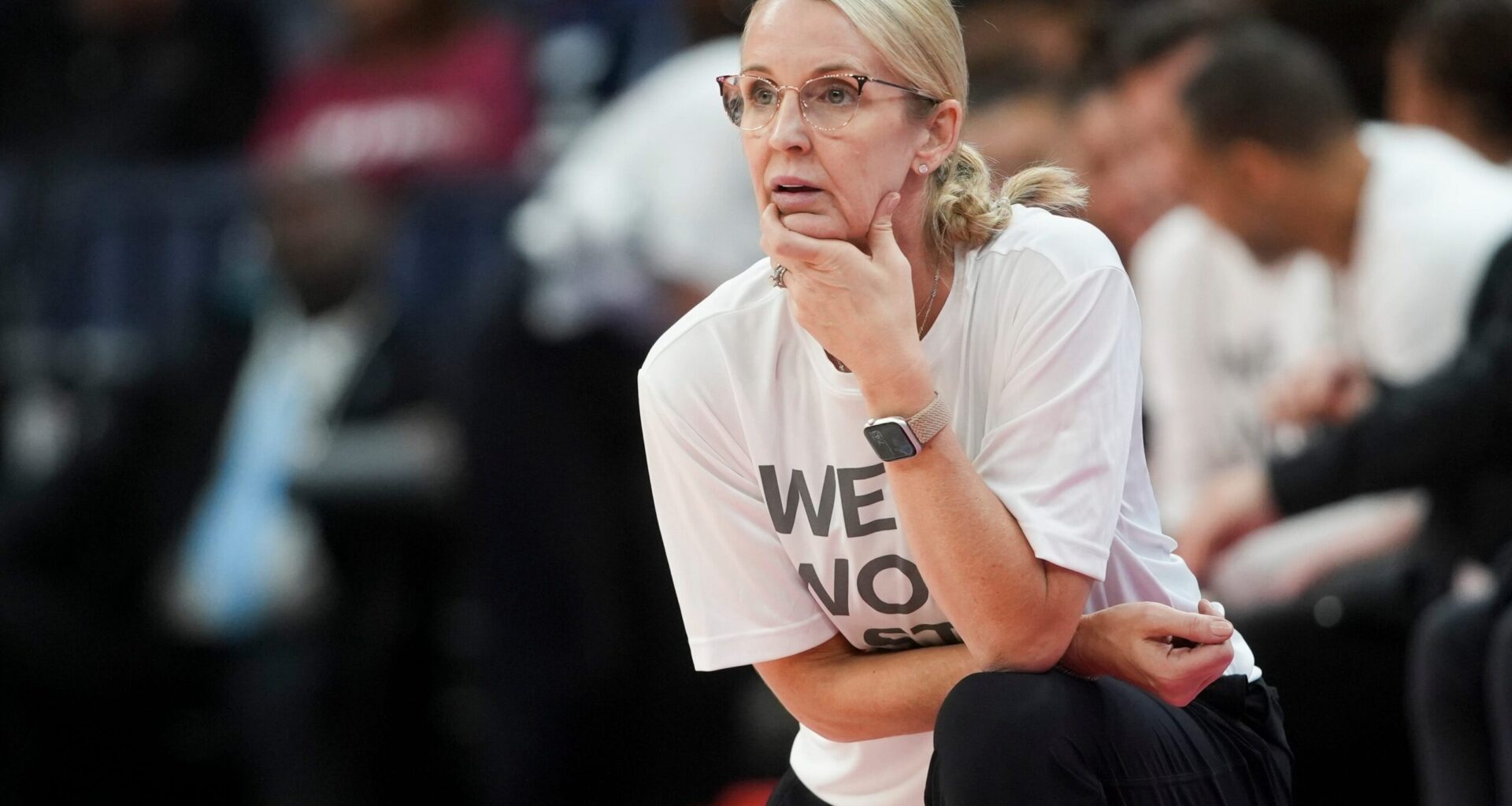
The team will land in France’s capital city and be whisked off on carefully curated tours of some of the world’s most iconic structures and museums; they’ll play a game against Cal on Nov. 3, and they’ll return home the same way they got there. Such a trip would have been unfathomable to Lake and her teammates, Lake told The IX Basketball last week.
In 2022, Lake and Ralph took part in ESPN’s 50th anniversary celebration of Title IX, the landmark legislation that ostensibly leveled the playing field for female athletes in the United States. Lake was struck by how different the game was for players in 2022, when compared to her own experiences in the ’70s and said as much in the interview.
“I said, “Oh, it’s great — things are so much better than they were. I didn’t have this … I flew one time. We didn’t have a postseason tournament, per se, like they do now. Nothing.” But Ralph, who played for Geno Auriemma and the UConn Huskies in the early 2000s, was quick to cut in: “And Shea says, ‘Yes, but there’s still a long way to go,’” Lake noted. “So I loved hearing that from her because she’s heard me talk about it for her whole life. And she’s lived it with me, because she kept going to North Carolina to all those alumni days and so forth. But she’s in it now and she says, ‘Yes, but there is much more that needs to be done.’”
When it comes to naming the flash in the pan that changed women’s collegiate basketball for the better, the 2023 Championship match between the Iowa Hawkeyes and the LSU Tigers nearly immediately springs to mind. The game had everything: high stakes, a WNBA superstar in the making, and a simmering tension between two young women — Caitlin Clark and Angel Reese — that threatened to reach a boiling point at any given moment.
In a lot of ways, that game did change everything. All of a sudden, it felt like everyone wanted to watch women’s basketball, and everyone cared about the conditions in which players traveled and trained and rehabbed. Clark and Reese’s potential WNBA salaries were called into question; NIL money was pouring in.
“Becoming Caitlin Clark” is out now!
Howard Megdal’s newest book is here! “Becoming Caitlin Clark: The Unknown Origin Story of a Modern Basketball Superstar” captures both the historic nature of Clark’s rise and the critical context over the previous century that helped make it possible, including interviews with Clark, Lisa Bluder (who also wrote the foreword), C. Vivian Stringer, Jan Jensen, Molly Kazmer and many others.
But two years before that, then-Oregon player Sedona Prince shocked the larger sports community when she shared a video of the so-called “weight room” set up for women’s basketball players at that year’s NCAA tournament. “This is our weight room,” Prince narrated over a video showing a small weight rack and not much else. “This is the men’s weight room,” she added as the camera panned over workout benches and multiple weights. The implication was clear: the NCAA wasn’t doing enough for its female athletes — not by a long shot.
But decades before that, Lake told the late WTVD sportscaster Don Shea that, though the team was playing well, they didn’t always have enough basketballs at practice. And, unlike the men’s team at the time, they didn’t always have a bus they could take to away games — instead, coaches and athletes were often ferrying themselves in their own cars.
Shea turned around and “put that on the news” that evening, Lake said, which caught the attention of then-Athletic Director, the late Homer Rice. “[Rice] called me into his office and said, ‘Marsh, why did you go to him?’” she continued. “‘I said, ‘I didn’t go to him — he came to me.’” And though Lake said she “wasn’t a feminist then,” she acknowledged that what she told Shea was the truth — and the truth had power.
Want even more women’s sports in your inbox?
Subscribe now to The IX Sports and receive our daily women’s sports newsletter covering soccer, tennis, basketball, golf, hockey and gymnastics from our incredible team of writers. That includes Basketball Wednesday from founder and editor Howard Megdal.
Readers of The IX Basketball now save 50% on their subscription to The IX.
Things began to change, “because of maybe people like me,” she admitted. “All of a sudden, we got to ride in the bus, and all of a sudden, we had enough basketballs. So people that spoke up, and then the people that did ruffle the feathers, made enough of a fuss that people started paying attention.”
No one is more aware of the legacy of Lake than Ralph, who told reporters at SEC Media Day this month that though her job is to win games, “The purpose that I have behind that is much bigger than that for me because of my mom and the other women that laid the foundation for me to even be standing here in front of you guys today talking about this.”
Taking her mom to away games on chartered flights and even all the way to Paris is “an honor for me,” Ralph also said, “because she is part of the foundation that was laid for us to be here.”
That foundation can be easy to disregard or even forget. Lake recalled a moment during Ralph’s recruitment phase when a reporter commented she was “living vicariously through” her daughter. “And I said, ‘Actually, no, I did okay myself,” Lake said. “You know – so no. But the fact that I had a daughter that plays my sport and is really good, that’s really fun as a parent … for me to watch Shea play and now watch her coach with the knowledge that I helped her bring to her, and helped her get from somebody else is wonderful.”
Want more women’s hockey content? Subscribe to The Ice Garden!
In case you missed it, The Ice Garden is now part of The IX Sports family!
The staff of The Ice Garden has paved the way for women’s hockey coverage from the college ranks to international competitions. Of course, that includes in-depth coverage of the PWHL too. For a limited time, free signups at The Ice Garden can sample all the work they do. Check it out, sign up now!
Things are different for college coaches now, Lake also said, due to the dual systems of NIL and revenue-sharing. That’s a concern that’s also been shared by South Carolina’s Dawn Staley and Texas’ Vic Schaefer — and one that Lake worries could shift the focus of the game. “[The game] is different from when Shea was hired four years ago,” Lake said, “Things have changed now. And, unfortunately, I think maybe the focus has moved away from what I think the focus should be on.”
She continued, “But I said to her, ‘You touch — you have no idea the thousands, maybe even tens of thousands, of young girls and women you touch, and you don’t know you touch them. You know, they read something you say or listen to one of your interviews, and they’re like, ‘Whoa, she really knows what she’s talking about,’ or ‘I really like the way she’s looking at this.”
That legacy, and that ability to reach well beyond the bounds of the basketball court, is baked into the history of the game. Toward the end of the conversation, Lake recalled a story her good friend and Tennessee’s legendary coach Pat Summit shared about tearing her ACL.
While recalling Ralph’s five ACL tears, Lake pointed out that “Nobody knew what an ACL was,” let alone how to treat such a tear the way they do now. “Pat told me, she said, ‘You know, I tore mine when I was playing, but they didn’t know what it was or how to fix it. So, I just went to my daddy’s barn, and I set up on one of the tables, and I hooked me up a little pulley where I had rope wrapped around some bricks, and I put it as weight on my leg.”
Then, Summitt told her, “I put it on my leg lift to make my knee stronger, just lifting up bricks tied around my foot with a rope, and that was my rehab for my ACL.”
The women’s game has changed — and as Lake and Ralph have pointed out, there is still so far to go.