
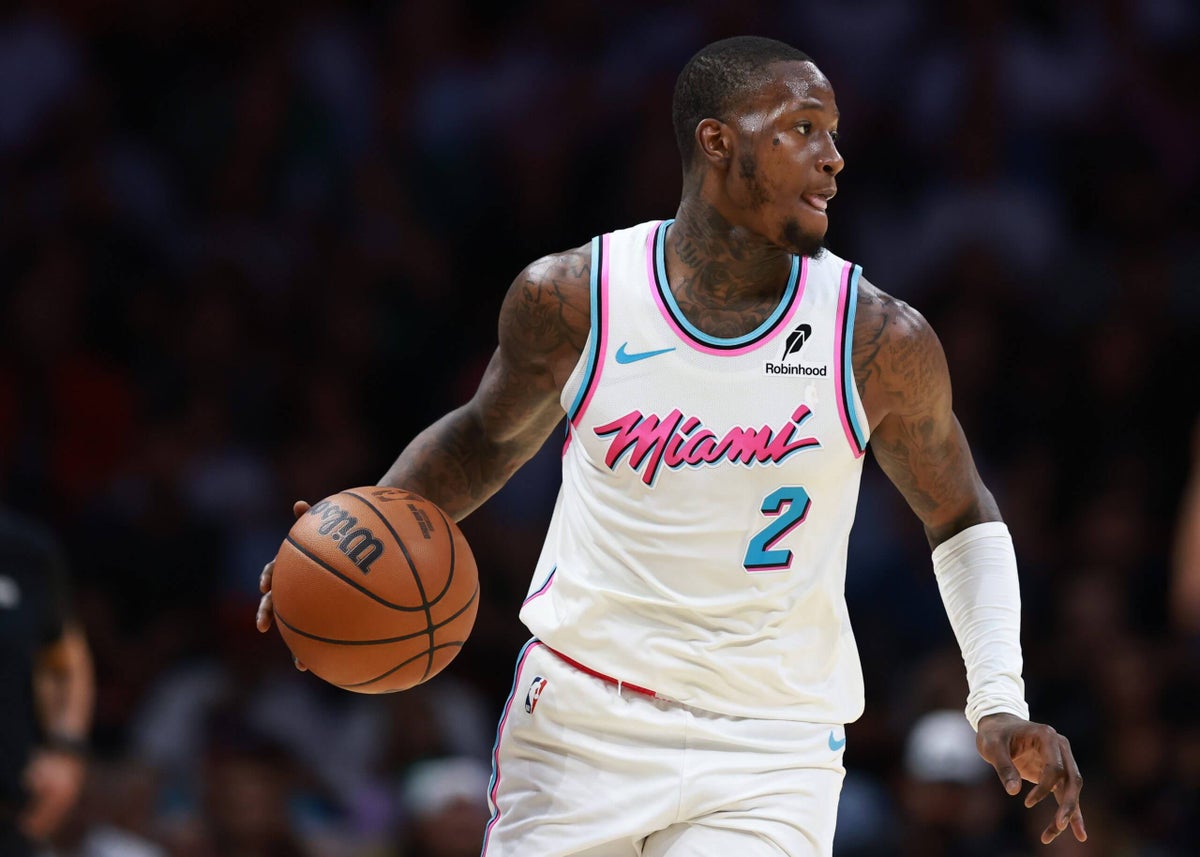
The NBPA will appeal the NBA’s decision to place Miami Heat guard Terry Rozier on unpaid leave after he was arrested last week on what the Department of Justice said was his role in an illegal sports gambling scheme.
The NBA placed Rozier on leave hours after the federal government unsealed charges against him and Portland Trail Blazers head coach Chauncey Billups. Rozier is accused of sharing his intent to leave a March 23, 2023 game early with Deniro Laster, another defendant in the case, who then sold that information for $100,000 to a group of sports bettors. Billups was charged for what federal prosecutors say was his involvement in a rigged poker game ring. He also was placed on unpaid leave by the NBA last week, a source confirmed.
Rozier and Billups, via their lawyers, have denied the charges.
“While we are in agreement with the league that upholding the integrity of the game is of the utmost importance, their decision to place Terry on leave without pay is counter to the presumption of innocence and inconsistent with the terms of our collective bargaining agreement,” an NBPA spokesperson said. “We plan to challenge their decision via the proper channels.”
The NBA initially conducted its own investigation into Rozier, when he was with the Charlotte Hornets, after suspicious wagering activity on him raised red flags. The league cleared him, and he continued to play and remain on active rosters for the last two seasons.
But hours after he was arrested, Rozier was placed on leave without pay. His $26.4 million salary — the last of a four-year, $96.3 million contract — will be placed in escrow, league sources confirmed.
The NBA’s collective bargaining agreement, the league’s governing document, does not specifically allow the league to put a player on leave for such matters. The only mention of a player being placed on leave in the 676-page document is in an attachment covering the league’s policy on domestic violence, sexual assault and child abuse. That section stipulates that a player would still receive his salary and benefits and that he can appeal the decision through a grievance process. But it does not lay out any specific punishment for a player caught for participating in a gambling scheme, though gambling on the NBA and sharing private information for that purpose is not allowed. The NBA, however, originally cleared Rozier of such behavior in its investigation two years ago.
The CBA does cover player arrests, but Article VI, section 16 describes how a team may discipline arrested players and that nothing stops the team “from precluding a player from participating in Team activities without loss of pay to the extent it otherwise has the right to do so.”
The NBA Constitution, however, seems to give commissioner Adam Silver more latitude. Article 24 gives him broad powers to punish members of the NBA in instances that are not directly spelled out in the constitution or its bylaws. Article 35 says that for any player who “directly or indirectly” wagers on an NBA game “shall, on being charged with such wagering, be given an opportunity to answer such charges after due notice, and the decision of the Commissioner shall be final, binding, and conclusive and unappealable. The penalty for such offense shall be within the absolute and sole discretion of the Commissioner and may include a fine, suspension, expulsion, and/or perpetual disqualification from further association with the Association.” Article 35A(g) affords Silver that power of non-players as well.
The NBA suspended and banned Jontay Porter in April 2024 after the Toronto Raptors backup was found to have bet on the NBA and tipped off bettors that he would leave a game early to manipulate his statistics so that they could win on prop bets on him. That came after the NBA concluded its own investigation into Porter, but months before he was charged, and pled to, a federal charge of conspiracy to commit wire fraud. That charge was brought by the U.S. Attorney’s Office for the Eastern District of New York, the same office that last week charged Rozier and others implicated in Porter’s case.