
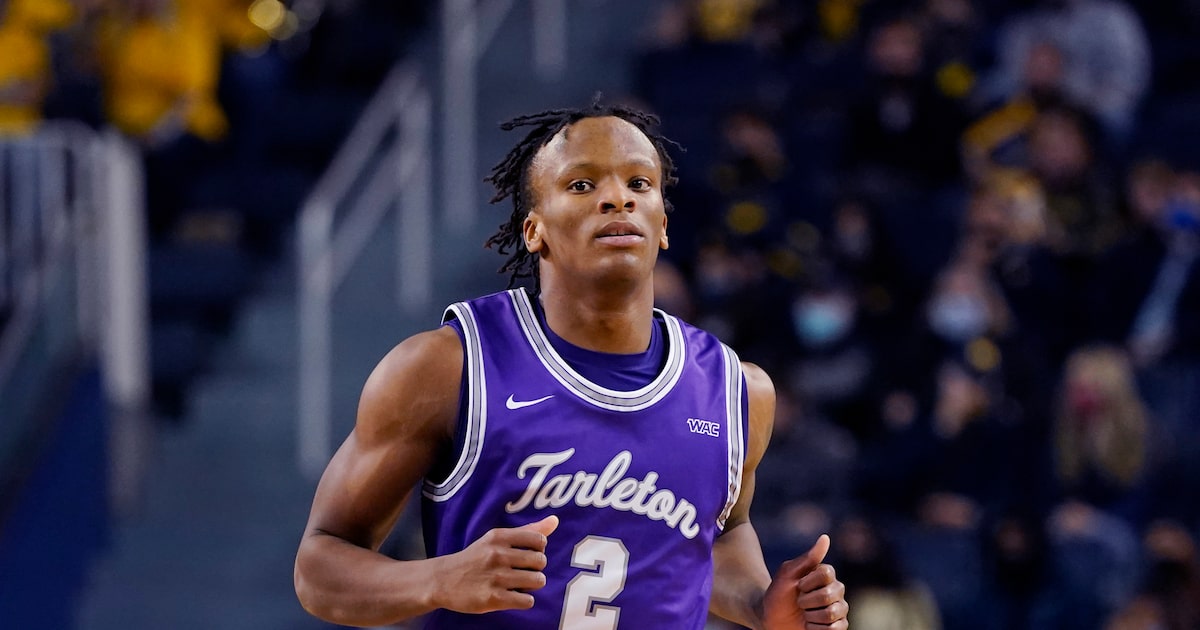
Amid college basketball’s vast universe of 352 Division I schools, what occurred Thursday afternoon in Erath County’s 266th District Court was a footnote, if even that.
It did, however, shine light on a significant difference between NCAA basketball and football medical redshirt rules.
A temporary restraining order was granted to allow standout Tarleton State basketball player Freddy Hicks to play at least the first two weeks of the Texans’ season, which begins Monday. His attorney, Ryan Downton, said he hopes it’s a step toward Hicks gaining full eligibility this season.
“I am hopeful that if the NCAA agrees that in Freddy’s unique circumstances he should get to play this year, they grant Tarleton’s appeal, we don’t have another [court] review,” Downton told The Dallas Morning News.
Texas College Sports
Downton on Wednesday took Hicks’ case pro bono, given the special circumstances and urgency to allow Hicks to practice this weekend and play in Tarleton’s opener.
Related

Downton’s name might be familiar to college sports fans. He is the attorney who successfully secured a preliminary injunction that allowed Vanderbilt quarterback Diego Pavia to play this season. Pavia will lead No. 9 Vanderbilt against No. 20 Texas in Austin on Saturday.
Pavia’s case involved the NCAA’s stance on junior college seasons counting toward FBS eligibility. In the case of Hicks, the first Tarleton player to score 1,000 points in a season since the school went Division I, the circumstances pertain to medical hardship eligibility.
Due to a foot injury and two surgeries, Hicks played in only seven of Tarleton’s 32 games as a senior last season. In football, a player is allowed to play up to four games at any point of the season and be granted an extra year of eligibility.
In basketball a player must not have played in more than 30% of a team’s games (Hicks played 22%) — but, additionally, not play in any games after the season’s midpoint, Jan. 15. Hicks missed the first 18 games, played three games, missed more time and then attempted to play three more times.
“The difference between the basketball rule and the football rule just does not make any sense to me,” Downton said. “And I’ve yet to hear anyone from the NCAA or anywhere else explain why the rules are different for the two sports.”
That, however, was not the sole basis for Thursday’s restraining order request. It was that Hicks before the season had foot surgery to have a screw implanted. He returned and played on and off for seven games in pain, but it was determined that the original surgery was botched and he required another surgery at season’s end.
Tarleton applied first to the Western Athletic Conference, then the NCAA for a medical redshirt, being denied both times. His case is on appeal to the NCAA, but that process often takes multiple weeks.
Thursday’s temporary injunction means the judge agreed that there is an antitrust issue with Hicks being deemed ineligible. And it buys time, enabling Hicks to return to the court while the NCAA weighs Tarleton’s appeal.
There are similarities between Hicks’ case and that of Gonzaga forward Tyon Grant-Foster, who on Monday was granted a preliminary injunction in Spokane County. The NCAA earlier in the month had denied Grant-Foster’s appeal for an eligibility waiver.
What long-awaited ACC showdown means for coaches, players involved in Miami-SMU pipelineWhere do Texas Tech, Baylor, others rank on Big 12 men’s basketball preseason media poll?
Find more college sports coverage from The Dallas Morning News here.