
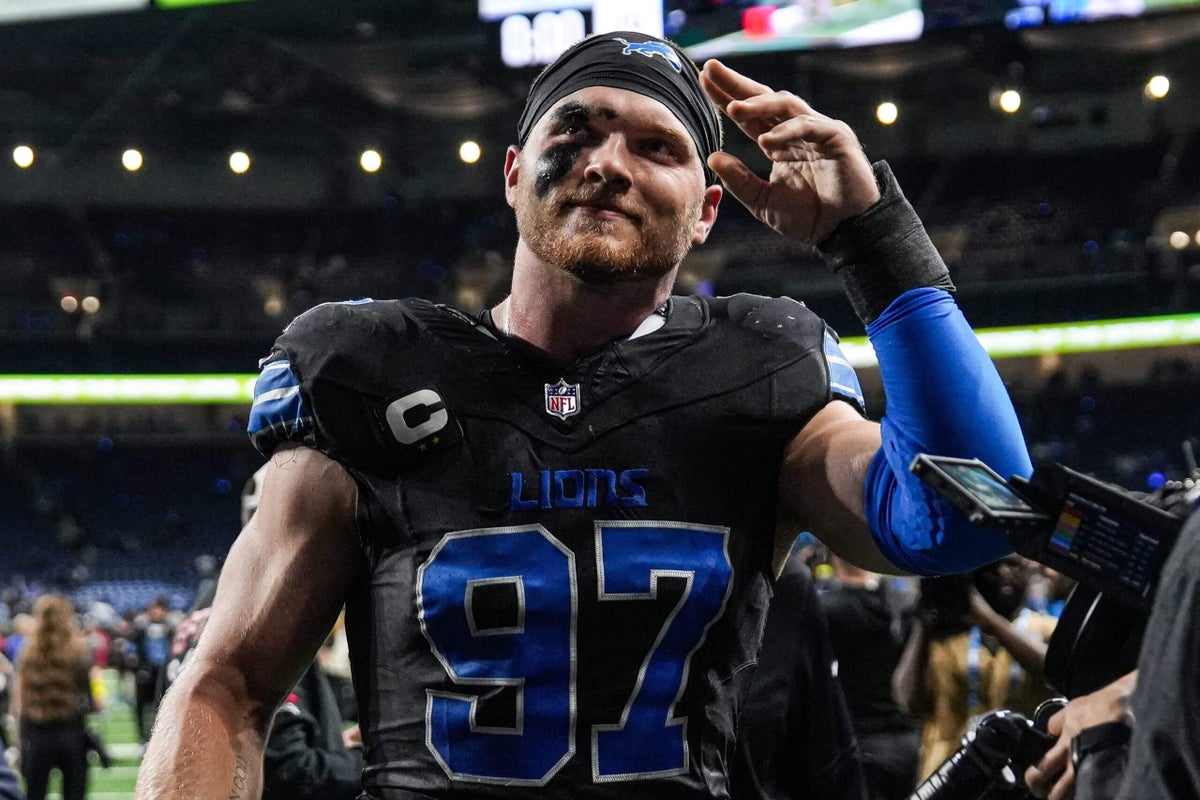
ALLEN PARK, Mich. — The long-awaited extension came without a war of words, public back-and-forths, avoidable drama or leaks. That’s preferred around these parts. Aidan Hutchinson put pen to paper — signing a contract extension that will guarantee him more money than any non-quarterback has received in this league — then put the blinders on and went back to work.
It’s all he knows. It’s all the Detroit Lions know.
“We really wanted to get a deal done,” Hutchinson said Thursday, after signing a four-year, $180 million contract extension with $141 million guaranteed on Wednesday. “As you know, these things can get a little bit hairy the more you get into it and the longer it goes, as you see with other guys around the league. And obviously, you want to avoid those situations and we were able to get it done.”
There was no reason to think they wouldn’t. Not the way these Lions conduct business. The idea of a star pass rusher in his prime — a core player, homegrown talent and star of an organization that prioritizes winning — playing for another franchise was never entertained by this regime.
Maybe elsewhere. But not here.
Hutchinson became extension-eligible this offseason, after his third NFL season. It felt like a foregone conclusion that we’d eventually reach this point. Lions GM Brad Holmes said in February that the Lions were in the “planning stages” of a Hutchinson extension. He likened the way the Lions have meticulously saved money for their homegrown stars to parents saving up for their children’s college funds. About a month later, team president Rod Wood spoke about looming extensions. “We’ve got contracts coming, obviously, with Hutch and other ones,” Wood said. “We have to prepare for that.”
That’s what the Lions have done, and it’s what they continue to do. When the Lions began their rebuild in 2021, they did so with extensions like this in mind. They placed an emphasis on drafting quality people, hard workers and good teammates, in addition to the talent prerequisites needed to jumpstart this franchise. The goal was to then develop those players, put them in positions to succeed and extend them to keep this core together as long as possible.
It’s easier said than done, but it’s worked brilliantly. Hutchinson is the latest in a long line of examples.
“It was good to see somebody who works their tail off really go out there and get what they deserve,” said Lions defensive tackle DJ Reader. “That’s the way it’s supposed to be in this league. It’s always appreciated when you see an organization do right by you.”
“It feels good to know if I’m drafted here and I do what I need to do, that I’m going to be taken care of here and I don’t ever need to look, reach or go wonder, ‘Where do I stand?’” Lions defensive coordinator Kelvin Sheppard, a former NFL linebacker, said Thursday. “I think the level of transparency throughout this entire organization is special.”
A player of Hutchinson’s caliber shouldn’t be going anywhere. The 2022 No. 2 overall pick, Hutchinson has developed into one of the league’s most feared pass rushers. He leads the NFL in pressures (48), ranks third in pass-rush win rate (25.3 percent) and is tied for seventh in sacks with 6. He’s in the prime of his career — fully recovered from a leg injury that shortened his 2024 campaign.
However, it’s not just that the Lions extended Hutchinson. Everyone knew that was coming. But it’s how they did it. The Lions keep things in-house and make that clear to agents they’ve done business with over the years. In August 2024, Lions GM Brad Holmes announced on 97.1 The Ticket that Taylor Decker and the team had finalized a three-year contract extension — in the middle of a training camp practice. Hutchinson’s agent, Mike McCartney, broke the news himself on X.
But more importantly, the Lions have done well to finalize these deals early, to avoid both drama and paying premiums to lock up players they’ve already factored into their future. Over the last 18 months, the Lions have dished out almost a billion dollars in extensions. Hutchinson joins the likes of Jared Goff ($212 million), Amon-Ra St. Brown ($120.01 million), Penei Sewell ($112 million), Decker ($60 million), David Montgomery ($18.25 million), Alim McNeill ($97 million), Derrick Barnes ($24 million), Kerby Joseph ($86 million) and Jameson Williams ($83 million).
Players and coaches have praised the dialogue and transparency in which the Lions operate. It’s offered to anyone who seeks it out. It gives players and coaches alike the peace of mind that allows them to put their head down and focus on ball.
It can be this simple with the right people in place.
“What we do, that’s not normal,” Sheppard said. “A lot of things (around the league) are hidden from coaches, a lot of things are hidden from players. But here, all you’ve got to do is take one trip upstairs. I mean — you’ve got to be careful because you’re going to get told the truth, but you take one trip upstairs. And the trickle to coaches is, it’s easy to coach in that type of environment where you don’t have to wonder, you don’t have to guess. … So, I’m very thankful to be a part of this organization.”
There’s a benefit to doing deals early and creating an environment like the one the Lions have. St. Brown was the NFL’s highest-paid WR in April 2024. He’s currently seventh, and could be on his way to his third consecutive All-Pro season.
Sewell’s extension (four years, $112 million) should age like fine wine, and doesn’t even kick in until the 2026 season. By the time he’s due for another extension, he’ll be 30 years old, likely still in the prime of his career with a chance to cash in again — without the Lions overpaying for past performance.
Joseph and Williams’ extensions are extremely team-friendly, and the Lions have done well to stagger these deals so they know exactly where they stand with more contracts — Jahmyr Gibbs, Jack Campbell, Sam LaPorta and Brian Branch — on the horizon.
Holmes, Lions COO Mike Disner and senior director of football administration Charlie Adkins — as well as his predecessor, Brandon Sosna — deserve a ton of credit for getting these extensions done.
Of course, they sleep easier after writing checks like that, knowing the type of players they’re dealing with.
“Obviously, things financially have changed for me,” McNeill told The Athletic, reflecting on his extension last year. “I just — I cannot see it that way. I just cannot. I still see myself as the regular college kid I was or whatever. It’s crazy to think that an organization trusts you that much and trusts you enough to want you to be here for more years because of the work you’ve put in. And now, it’s time to go that much harder, in my opinion.”
“If I ask myself why I play this game and why I do what I do, the money is really a byproduct,” Hutchinson said. “So while a lot of those numbers are fun to look at — it’s cool and it’s such a blessing — in order for me to keep putting one foot in front of the other and keep looking forward, I have to focus on my play and my evolution as a player. Because to me, when I see that, that fires me up more than money ever would.”
The secret to the Lions’ success isn’t proprietary information. Draft, develop, extend. It’s gotten them this far, and the contracts they’ve dished out now serve as motivation to others — the pot at the end of the rainbow for prospective players in line to be extended in the near future.
And so, Hutchinson is now a rich(er) man. The Lions, in turn, kept an integral piece in place. If it feels like the moment came and went, that’s because it has.
“It’s a weird feeling, because you go in and you sign the contract but then you wake up and it’s Thursday practice all over,” Hutchinson said — drawing a laugh from the room. “It’s like, not much really changes. … But again, while it’s great news, it’s all Minnesota in my brain right now when I’m thinking about this week.”
That feeling is the sign of a healthy ecosystem in action. The Lions know it well.