
The early portions of a new NBA cycle — I’m talking late offseason, training camp, preseason — usually arrive with the same platitudes.
Player A has either gained 15 pounds of muscle, or has lost 20 pounds, and finds himself in the best shape of his life. Player B has tweaked his jumper mechanics and now has a quicker, smoother release.
Advertisement
Team C wants to be more aggressive defensively this year, really set the tone. Team D wants to play with more tempo and incorporate more ball and body movement.
You’ve seen it, you’ve heard it, and you’ve likely joked or rolled your eyes about it at some point. Heck, you probably thought about some other examples while reading that.
Most times it’s a blip on the radar before the vaunted norm settles in with a larger sample; but sometimes, players and teams actually mean it. We actually get an aggressive shift from the year prior. Something’s different. It’s tangible. Fresh. Effective.
Advertisement
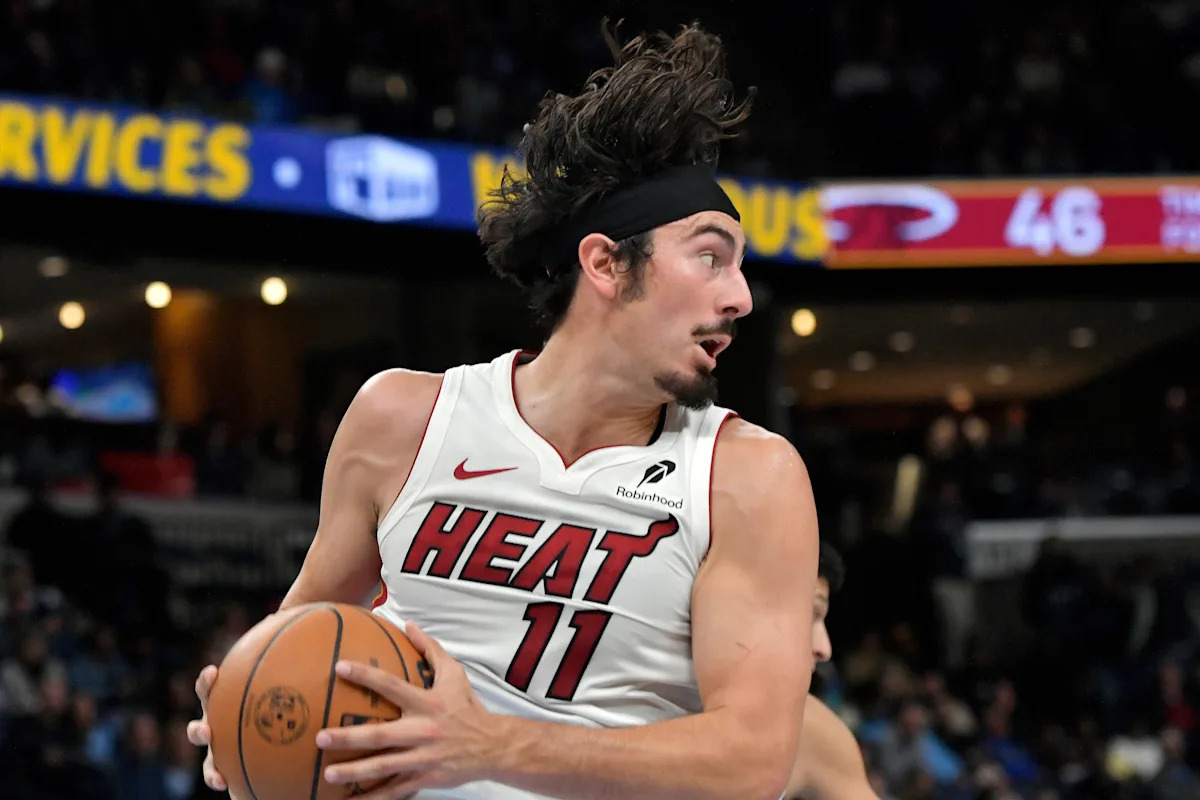
Yes, I’m talking about Jaime Jaquez Jr.
OK, I’m not exclusively talking about Jaquez — he’ll get his flowers in a bit — but I could be.
We’re really here to talk about the Miami Heat as a whole, who look and feel much different than last season. They’re 3-2, coming off a 107-101 loss to the Wemby-led San Antonio Spurs on Thursday night, but they’ve been one of the league’s most fascinating stories of the young season.
Picking up the pace
Long ago, basketball legend Pat Riley established a mantra for the Heat franchise he was looking to turn around. There wasn’t just a demand for excellence: They were to be *clears throat* the hardest-working, best-conditioned, most professional, unselfish, toughest, meanest, nastiest team in the NBA.
Advertisement
What you don’t see mentioned, among all those terms, is anything related to speed.
The Riley-led Heat were fine grinding games to a halt and controlling the flow with physical defense. Erik Spoelstra has largely followed the same script; since becoming the head coach ahead of the 2008-09 season, the Heat have never had a top-10 finish in pace. They’ve almost always had a high-level defense, though.
As of this writing, not only are the Heat on pace (don’t yell at me) to finally crack the top 10, they lead the league in that category so far. Their average possession length is roughly 12 seconds, also tops in the league.
Advertisement
It’s been an emphasis since training camp that certainly carried over into the preseason. The early hit-ahead passes and quick advancements up the court, after misses and makes, popped early on film, but it was fair to question just how much of it would carry over to the regular season.
So far, there’s been a high level of buy-in from the players to push the tempo and get into their offense earlier. They’ve all been empowered to bring the ball up if the opportunity presents itself.
“I mean the game’s evolving,” Bam Adebayo recently said.
“Everybody’s trying to play fast. To be a part of a team with this much pace and this much speed, where we get that ball in transition, this is probably my first year where we’ve been emphasizing playing this fast. And we’re playing the right way. That’s what I love about it. We’re sharing the game. And everybody feels involved. We’re all bought into the system.”
Advertisement
So, what is the system?
Getting the ball up the floor quickly is only the first phase of Miami’s attack. Similar to the Memphis Grizzlies early last season, the Heat have been deprioritizing — not to be confused with eliminating — traditional two-man actions.
Per GeniusIQ tracking, the Heat are averaging a shade over 20 pick-and-rolls per game (19.1 per 100 possessions), easily the lowest mark in the league. The Utah Jazz, who rank 29th in that category right now, are doubling them up in volume (40 per game, 39.1 per 100). Shoot, the Heat ranked just outside of the top 10 in pick-and-roll usage (67 per game, 69 per 100) last season.
There’s been a similar downshifting of dribble-handoff usage. After averaging roughly 22 per game, with Adebayo often at the center of those, the Heat are averaging a league-low 5.8 handoffs per contest.
Advertisement
Instead, we’ve seen more one-on-one attacks with a high volume of space-clearing cuts to create room for those exploits. The cuts are the real key in this; if you’re going to drive and/or isolate as much as the Heat have — only the Rockets (36.3) are logging more isolation possessions than the Heat (31.8) — you better make sure the context is optimized.
The results have been positive so far this year. In large part because of how the Heat have worked to space (and re-space) the floor around their drive-and-kicks, they’ve seen help defenders present on only 60% of their drives, the lowest figure in the league.
The non-stars are thriving right now
This is where we can get into some Jaquez praise.
Advertisement
First, he just seems healthier and more explosive than he was during last season’s disappointing campaign (8.6 points on 54.3% true shooting). That, plus the empowerment he’s received to grab-and-go and the spacing setup, has led to an electric start to the season.
Even accounting for a quieter outing against the Spurs on Thursday (6 points, 8 rebounds, 6 assists), the third-year forward is off to the best start of his young career. He’s averaging 16.2 points while converting an absurd 68.9% of his shots inside the arc. The Heat are generating an elite 1.2 points per possession on trips featuring a Jaquez drive, placing him ahead of notable names like Jaylen Brown (1.11 PPP), Cade Cunningham (1.10 PPP), Shai Gilgeous-Alexander (1.07 PPP) and former Heatle Jimmy Butler (1.00 PPP).
The intrigue with Jaquez heading into the league was the marriage of his frame, physicality and advanced footwork. He’s generally been able to up-fake and pivot his way into solid looks; that certainly popped during his rookie year. With a full head of steam — and a spaced floor around him — he’s been able to gain early advantages more often and turn them into wins.
In a similar vein, Heat guard Davion Mitchell has been able to use a blend of speed and shoulder-nudging to puncture the paint and create advantages (1.12 PPP on drives). Mitchell has done a solid job of reading when he should call his own number, when he has a big available, or when he should jumpstart a chain reaction with a kick-out pass.
Advertisement
To the kick-out point: Only five players — Shai (40), Austin Reaves (33), Deni Avdija (31), Tre Jones (31), and Pascal Siakam (29) — have logged more kick-out passes on drives than Mitchell (26), and the Heat have scored at an elite clip (1.39 PPP) on those possessions.
There’s a complementary aspect to all of this
While the offense is structurally different, it’s worth noting the Heat are sprinkling in just enough traditional stuff — particularly off the ball — to keep defenses on their toes.
We haven’t seen Norm Powell in the last two games as he recovers from a groin injury. But when he was on the floor, the Heat were intentional about setting a reasonable amount of wide pin-down screens — or staggers (two screens) — for him to shoot or attack from.
Advertisement
[Get more Heat news: Miami team feed]
Simone Fontecchio has gotten similar usage when checking in, and those trips have been wildly fruitful. Only Michael Porter Jr. (1.43 PPP) has produced more efficient offense after receiving a wide pin-down than Fontecchio (1.42 PPP) among players with reasonable volume on that specific action (min. 20). Shooting the leather off the ball (59.3% on 5.4 attempts) certainly helps matters.
As mentioned earlier, the Heat aren’t sprinkling in many handoffs. It’s notable, though, that Andrew Wiggins leads the team in volume while also receiving a higher rate of off-ball screens than he did last year. Wiggins getting the ball with some sort of head start or tilted defense has always been the most productive version of him.
Adebayo has certainly had to adjust in this environment — with a much lower dosage of ball screens and handoffs, he’s often spacing the floor. He’s currently shooting 36.1% from deep, a moderate improvement on last year’s mark (35.7%), while almost tripling his volume (2.8 to 7.2) from last year. How the Heat balance his perimeter exploits, his screening talents and his hub work — he’s averaging 5.8 elbow-area touches this year, down from 12.2 last year — will be something to track all season.
Advertisement
This doesn’t work without the defense
The Heat are playing incredibly fast. They’re scoring a ton of points. They’re driving and cutting all over the place. Defenses have often been on their heels against this unit.
The moments where the Heat have looked their shakiest — late fourth quarter of their opening loss to Orlando, pockets of the first half against the Knicks, Thursday night’s Spurs game — have been when they’ve consistently had to work against set defenses.
Getting stops will be key to jumpstarting the early attacks they’ve had much success with. The Heat have ramped up their switching and activity from last year, and are once again crowding the paint to prevent attempts at the rim. I’d worry a touch about the rate of corner threes they’re giving up (14.1% of shots, most in the league), but this isn’t new for a Spoelstra defense.
Advertisement
The Heat’s half-court offense has been elite to this point — their 101.2 offensive rating in that context ranks fifth league-wide, per Cleaning The Glass — but it’s also worth noting they’re sporting the ninth lowest share of half-court possessions in the league (76.9%, league average is 78.3) right now.
Their two losses (Magic, Spurs) just so happen to be the only two games this season where they’ve logged 80% or more of their possessions in the half-court. Not every team has the collective size of the Magic, and no other team but the Spurs has been blessed with Victor Wembanyama, but that is something to monitor moving forward. Their play-type balance will (and should) be under more of a microscope in those types of games; in order for the Heat to build a level of sustainability, they have to press the right buttons when 1) the game slows down and 2) when teams take away their initial drive.
Advertisement
If the Heat are able to build reliable counters, this could be the best — or at least the most unique — offense of the Spoelstra era. If they don’t, we could see a similar swoon in offensive efficiency as we saw with last year’s Grizzlies (though there’s a lot of injury-related context to add there) as the sample grew.