
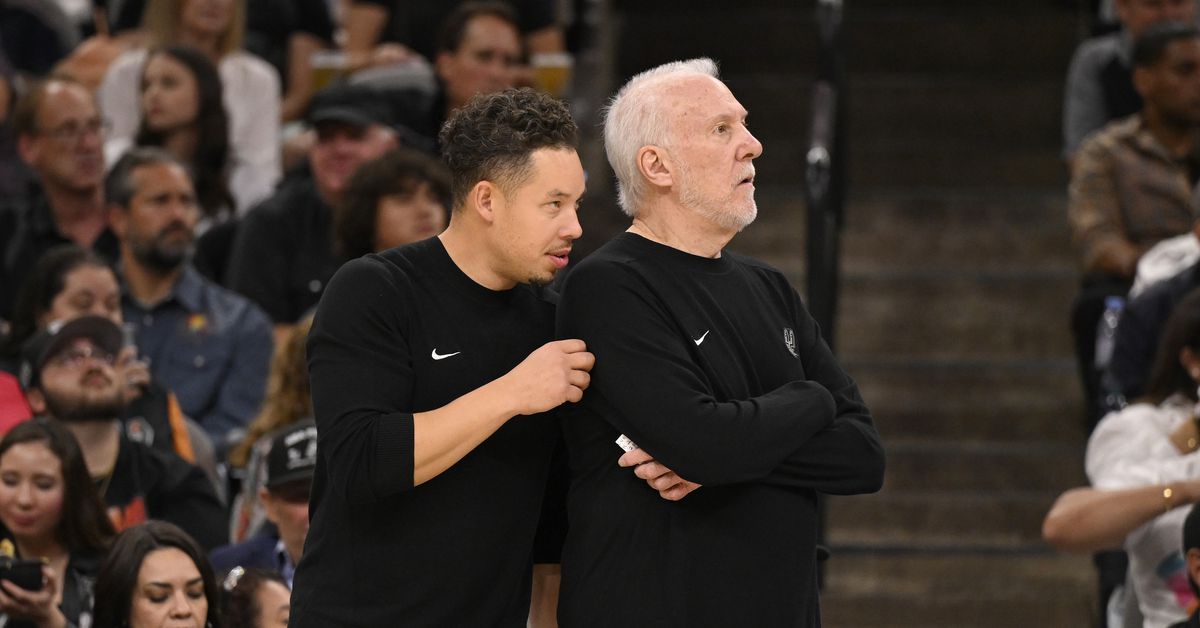
There was dramatic news in the Spurs’ world today. Gregg Popovich will retire from coaching and transition into a front office position. Mitch Johnson, a long-time assistant and interim coach during most of the 2024/25 season, will take over the big chair officially. It’s the end of an era.
Normally, a legendary coach leaving and a young, largely untested replacement being put in place would feel like a seismic shift. The curious thing with this transition is that, while arguably unoptimal from an organizational perspective, it feels seamless and even predestined, to a degree.
It’s impossible not to feel the shock of the official news of Pop’s retirement. He has been at the helm in San Antonio for longer than a lot of fans have been alive and has presided over several iterations of Spurs teams, some more successful than others, but all carrying his seal and identity. Accepting that there will never be a Pop team again is not easy. At the same time, the second you zoom out a little, his retirement was a completely predictable event. The health issues are well-known. Pop was energized by getting the opportunity to teach younger players in recent years, but the grind of an NBA season couldn’t have been easy to handle after almost 30 years of constant stress and plane rides. There were no more mountains left to climb for him, and he knew he’d always have a job in basketball with the Spurs, which could leave him more time to be around family.
When you stop to think about it, of course Pop retired. There’s a tendency to look at people in pro sports as superhuman, but Pop was self-aware enough to know that there was a chance he simply wasn’t physically able to continue to do his job anymore. He understandably wanted to make sure that was the case, but the writing was on the wall. It’s a little more surprising he’s sticking with his title of team president of basketball operations instead of “executive of whatever he feels like,” but he’ll get a say on whatever his duties end up being, because he’s earned that.
The second part of the story is about Pop’s replacement, and it will be more controversial. The retiring living legend will get the glowing retrospectives and will be immune to criticism for a while, but the franchise should get some scrutiny about how they handled the transition. There was an unusual number of recently successful veteran coaches in the market this offseason, and it’s safe to assume the Spurs didn’t consider them seriously. Maybe there were talks that never got leaked, but it feels like the idea was to ride with Mitch Johnson if Pop walked. If things don’t pan out for Johnson, who didn’t look like a prodigy in an admittedly bad situation last season, there will be criticism levied at the franchise for not going through a more thorough coaching search, or for still picking Mitch even if they did.
Again, however, zooming out just a little makes the plan of succession, if not ideal, then perfectly rational and predictable. The Spurs value continuity so much that they allowed Johnson to continue to work with Victor Wembanyama like he did when he was just an assistant, even after he took over for Pop as head coach. The foundation for this team has been built by the R.C. Buford – Brian Wright – Gregg Popovich triumvirate, so bringing in an outside hire that might disagree with the way things have been done or the timeline they have been done at could create instability in an organization that detests it. It doesn’t mean Johnson is a yes man who will be a figurehead; people who get as high on the totem pole in any bench tend to have strong ideas on how they’d run a team. But at least in the short term, San Antonio is making sure they don’t get into a Michael Malone – Calvin Booth toxic situation or a complete change in direction on a rebuild that has gone well so far.
It’s one of the biggest days in franchise history, a date that effectively separates the pre-Popovich and post-Popovich Spurs. It’s also a monumental moment for Mitch Johnson, who will have some huge shoes to fill, and for the San Antonio brain trust that has put him in charge. Yet while it feels historic, it doesn’t seem to carry the mix of dread, adrenaline, optimism, and melancholy that such a momentous occasion normally does. There was no violent or unexpected break between eras, as the Spurs did their best to change irrevocably while largely staying the same.
Whether that’s a good thing in the long run will be determined by results. For now, two announcements that should, on paper, feel earth-shattering have had almost the opposite response. What happened feels reasonable, cautious but forward-thinking, and well-executed, if not particularly exciting. The Spurs wouldn’t have it any other way.