
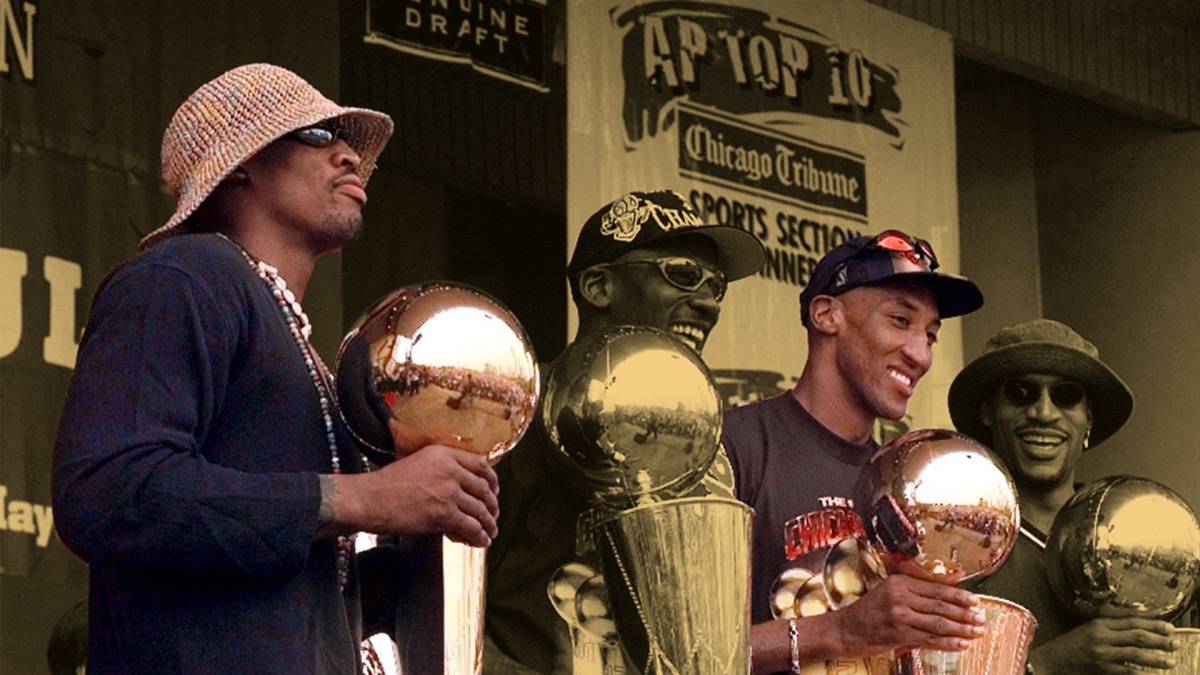
In the summer of 1995, the Chicago Bulls found themselves on unfamiliar ground — watching the NBA Finals from home two years in a row. Michael Jordan had returned from baseball the season prior but had only managed a partial campaign that ended with a second-round loss to the Orlando Magic.
It was clear that the Bulls needed more than Jordan back in the fold to reclaim the throne. They needed an edge. They needed chaos under control.
Advertisement
They needed Dennis Rodman.
Enemies to friends
Years prior, Rodman was the enemy, a very brutal one, but the move was a welcome one. When his name emerged as a real target for Chicago, it was a front-office decision and an emotional reckoning for the players who had spent years battling him. Especially for Scottie Pippen. But the bitterness began to thaw.
“We hadn’t seen the Pistons since 1991, all that time, time heals everything,” Pippen recalled. “And I think for Dennis, his career had taken a hit to the point that we obviously could use a rebounder.”
Bringing in Dennis wasn’t a plug-and-play decision. The man who once embodied the bruising, belligerent heart of the Detroit Pistons Bad Boys era came with deep scars in Chicago, scars Scottie wore quite literally. Their last playoff encounter had ended not just in a sweep but in blood.
Advertisement
Game 4 of the 1991 Eastern Conference finals saw Rodman shove Pippen to the floor so hard that it required six stitches on the chin of the Bulls man. For years, the tension lingered, unspoken but very real. That shove had symbolized everything that separated the old Pistons and the rising Bulls — the hate, the wars, the hard fouls and harder feelings.
Time did what time often does. It softened the edges. The Pistons of the late ’80s and early ’90s had been dismantled and Rodman’s own journey had veered wildly. After championship seasons in Detroit, he spiraled through the San Antonio Spurs, clashing with management, dyeing his hair and turning his behavior into headlines.
Rodman’s impact
Beneath all the theatrics, Rodman remained the league’s most dominant rebounder, averaging 16.8 boards per game in the 1994–95 season. For a Bulls team now without Horace Grant and desperate for someone to hold down the paint, the math began to make sense.
Advertisement
But the wounds weren’t forgotten. Before Rodman could wear the red and black, he had to offer something rare — an apology. He personally apologized to Pippen for the history between them. The team had to come first and Pippen knew that.
At that moment, ego took a back seat to winning. Pip, by now a six-time All-Star and one of the league’s best two-way players, understood what was at stake. The Bulls were one elite piece away from reshaping the league once again.
“Horace was gone,” the legendary forward said. “We were needing a rebounder, so Dennis coming in, I embraced it. I thought it was a great move.”
The move was historic. Rodman joined the Bulls for the 1995–96 season and Chicago bulldozed the league. He anchored the boards and handed the dirty work and the Bulls cruised to an NBA-record 72 wins. “The Worm” averaged 14.9 rebounds per game and gave the team precisely what it had lacked since Grant’s departure, which was a relentless interior presence.
Advertisement
Pippen and Rodman never became close friends, but they understood each other. They didn’t need to talk much, just work. What mattered was trust on the floor, and Rodman, to his credit, earned that trust quickly. By the time the Bulls rolled through the playoffs and reclaimed the NBA title in 1996, any questions about chemistry had long since vanished.