
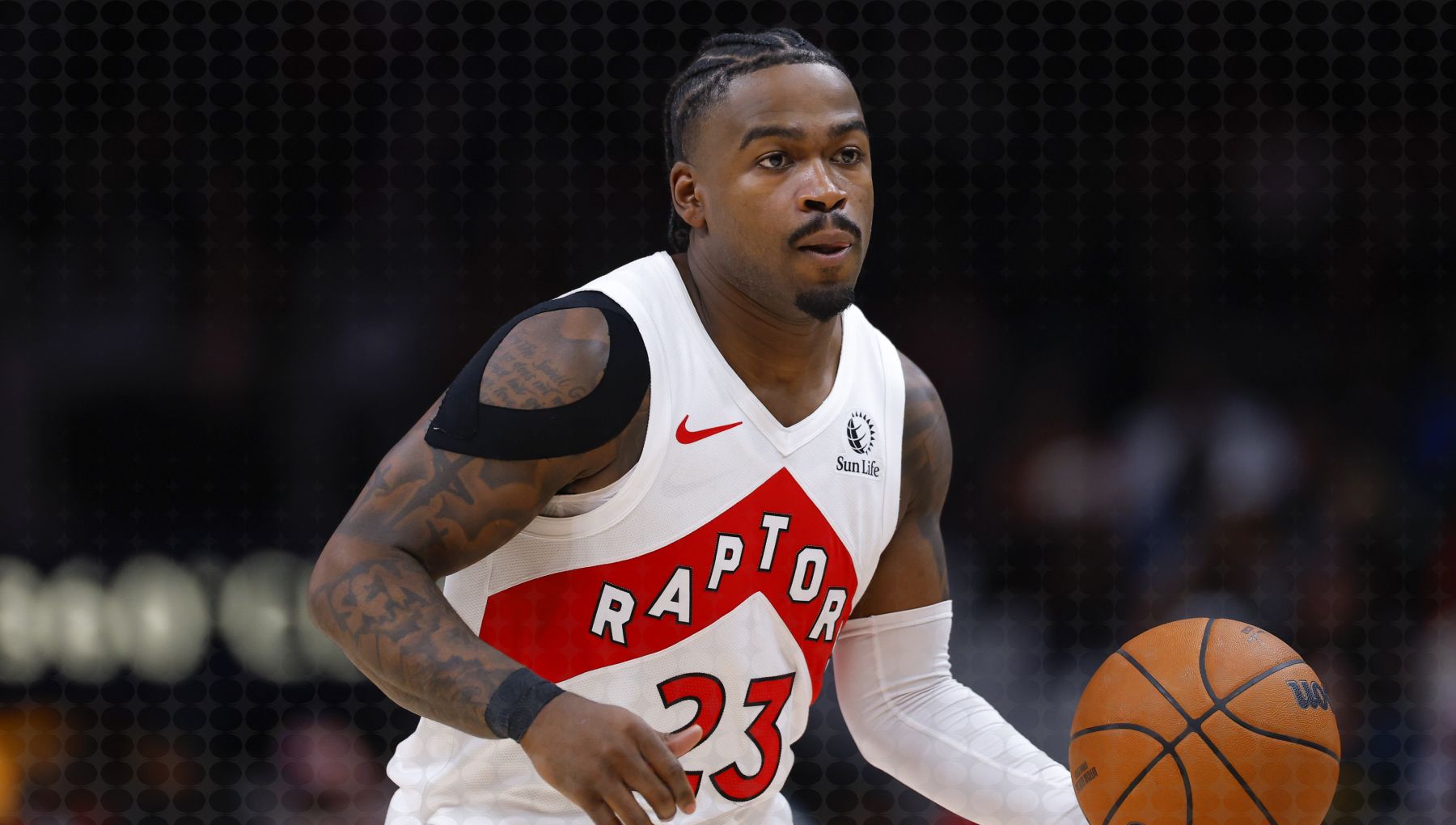
Jamal Shead (Photo by Emilee Chinn/Getty Images)
Contrary to most professional basketball players, Toronto Raptors guard Jamal Shead didn’t watch many NBA games or college basketball growing up. So instead of looking up to a favorite player or star, he aspired to be like his older brother, Jaylen.
“He was a D-1 athlete who I paid attention to and modeled my whole game off of. He’s just a left-handed version of me now,” Shead told RG Media in an exclusive interview before Toronto’s 126-113 win over the Cleveland Cavaliers.
In his second season with the Raptors, Shead is pacing one of the best benches in the league. He’s pushing the tempo, picking up full court defensively, and making the right plays. Shead’s simple but effective approach has helped get his team to a 7-5 start.
It was on display Thursday night at Rocket Arena again, the same place he stifled his opponent on Halloween night. In that game, he had nine points and seven rebounds as a plus-10. But in Toronto’s second matchup with the Cavs, Shead was a plus-15 with eight points and seven assists.
“We changed our strategy, too,” Cleveland head coach Kenny Atkinson said postgame. “We didn’t pick him up as high. We dropped on him and tried to pick him up lower just to keep him in front of us. But man, he’s a ball of energy.”
What stands out about this particular evening is the job he did on Donovan Mitchell. Shead spent 5:01 of game time on the six-time All-Star and forced three turnovers, per NBA Stats. He played with force and physicality on both ends of the floor. Stripping Mitchell after a defensive board and firming up against Evan Mobley on a switch are the moments that popped.
During pregame, Atkinson likened the Raptors’ ball pressure to the 40 Minutes of Hell Arkansas Razorbacks from 1994. Shead spearheads that effort, and that lifted the urgency and flipped the night for the visitors.
“I feel like that’s why I was drafted, to come in and disrupt, bring energy, and play a lot of good defense,” Shead said. “I think being in that space, and Coach Atkinson giving us some props, we’ve got to make sure that we go out there and do it, and make sure that we live up to the word that he put out there.”
Locking up the Best
On opening night, Shead took on the challenge of limiting Trae Young. Attached for nearly three minutes to his assignment, he smothered the Atlanta Hawks’ franchise player, who was scoreless on only one shot attempt against Shead.
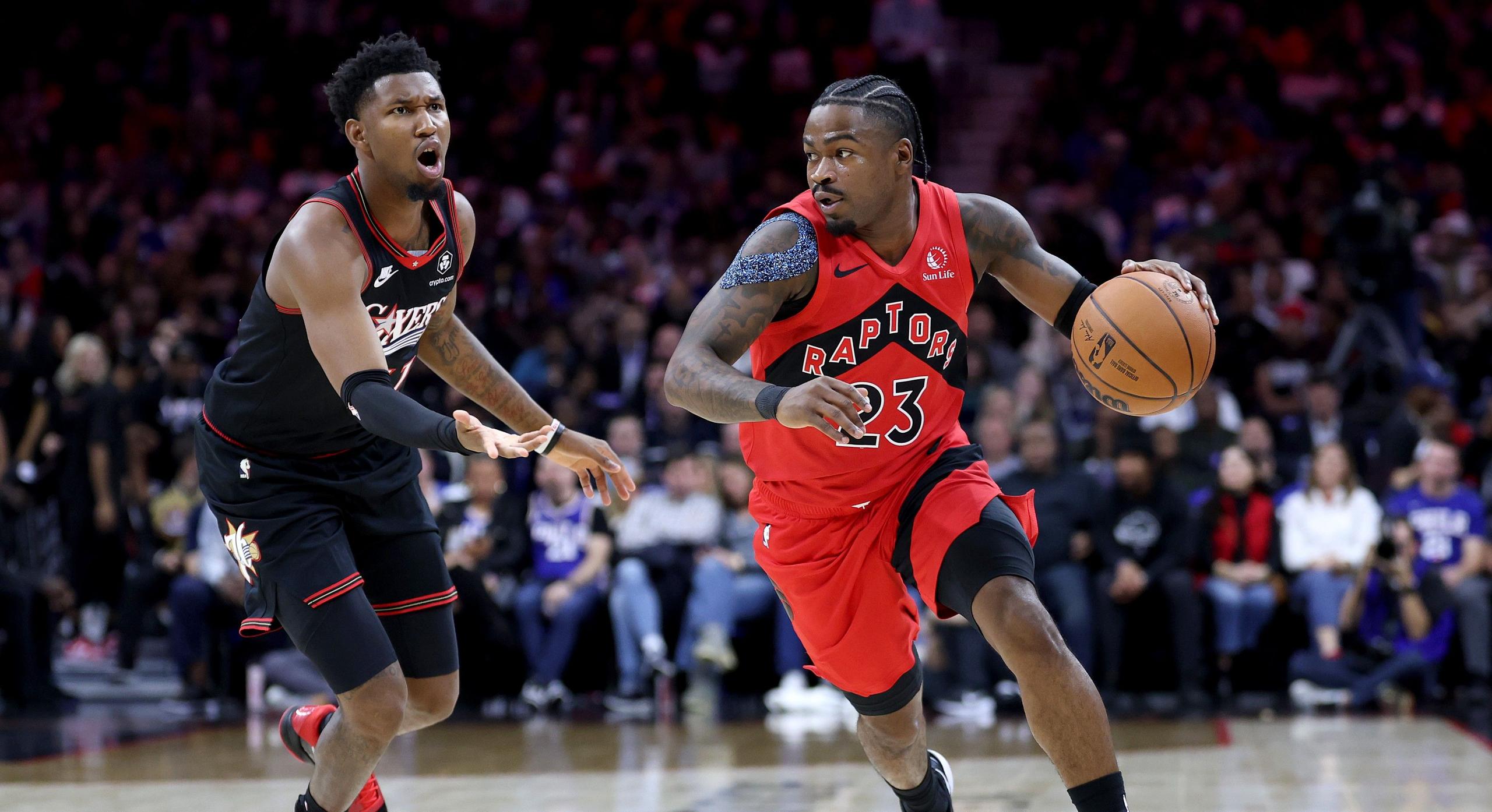
Just last week, on November 8, the Raptors entrusted him with Philadelphia 76ers star Tyrese Maxey. According to NBA Courtside, in 6:18 of matchup time, Shead held him without a field goal on three tries.
There’s a distinct role he’s playing for this Toronto squad, and it’s been critical to the group’s success.
“Our front office did a great job in the draft recognizing what type of player he is, what kind of energy he brings,” Toronto head coach Darko Rajakovic shared with RG in his pregame press conference. “He’s the guy that, his energy, he has such a huge influence on our team. He plays defense with joy, and he’s a winner, he’s a competitor.”
“When you have a point of contact on defense that plays that way, that really affects everybody else in a positive way. We’re really lucky and blessed to have him on our team and to grow him and grow here with us.”
Offensively, Shead does a great job of advancing the ball and pinpointing passes in the paint. For example, he had one on Thursday where he drove from the left wing to the rim and left a beautiful backward bounce pass to a flushing Scottie Barnes. It started the second quarter with a momentum play, and the Raptors didn’t look back.
Among those who have played at least 100 minutes this season, Shead ranks 13th in the NBA with a 36.3% assist percentage, according to Basketball Reference.
And despite playing the game as fast as he does, Toronto’s turnover percentage has decreased with Shead compared to last year. In his rookie season, the Raptors were giving the ball away 15.2% of the time; this campaign, that number has dipped to 13.7%, per Cleaning The Glass.
Rajakovic emphasizes that this development is “paramount.”
“For a backup point guard, that’s one of the most important things that you need to be aware of,” Rajakovic said. “You cannot come off the bench and play four or five minutes in stretches and turn the ball over. It doesn’t work like that.”
“You’ve got to be able to sustain what starters created, or to make a jump there and then create a plus. Not just to Jamal, but our guys coming off the bench, they do a pretty solid job defensively and also on offense. They help our team.”
It’s also notable that the Raptors are at the top of the NBA in assist-to-turnover ratio at 2.17.
“Just not as nervous, but also, Coach [Kelvin] Sampson’s in the back of my mind,” Shead said with a grin. “It feels like I’mma run for every turnover again. I think it’s just having that mindset of not wanting to do it and understanding that I can, and just watching a lot more film.”
Shead Reacts to Kelvin Sampson Pushing for Houston Jersey Retirement
Just recently, Houston Cougars head coach Kelvin Sampson went to bat for Shead and Detroit Pistons guard Marcus Sasser, campaigning for No. 0 and No. 1 to be retired in the rafters at the Fertitta Center.
“When someone you played for, the man you looked up to, says something like that about you, it’s awesome,” Shead said. “It’s a really good feeling. I think a lot of people did everything for Houston over the past couple years, but me and Marcus being four-year guys and doing what we were doing, it’s special.”
Shead’s list of collegiate accolades would take forever to list. He worked his way up from being a freshman playing 10 minutes per game, to a hard-nosed, defense-and-pass-first point guard, to a Consensus All-American as a senior. He credits Sasser, the first Consensus First Team All-American at the program since Hakeem Olajuwon in 1984, for “paving the way.”
The bullish Cougar backcourt stays plenty in touch, talking every week to catch up on Houston hoops or life in general.
“It’s like a brother or a close first cousin, you know what I mean,” Shead continued. “We were super close when I was there, and I think our bond is gonna be like that forever. I’m really happy for his success. I’m really happy to see him do good. I always root for him, so to see us both do good, it’s really fun to see.”
Four years in college is a rarity for pro prospects nowadays. With NIL and the transfer portal rules, it’s even more infrequent to spend that amount of time in one place. Because he stuck with it, Shead finished his career as the second-winningest player in Houston history with a 120-18 record.
“I don’t think I would be here without it,” Shead said. “I think I learned something new every year. I added something new to my game every year in college, and I think all the lessons that [Sampson] taught me has helped me tremendously since I’ve been in the league.”
Asked if that amount of experience gives him a leg up on younger players coming into the NBA, Shead downplayed the notion. He believes that everybody runs their own race, bringing up Sixers swingman Quentin Grimes’ success despite three seasons with Kansas and the Cougars.
“I think everybody’s right on time,” Shead said. “I think God has tremendous timing in everybody’s lives.”
Rajakovic, on the other hand, feels it “absolutely” prepared him for the next stage.
“Guys that stay longer in college, there’s a lot of benefits to that,” Rajakovic said.”He was also lucky to be with a great program with great coaches that kept him accountable at any point of time.”
“I know when he’s trying to start to go a little bit left and right, I know I can coach him hard. He accepts that really well. So that definitely helps. He’s the guy that ultimately wants to do the best for the team and help the team. He’s doing a great job.”
Standing at 6-foot with a 200-pound frame, Shead is a small guard with a big heart. His style of play should lead to a long career in the NBA, where plenty of “undersized” players have found a way to stick and make an impact in the league.
For him to accomplish that, it’s all about doing what’s needed.
“Obviously guarding the ball, but getting my teammates shots that they wouldn’t get if I was in the game,” Shead said. “Just bringing energy, being a smarter guy, and helping out all the guys on the floor.”
“Just being a good point guard.”