
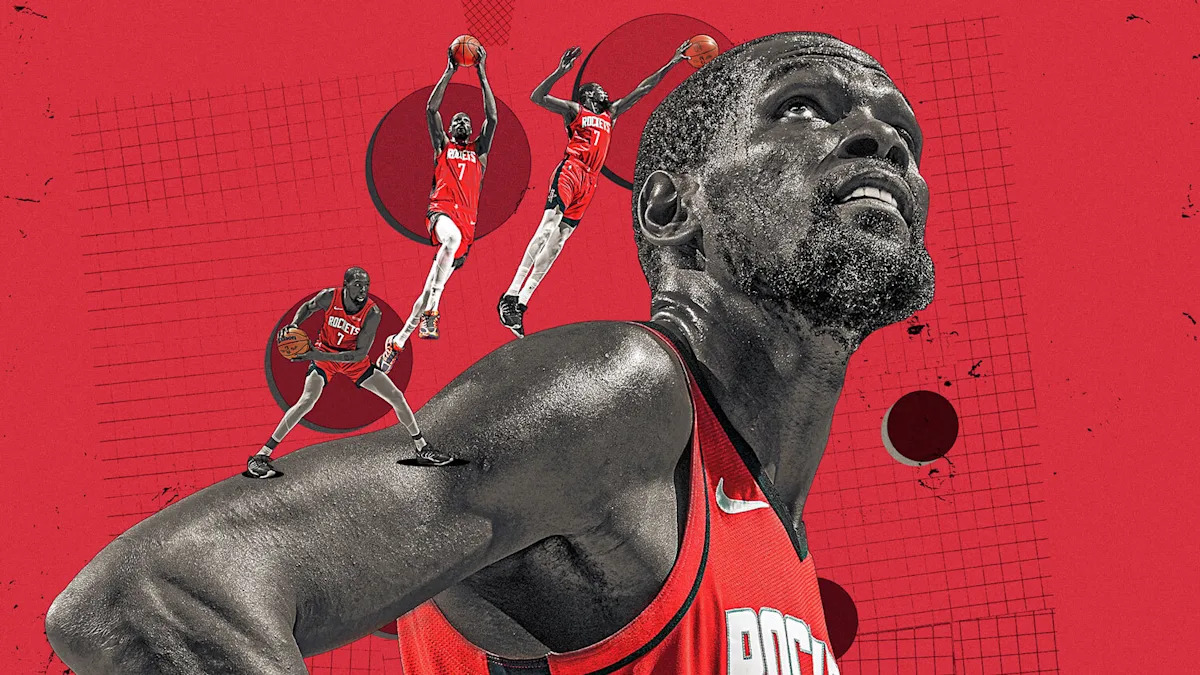
HOUSTON — Kevin Durant is standing at the free-throw line. It’s the closing act of Rockets practice, and the slender 37-year-old is locked in a tense battle with second-year guard Reed Sheppard, veteran Aaron Holiday and two-way guard JD Davidson while classic R&B tunes fill the Memorial Hermann training center. Here, the only shots that count are the ones that don’t touch the rim, Durant’s second language.
Assistant coaches Royal Ivey and Josh Bostic are there to encourage the non-Durant participants, but it’s futile. Durant is a near-career 90% free-throw shooter and wins the competition with ease. Most afternoons end like this. Still, the routine, which has become a rite of passage, is more valuable than the actual outcome. There’s no downside for these Rockets to be near greatness, even during one of the most rudimentary aspects of basketball.
Advertisement
“Just being in the same gym with him, same practice and being beside him, I’m just in awe,” Davidson said. “Hearing him talk, seeing how he always works out at full speed, even at that age and the career he’s had, is crazy.
“He’s the ultimate vet, the ultimate brother.”
Durant’s presence, which the Rockets aggressively sought to acquire this offseason, is worth more than a simple competition, especially during a season in which starting point guard Fred VanVleet has been lost. The lessons on display from the future Hall of Famer have made an immediate impact on the Rockets, who are 9-3 and third in the West, and his growth as a leader is critical to the team’s success.
Houston is embarking on a brave, two-timeline expedition, one born from a heartbreaking first-round exit six months ago — and one few teams have emerged from successfully. Blending young talent with experience and striking a balance between the two requires an outside-the-box approach. Something that appears to suit Durant well.
(Bruno Rouby/Yahoo Sports Illustration)
Durant’s 2007 draft class is now littered with retired players, a few NBA coaches and a litany of forgotten names. How he’s been able to last this long in a cutthroat league — while producing at an elite level — boils down to Durant’s uniqueness, doing things his own way.
Advertisement
To the untrained eye, his methods are unorthodox. But for nearly two decades, his approach has also been admired, adored and, yes, followed.
“He’s easy to follow because he’s the hardest worker in the locker room. When your big dog is that type of worker, it’s easy to follow,” Magic guard Tyus Jones, who played with Durant in Phoenix, told Yahoo Sports. “He’s a great leader — I know there’s a narrative about him as a leader, but there’s not one way to lead. You don’t have to follow a certain script.”
Durant’s leadership has been criticized in the past — notably by former players like Charles Barkley and even Kendrick Perkins, a former teammate — over his decision to leave Oklahoma City for Golden State, the collapse in Brooklyn and the mess that Phoenix became.
More than anything, I always wanted to be a guy that does s*** instead of says s***.
Kevin Durant
In Oklahoma City, the team was centered around a youthful version of him and Russell Westbrook, a boisterous, unapologetic spirit.
Advertisement
“We didn’t know how to be leaders that young,” said teammate Jeff Green, who was a part of that same 2007 draft class.
The Warriors were already a model, established franchise with Steph Curry, Draymond Green and Steve Kerr, allowing Durant to simply step in and raise an already high ceiling. In Brooklyn, Kyrie Irving carried the torch and bore the brunt of public perception, with Durant and James Harden forming a support staff. And in Phoenix, his previous stop, Devin Booker had been cemented as the Suns’ leader for years. In other words, Durant never needed to be the loudest or most important voice in the room.
“More than anything, I always wanted to be a guy that does s*** instead of says s***,” Durant told Yahoo Sports. “You could talk loud as you want, but if you’re not going out there and doing what you’re talking about, your teammates are not going to really respect it. So I always erred on the side of shutting up and going to work, and hopefully that inspires. But if I need to say something, if I feel something and something is on my heart, then I’ll come out and talk.”
That changed a few months ago when Durant arrived in Houston, the centerpiece of the most expansive blockbuster trade in NBA history.
Advertisement
Rockets coach Ime Udoka, who had spent time with Durant previously in Brooklyn and on the U.S. men’s national team as an assistant coach, understood the impact of Durant’s leadership and spoke with the veteran about his new job requirements. His message to Durant, who has become more empowered to speak up over the years, was to share his thoughts and experiences with his new teammates.
“It’s a different situation for him,” Udoka said. “Being with a younger team, he has to be more vocal and more demanding at times. You got James Harden, Kyrie and a lot of vets around you — you don’t have to speak up or do certain things as much — but being with this group, it’s a different type of leadership. Not just showing it, it’s more teaching, putting your arm around guys.”
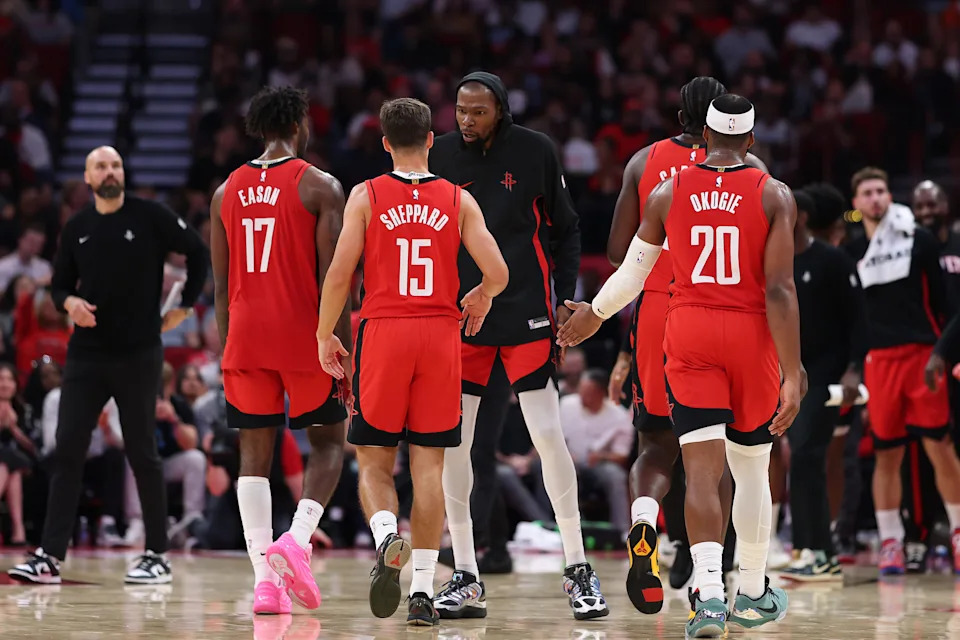
Kevin Durant has become a more vocal leader in Houston. (Photo by Kenneth Richmond/Getty Images)
(Kenneth Richmond via Getty Images)
Forty-five minutes after a home loss to Detroit on Oct. 24, a downtrodden Sheppard, fresh off a sluggish nine-point, three-turnover night on 3-for-11 shooting, trudged into Houston’s locker room head down, disinterested in his surroundings. For all the optimism that Sheppard had spoken to during training camp and preseason, he had missed 16 of his first 22 shots, coughed the ball up five times and looked anything like the confident shooter the Rockets had hoped to see.
Advertisement
Durant, sitting at his locker on his phone, still in his game gear, got up and approached Sheppard. He didn’t want or need to sit Sheppard down for a fireside chat; he had been in that situation before and understood the emotions running through the guard’s head. A few words would be enough to get the message across.
“Two down, we got 80 more,” Durant said. Sheppard looked up and nodded his head. October was too early for negative body language, not with what’s at stake in Houston.
It’s a different situation for him. Being with a younger team, he has to be more vocal and more demanding at times.
Ime Udoka
That interaction served as a catalyst for Sheppard, and perhaps for the team as a whole. Since the calendar flipped to November, Sheppard is averaging a shade under 14 points per game on an impressive 53.5% shooting from distance. In turn, Houston has won nine out of its last 10 games after a slow 0-2 start.
The Rockets are in this position in large part because they’ve allowed Durant to be the best version of himself, which in turn has benefitted the team. Durant’s 25.9 points per game lead the team in scoring, and his .510/.400/.888 shooting splits are a reminder of the gravity of his offensive talent that this team so desperately needed. But this new partnership in Houston isn’t aiming to reinvent the wheel when it comes to Durant’s leadership, especially with the future Hall of Famer closer to the end of a stellar career than the beginning. His new environment has empowered KD to just be KD.
Advertisement
“I got more comfortable speaking up when I see stuff,” Durant said. “I feel like I study the game a lot. I’ve been through every situation and experienced every situation. So I feel like that’s given me more confidence to speak up when I see things and to help my teammates as much as possible. But it’s just been a natural progression of me just being comfortable in the locker room, and also my teammates being open-minded to hear what I have to say.”
At its core, Durant is a people person who strives to connect with others, regardless of their status — just peruse his social media. A few weeks after Durant was traded to Phoenix, he invited all of his new teammates to his hotel room before a road game against Dallas to officially break the ice. More important than getting to know the Suns as players, he wanted to understand them as human beings.
Rockets guard Josh Okogie, who was present for that bonding session when they were teammates in Phoenix, sees the impact of his leadership in Houston, too.
Advertisement
“Since he first came in, he’s been open and vocal,” Okogie said. “Obviously, a lot of people try to paint him as not a leader, but he’s just not a rah-rah guy. He just calls it how he sees it and lets guys know. You can call it how you see it with him as well.”
[Get more Rockets news: Houston team feed]
Durant’s desire for brotherhood has spilled over to his new locker-room mates. He shares a space with Tari Eason, who makes it a point to explain how much time KD has spent with him off the floor. Sheppard, whom Durant is particularly fond of, is constantly picking Durant’s brain. “Knowing the kind of person he is and how much confidence he’s given me is really cool,” Sheppard said. While on the road, Durant also enjoys taking his young teammates out to dinner to unwind, decompress and be themselves away from basketball.
“I’ve been on teams where you have young guys trying to establish themselves,” Durant said, “Which isn’t a bad thing, but sometimes that can get in the way on a team. [Here] you have young great players still figuring things out, so their approach to the game might change, and my approach to them might change. But these guys are humble, appreciative of being here and grateful to come in every day. It’s always fun coming into the locker room.”
After games, Durant routinely clutches the box score during his postgame availability, reading out the stats of his teammates to the media and driving home the importance of the team approach. On the court, he doesn’t seek to dominate the lion’s share of touches, either. Despite being one of the most clutch players in NBA history, Durant is fourth on the team in shots in the final five minutes of regulation and overtime, according to Second Spectrum.
Advertisement
Following Friday’s emphatic 140-116 win over the upstart Trail Blazers, Durant admitted it was more enriching seeing multiple players with assists as opposed to one central force dominating the ball. That’s the essence and beauty of Durant, who offers a different meaning of the term “floor raiser,” lifting the spirits of others around him in Houston.
“I’m not a tap the glass in front of the whole group and get everybody to listen to me real quick on the megaphone,” Durant said. “But I pull a guy to the side here and there, say a quick thing that I got on my mind and move on.”
Houston’s impressive start — and Durant’s positive impact — has been refreshing, but an NBA season has a myriad of highs and lows. The Rockets’ depth, now without key reserve Eason (out for up to six weeks with an oblique injury) and Dorian Finney-Smith (returning from offseason ankle surgery), will be tested — with Cleveland, Denver, Phoenix and Golden State on the docket before Thanksgiving. How the Rockets navigate rocky stretches and rough waters, and how Durant steers the ship, will determine Houston’s viability. But there’s a growing brotherhood within those walls.
Advertisement
“It’s a camaraderie that needs to be built in the locker room, that’s my theory,” Durant said. “People might not feel the same way, but I just think that the camaraderie makes a good basketball team; knowing one another, understanding each other as human beings and getting to know each other off the court. I think that stuff goes a long way.”