
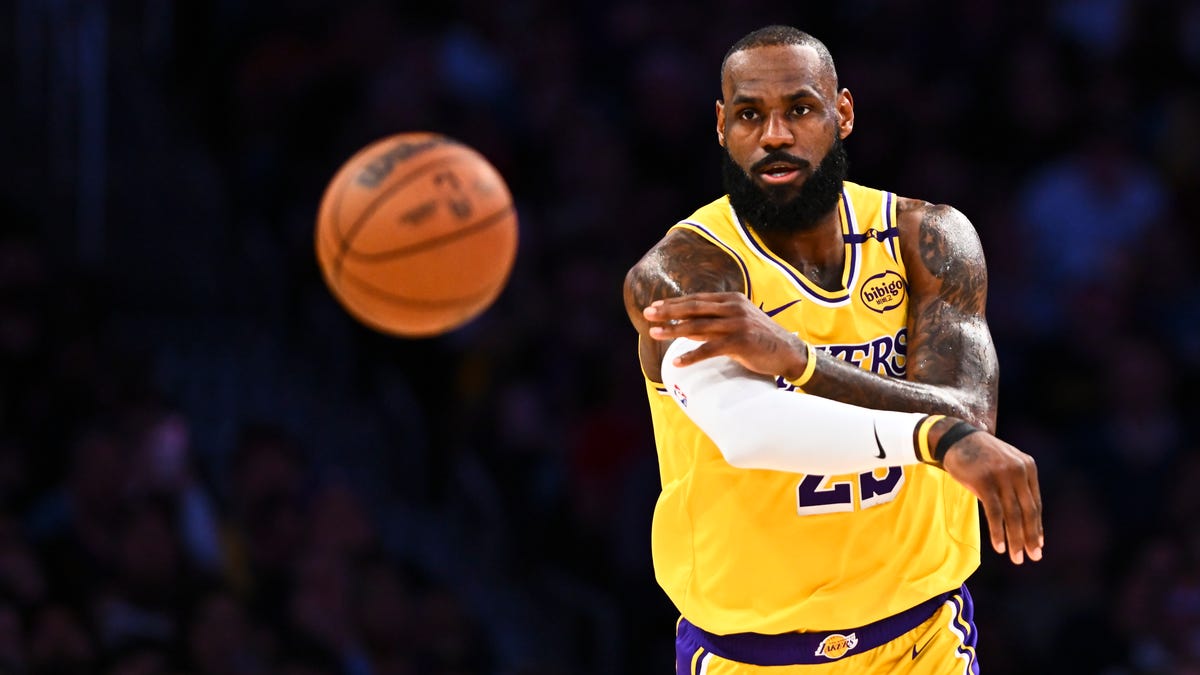
Check out where The Chosen One LeBron James ranks in every major NBA accolade and stat… from championships to scoring titles to advanced metrics.
The Chosen One, LeBron James, arrived in the NBA with tons of hype and yet, somehow, managed to surpass even the wildest expectations, becoming the NBA’s all-time leading scorer, the all-time leader in All-Star and All-NBA selections, all while winning four championships and four Finals MVPs.
Just like we did with Michael Jordan, we have put together an accolade- and stat-filled GOAT debate cheat sheet about James, one that will allow you to check out where James ranks in every stat and accolade, from NBA championships won, NBA Finals MVPs, playoff scoring, rebounding and assisting, as well as advanced metrics like BPM, PER and VORP, and much more.
Check out all the juicy info below.
NBA titles: No. 27 (four)
As just about everyone knows, the main argument by the pro-Jordan camp is the fact that James only has four NBA championships and a losing record in the Finals (4-6 in series, 22-33 by games), compared to Jordan’s much-vaunted 6-0 record in the Finals (24-11 by games).
James is pretty unlikely to move up in this category, barring an unexpected Lakers’ title run. And even if that does happen, it’s likely Luka Doncic will get more credit than James for those potential championships.
Still, James is tied for having the most rings won by any player in the 21st century, along with Tim Duncan and Stephen Curry, among others. Plus, it’s hard to fault James wholly for his poor Finals record, as he has put up 28.4 points, 10.2 rebounds and 7.8 assists in 55 championship series games in his career.
As you’re about to find out, you will have to scroll quite a bit to see James this low in any other ranking.
Finals MVPs: No. 2 (four)
The fact that James ranks 27th in NBA titles won but is second in Finals MVPs speaks to his greatness as a player, and if anything, he could have more such awards. The NBA has only ever once given Finals MVP to a player on the losing team, and that went to Jerry West in 1969. There’s no question, though, that James deserved similar consideration, particularly in 2014 and 2015.
In 2014, James’ Miami Heat got demolished by the San Antonio Spurs in the Finals, falling four games to one. Kawhi Leonard won Finals MVP that year after averaging 17.8 points, 6.4 rebounds, 1.6 steals and 1.2 blocks in the series. Leonard won it, in part, for his job in slowing down James in the series. Well, Leonard’s version of slowing James down still amounted to James averaging 28.2 points and 7.8 rebounds on 57.1 percent shooting, 51.9 percent from three.
Then, in 2015, James’ Cleveland Cavaliers lost in the Finals, falling in six games to the Golden State Warriors, with Andre Iguodala, who put up 16.3 points, 5.8 rebounds and 4.0 assists in the series, winning Finals MVP. As was the case with Leonard, Iguodala was credited with being the James-stopper in the series, which helped him in the final vote for MVP. However, James still put up absolutely preposterous marks in the Finals – 35.8 points, 13.3 rebounds and 8.8 assists – so how much did Iguodala actually slow him down?
We understand why the NBA would rather give Finals MVP to players on the title-winning team, but if anyone besides West might have deserved that distinction, it was James in 2015.
Regular season MVPs: No. 4 (four)
We actually did a study on this three years ago, in which we used our Global Rating metric to determine who should have won league MVP awards if factors such as voter fatigue weren’t a thing. In that study, we determined James should have won league MVP honors nine times, five more than he actually did, based solely on the fact that he was Global Rating’s best player on nine separate occasions.
As we wrote three years ago:
The biggest MVP “robbery” of James’ career, per our metric, was in 2005-06 when James put up 31.4 points, 7.0 rebounds, 6.6 assists and 1.6 steals and led a weak Cavaliers’ roster to a 50-win campaign. MVP that year went to Steve Nash instead, who, in fairness, was fantastic that season, leading the league in assists with 10.5 to go with 18.8 points and 43.9 percent shooting from three.
In reality, James’ four regular-season MVPs are tied with Wilt Chamberlain for the fourth-most ever, trailing Kareem Abdul-Jabbar (six), Jordan (five) and Bill Russell (five).
All-NBA 1st Team selections: No. 1 (13)
James hasn’t earned 1st Team All-NBA honors since 2019-20, and yet he still has two more 1st Team All-NBAs than any other player in league history. Kobe Bryant and Karl Malone are tied for second for this honor with 11 apiece, while Jordan and various others are tied for fourth with 10.
Surprisingly enough, James isn’t the oldest player to make 1st Team All-NBA, as that distinction actually belongs to Abdul-Jabbar, who achieved the honor at nearly 39 years old, which is absolutely ridiculous. James was 35 the last time he made 1st Team All-NBA.
All-NBA Team selections: No. 1 (21)
After earning 2nd Team All-NBA honors in 2024-25, as a 40-year old, James now has six more All-NBA selections than any other player in league history, and as many as Jordan and Chamberlain combined. He also has one more than Magic Johnson and Larry Bird put together.
Of course, we must factor in the fact that 3rd Team All-NBA didn’t exist until 1988-89, so that’s an advantage modern players have over the old-school guys as far as racking up All-NBA selections. But even then, James is so far ahead of every other player here, in large part thanks to his greatness over such a long span of time, that that may not even matter much.
For example, Chamberlain only played 14 seasons in the NBA, and Russell only 13, so they’d still be far behind James, who is entering Year-23, in this distinction, even if they made an All-NBA team every year of their career.
All-Star selections: No. 1 (21)
James caught the previous all-time record holder in All-Star appearances, Abdul-Jabbar, back in 2022-23, when he made his 19th All-Star appearance. Now, he’s two ahead of Abdul-Jabbar and running up the score on him and the rest of the field.
The only season of his career that James wasn’t named an All-Star was his rookie campaign, a year that saw 2003’s No. 1 pick put up a 21/5/6 stat line with 1.6 steals per game over 79 appearances. He probably should have been an All-Star that year, too.
Again, this record is a testament to James’ unreal longevity, as not only has he maintained excellent health throughout his career, he’s kept up a near All-NBA level through all these years.
All-Star MVPs: No. 3 (three)
James won All-Star MVP honors three times in his career, which ties him with Jordan, Oscar Robertson and Shaquille O’Neal for the third most of all-time. Those four all-timers only trail Bob Pettit and Kobe Bryant, who each won the distinction four times.
James won the award in 2006, 2008 and, most recently, in 2018. That All-Star Game was highly competitive, as Team James took down Team Stephen Curry 148-145, with James leading the way, putting up 29 points, 10 rebounds and eight assists. James even hit what proved to be the game-winning basket, a layup, with 34.5 seconds left in the contest.
All-Defensive 1st Team selections: No. 14 (five)
At his athletic peak, James was a fantastic defender when locked in, thanks to his ridiculous lateral quickness at his size, as well as his otherworldly strength for a wing. He even had a strong case to win Defensive Player of the Year in 2013, when he made 1st Team All-Defense. The player who did win Defensive Player of the Year that season, Marc Gasol, was 2nd Team All-Defense that season, something James remembers well all these years later (on a 2024 episode of The Shop):
“Defensive Player of the Year,” James said. “I mean, that’s the only award that I don’t have in my house. It kind of stings. I’ve talked about this before. Like, it don’t make sense. It’s almost like what Jay [Z] just said about [Beyonce]. How could she have the most GRAMMYs? But never won Album of the Year. So, the year I finished second in Defensive Player of the Year award, the guy who won Defensive Player of the Year didn’t even make first team on defense.”
Petty or not, James may have a legit gripe, although Gasol did spearhead an elite Memphis Grizzlies defense that season.
Regardless, the fact that James spent much of the second half of his long career more or less coasting on the defensive end, a perfectly normal thing for superstars – especially aging ones – to do, hurts his place in this all-time ranking, as he’s merely 14th all-time in 1st Team All-Defense appearances.
All-Defensive Team selections: No. 23 (six)
Maybe it had something to do with the 2013 slight, but James never made a 1st Team All-Defense after that season. His last All-Defensive Team selection came in 2013-14, a 2nd Team All-Defensive Team showing in his last campaign in Miami.
Considering James was still just 29 by the time he rejoined Cleveland in 2014-15, that’s pretty shocking, though perhaps saving himself a bit on the defensive end of the floor could be what has helped him extend his prime into his 40s. Plus, it’s not like James didn’t have various spectacular defensive moments in the second half of his career, they just rarely came in the regular season, and were mere flashes as opposed to coming on a nightly basis.
Player of the Week: No. 1 (69)
In part, James benefits from playing in an era in which a player from each conference wins Player of the Week each week. That wasn’t the case until 2001-02. James also spent a huge bulk of his career playing in the far-weaker Eastern Conference.
At the same time, James has 69 Player of the Week awards in his career, an absolutely astounding number – and 36 more than the next closest player, Bryant. Combined, Jordan and Bryant have 11 fewer Player of the Week awards than James, leaving us no choice but to tip our cap at James’ sustained excellence.
There’s a 20-year gap between James’ first and most recent Player of the Week award, and it’s not out of the question that James earns the distinction a few more times in the future, which would make that gap even more shocking.
In 2008-09, James won Player of the Week seven times in 23 weeks, a personal best for arguably the greatest player of all time.
Player of the Month: No. 1 (41)
Like with Player of the Week, James has a bit of an advantage here, as Player of the Month went to just one player from 1979-80 until 2000-01. Either way, James has such a massive lead here that it doesn’t matter, as James’ 41 Player of the Month awards are over twice as many as the No. 2 player on the list, Bryant with 17. Put Bryant’s 17 and Jordan’s 16 awards together, and they still trail James by eight Player of the Months.
James is both the youngest and oldest player to earn Player of the Month honors, first winning the award in November of 2004 – as a 19-year-old – and most recently winning it in February of 2025, as a 40-year old, beating the latter record that was previously held by Karl Malone, who won it at 37 years old in November of 2000.
Fun fact: James isn’t only the youngest player to ever win Player of the Month, he’s also the second-youngest after again winning the award in January of 2005, as a recently turned 20-year-old.
Regular season points: No. 1 (42,184)
On Feb. 7, 2023, James surpassed Abdul-Jabbar’s nearly 40-year-old record for most regular-season points scored in NBA history, a mark that was established in 1984 and was built upon until 1989, when Abdul-Jabbar retired.
Since breaking the record, James has done nothing besides average 25.0 points over 152 more appearances, showing little sign of slowing down, so we’re confident in saying that if this record is ever broken, it will take at least a couple of decades.
Without even having played in 2025-26, James has a 9,892-point lead on Jordan in this record, a mark that will surely be 10,000-plus by the time James does retire. That’s probably why Jordan backers in the GOAT debate prefer to talk about per-game numbers as opposed to overall totals.
Regular season rebounds: No. 25 (11,731)
Part of what makes James’ such a once-in-a-lifetime talent is his ability to do it all – score, rebound, assist and defend. As such, James, thanks to his 6-foot-8 size, brute strength and unreal athleticism, has been a great rebounder throughout his career, averaging 7.5 boards per game as pro, and ranking Top 25 all-time in total regular-season rebounds.
Among small forwards, James’ 7.5 rebounds per game ranks as seventh highest mark of all-time. What’s more, it’s actually the third-highest mark among small forwards who have played since the NBA added the three-point line in 1979-80 (minimum: 500 career NBA appearances). The only wings who averaged more nightly rebounds for their careers than James are Shawn Marion (8.1) and Antawn Jamison (7.6).
Regular season assists: No. 4 (11,584)
A do-it-all superstar, James’ playmaking is probably his most impressive trait (making it all the more awe-inspiring that he broke the NBA’s scoring record). James has averaged 7.4 assists per game for his career, enough to have produced 11,584 career dimes (so far), the fourth-highest mark ever, trailing only John Stockton (15,806), Chris Paul (12,519) and Jason Kidd (12,091), i.e., three of the greatest playmakers of all time.
If James stays healthy and plays another couple of seasons, there’s a chance he can pass Kidd, who he trails by 507 assists, on this list. There’s an outside chance he can catch his friend, Paul, too, as Paul is only 935 dimes ahead of his contemporary. In 2023-24, James totaled 589 assists and in 2024-25, he amassed 575, so passing Kidd and Paul is well within grasp, depending on how much longer he plays.
James’ 7.4 assists per game is over two more than the next closest small forward to him on the list of best assist averages among wings all-time. The player trailing him is Scottie Pippen, who averaged 5.2 for his career.
Regular season steals: No. 6 (2,345)
Surprisingly, James still trails Jordan (2,514, fourth all-time) in this category.
It’s not surprising in the sense that maybe we shouldn’t be shocked, considering Jordan was a more engaged defender on a nightly basis (His Airness earned 1st Team All-Defense honors nine times in his career, including all the way until his final season in Chicago), but it is surprising since James has played in 500 more regular-season games than Jordan, and counting.
Regardless, as we already covered, James was an amazing defender in his prime when engaged, but he clearly began to conserve energy on that end of the floor once he turned 30.
Even so, James has averaged 1.5 steals for his career, an impressive number, and he could finish his career Top 5 in this metric if he keeps going.
Regular season blocks: No. 71 (1,150)
A rare area in which James hasn’t been totally otherworldly is as a shot-blocker, which is surprising considering his size, length, athleticism and instincts. James has averaged just 0.7 blocks per game in his career. He has also never averaged more than 1.1 blocks per game for a season, which he has done three times in his career, including, impressively, in his age-37 campaign with the Lakers when he played a lot of center for the club.
Playoff points: No. 1 (8,289)
On the other hand, James’ grasp on the No. 1 spot in all-time playoff points scored is so great that unless the NBA does something crazy like change the playoff format to nine-game series, we can’t see James ever losing his place in this ranking.
James’ 8,289 points scored in the playoffs is 2,302 points than No. 2 on the list, Jordan. That would require a player averaging 23 points per contest over 100 playoff games to make up the difference. The gap between James and Jordan in this respect is bigger than the one between Jordan and Magic Johnson (3,701 career playoff points scored), who is No. 17 on the list of all-time playoff points scored.
Of course, the fact James is the all-time leader in NBA playoff appearances with 292 (113 more than Jordan) helps him a great deal here. At the same time, James has been exemplary in the playoffs historically, averaging 28.4 points per game in the postseason for his career, the sixth-highest mark ever, so he has very much earned his spot atop this ranking.
Playoff rebounds: No. 4 (2,628)
What does it say about James that he, a small forward by trade, ranks Top 4 in NBA history in total playoff rebounds? His longevity is fantastic, but so is his rebounding ability for his position, as James has averaged 9.0 rebounds per playoff game.
Among players with at least 100 NBA playoff appearances, James’ 2,628 playoff rebounds are 904 more than the next closest swingman on the list, Elgin Baylor, who grabbed 1,724 postseason rebounds in his career, and ranks 10th on the list among all players. If that wasn’t impressive enough, it must also be noted that James is ahead of Shaquille O’Neal (2,508) and Abdul-Jabbar (2,481) in playoff rebounds.
Playoff assists: No. 2 (2,095)
One metric in which James likely won’t finish No. 1 overall is in career playoff assists, as he still trails Magic Johnson by 251 postseason dimes. That’s despite Johnson playing 102 fewer playoff games in his career than James, by the way.
Over his last three postseasons combined, James has amassed 176 playoff assists, making it unlikely he’ll catch his fellow Laker legend here, unless Los Angeles makes multiple deep playoff runs over the next two seasons.
Playoff steals: No. 1 (493)
As we discussed in the sections about defensive accolades, James wouldn’t really turn it on defensively until he had to. Well, in the playoffs, he had to, and the numbers reflect that, as the NBA’s all-time leading scorer also leads the league in career playoff steals – and by a wide margin. No. 2 on the list, Pippen, is 98 steals behind James here, and the next closest active player, Chris Paul, is 206 postseason takeaways behind him.
That’s all to say, James won’t be getting passed here anytime soon – if ever.
Playoff blocks: No. 9 (284)
For further proof that James turns it up a notch defensively in the postseason, how about the fact that he averages more blocks in the playoffs (1.0) than in the regular season (0.7) for his career? As such, James is Top 10 all-time in career playoff blocks, although that ranking wouldn’t look as pristine if blocks were recorded back in the days of Russell and Chamberlain.
Even so, James has had moments of brilliance as a postseason paint-protector. We can ask current Portland Trail Blazers interim head coach Thiago Splitter about that:
Or, even more memorably, 2015 Finals MVP Andre Iguodala:
Another fun fact: James is the only player in NBA history to rank Top 10 in playoff points, rebounds, assists, steals and blocks.
Finals points: No. 2 (1,562)
The one big knock on James is his 4-6 Finals record, but Jerry West wishes he had a Finals record as good as James’, as The Logo went 1-8 in championship series matchups himself. Regardless, West is the all-time leader in points scored in the NBA Finals with 1,679, 117 more than James. If the Lakers can make a Finals run over the next season or two, it’s likely James surpasses West in this metric, but reaching the Finals is far easier said than done in the Western Conference.
James is sixth all-time in point-per-game average in the Finals at 28.4 points, behind West (third all-time, 30.5) and Jordan (second, 33.6). Rick Barry leads all players in NBA Finals scoring average at 36.3, though he played in way less Finals games than any of those aforementioned names.
James and West have actually both played 55 Finals games apiece, tying them for fourth in the metric.
All-Star Game points: No. 1 (434)
As the all-time leader in All-Star Game appearances (21), two more than any other player, James is naturally also first all-time in points scored in All-Star Games at 434 points, 144 more than the No. 2 player on the list, Bryant (290). James is third in All-Star Game scoring average at 21.7, a lower rate than Giannis Antetokounmpo (24.9) and Joel Embiid (23.8), but ahead of ninth-place Jordan (20.2).
Of course, James has benefited here from being the all-time leader in All-Star appearances, as well as playing in an era where, most of the time, very little effort was put into the defensive end of the floor in All-Star Games.
Even so, another impressive first-place record for James.
Scoring titles: No. 20 (one)
19 players have led the NBA in scoring multiple times in their careers. Ironically, James – the league’s all-time leading scorer – only accomplished the feat once in his whole career, in 2007-08 at 30.0 points per contest.
Of course, James is a more all-around player than just about any other NBA great, especially those who were score-first guys. James could score at an elite level, too, but he’s also a fantastic playmaker and rebounder, while standing 6-foot-8 with outrageous strength and explosiveness, so there was way more to his game than just scoring.
For the record: James’ 30.00 point-per-game average in ‘08 is good for the 91st-highest single-season scoring average in league history.
Assists leader: No. 14 (one)
James was the NBA’s assist champion once in his career, in 2019-20, when he put up 10.2 dimes per contest. That goes to show how well-rounded of an all-time great James is, as he’s one of just seven players in league history to boast a scoring and assist title on his resume, along with Robertson (one scoring title, six assists titles), West (one apiece), Tiny Archibald (the only player ever to accomplish both feats in one season), Russell Westbrook (two apiece), James Harden (three scoring title, one assists title) and Chamberlain (seven scoring titles, one assist title).
Regular season PER: No. 3 (26.9)
James ranks third all-time in regular-season PER, trailing only Nikola Jokic (28.6) and his biggest competition in the GOAT debate, Jordan (27.9).
PER is really only a good barometer for modern players, though, as finding accurate PER data pre-1996 is extremely difficult, because blocks and steals weren’t recorded before 1974, turnovers weren’t recorded before 1979 and possession stats weren’t tracked until 1996. Even in the George Mikan years, there were various seasons where not even rebounds were measured nightly. All that to say, pre-1996, PER – and other advanced metric stats – are wonky to say the least.
Who knows how well the likes of Chamberlain and Russell would fare in PER if the NBA had been tracking steals and blocks back then?
Regular season Win Shares: No. 2 (271.4)
James ranks second all-time in regular-season Win Shares, a testament to his productivity and longevity. He only trails Abdul-Jabbar (273.4) in this stat, but he’s likely to pass him in 2025-26, as James has added, on average, 7.3 Win Shares to his career total over the past three seasons. So this will be yet another metric in which James ranks first in NBA history when it’s all said and done.
Regular season BPM: No. 3 (8.5)
Ranking third all-time in regular-season BPM behind Jokic (10.4) and Jordan (9.2), it’s likelier James sees his +8.5 career BPM go down rather than go up, as over the past three seasons, he’s averaging a +6.0 BPM. That’s still a fantastic mark, mind you, as James has been Top 8 in BPM in each of the last two seasons, but as far as James making a move up this ranking in the twilight of his career, that’s just not going to happen.
Regular season VORP: No. 1 (156.6)
One area in which James ranks first all-time, and will more than likely never be surpassed, is in regular-season VORP, as second place in this metric, Jordan (116.1) is 40.5 points behind James. The difference between James, first, and Jordan, second, is almost the same as the difference between Jordan and Shaquille O’Neal, who is 17th all-time in this metric at 75.6. The closest active player to James here is Chris Paul, who is fifth all-time in the stat at 98.9.
Playoff PER: No. 4 (27.9)
Surprisingly, James is just fourth all-time in Playoff PER, and that number would be even lower if the likes of Russell and Chamberlain got their just due in this stat. Due to numerous raw metrics, including blocks and steals, not being tracked back then, most old-school all-timers fare poorly in career PER. Regardless, James is fourth here, behind Jordan (28.6), Mikan (28.5) and Jokic (28.5), and it’s not likely he has enough time left in the NBA to make a run up the ranking.
Playoff Win Shares: No. 1 (59.5)
Win Shares are a cumulative stat; hence, it should come as no surprise that James, who has 32 more career NBA playoff appearances than the player with the second most playoff appearances ever (Derek Fisher), has a monstrous lead in all-time playoff Win Shares, too.
James dominates in this metric. He’s got 19.7 more playoff Win Shares than Jordan did, with the difference between first (James) and second (Jordan) on this list being roughly the same as the difference between second and 26th place (Horace Grant with 20.0 career playoff Win Shares).
Another impressive No. 1 all-time ranking for James here.
Playoff BPM: No. 3 (10.0)
Among players with at least 2,000 NBA playoff minutes, James ranks third all-time in playoff BPM, trailing Jordan (11.1) and Jokic (10.8). Considering BPM is a per-100-possession metric, this should perhaps come as no surprise, as Jordan and Jokic are per-game monsters statistically, while James is the more dominant player when it comes to cumulative metrics that build up over time.
Playoff VORP: No. 1 (36.6)
VORP takes a box score estimate of points per 100 team possessions that a player adds, which then gets prorated to an 82-game pace, so James naturally dominates in this metric. The 2020 NBA Finals MVP leads Jordan here by an 11.9 VORP mark, though that is at least in part thanks to the fact that James played 113 more postseason games than Jordan. The difference between James and Jordan in playoff VORP (11.9) is similar to the difference between Jordan and 15th place, Hakeem Olajuwon (12.9), an astounding mark. We don’t think James will ever get surpassed in this metric.
Regular season game-winning buzzer beaters: No. 22 (three)
Surprisingly, James only has three regular-season game-winning buzzer beaters, placing him 22nd all-time in the metric.
His most recent came in the 2024-25 season and was actually a tip-in after a Doncic miss:
Prior to that, James’ most recent regular-season buzzer-beating game-winner came in 2017-18, an impressive fadeaway jumper with a second left on the clock to beat the Minnesota Timberwolves:
The first, meanwhile, came in 2008-09, James’ sixth season in the NBA:
For those who think this means James has not been a clutch player in the NBA, just wait for the next section.
Playoff game-winning buzzer beaters: No. 1 (five)
For how much flak James has caught for lacking the hard-to-quantify clutch gene, ironically enough, he leads all players in NBA history in playoff game-winning buzzer beaters.
Arguably his most memorable one came in Game 2 of the 2009 NBA Eastern Conference Finals, in which he gave the Cavaliers a 96-95 win after sinking a deep three with his team down two.
Doesn’t get much more clutch than that, does it?
(Of course, Cleveland would go on to lose that series.)
James also had the crazy, almost-impossible-to-replicate running jumper/floater off the glass to shock the Toronto Raptors in Game 3 of their second-round series.
This was arguably James at the peak of his powers. (And also the peak of the LeBronto memes.)
All in all, for how not “clutch” James detractors say he is, he sure has mountains of evidence to indicate he is, in fact, quite clutch.
Regular season wins: No. 3 (1,009)
Although James is third here behind Abdul-Jabbar (1,074) and Robert Parish (1,014), there’s a chance James can surpass Abdul-Jabbar here, too, at least if he plays in 2026-27, as he trails the NBA’s former scoring king by just 65 wins.
James’ missing time to start the 2025-26 season didn’t help his cause, but even so, if the Lakers (or whatever team he wraps up his career with) are even a .500 team in ‘27, James could take this record. James passed the great Tim Duncan in career regular-season wins just this past season, 2024-25.
Playoff wins: No. 1 (184)
Jordan fans love to bring up James’ poor Finals record (4-6), but what they often fail to mention is the fact that James has the most playoff wins in NBA history, and by a pretty wide margin, as No. 2 on the list, Fisher, is 23 wins behind James. Jordan, meanwhile, is just 13th here with 119 career playoff wins.
James’ 184 career playoff wins would rank 10th all-time among NBA teams, a ridiculous stat on a long list of ridiculous LeBron James stats. James has more career playoff wins than various proud franchises, such as the Heat (163), Utah Jazz (135) and Dallas Mavericks (118). In fact, since James reached the NBA in 2003-04, he has more playoff wins (184) than every other team in NBA in that time span, such as the Celtics (144), Spurs (123) and Warriors (118).
Olympic titles: No. 2 (three)
James has won Olympic gold with Team USA three times in his career: in 2008, in 2012 and then, most likely, one last time in 2024. That leaves James second all-time in basketball Olympic gold medals, an impressive metric.
The number of Olympic gold medals is more than anything a testament to how often superstars decide to suit up for Team USA, at least for American players. James could have suited up in 2020 and won gold, and that would have left him tied with Kevin Durant for most Olympic golds ever. And if he had suited up in 2016, he’d have the most ever.
Still, Durant won gold every time he suited up with Team USA. James, who won bronze in 2004 at the prestigious Summer Games, cannot say the same. Bryant and Jordan also never lost a game with the national team. James cannot say the same, though the era was far easier internationally in Jordan’s era, truth be told.
Olympic MVP: No. 1 (one)
FIBA has only given this award out three times, in 2004, 2020 and 2024. In 2024, James won the award after leading Team USA to gold in Paris, averaging 14.2 points, 6.8 rebounds and 8.5 assists per game, on his way to earning the third Olympic gold medal of his career. The other two winners of the award were Durant in 2020 and Argentina’s Manu Ginobili in 2004.
USAB Athlete of the Year: No. 6 (one)
Surprisingly, James only won USAB Athlete of the Year once, in 2012, when he led Team USA to Olympic gold at the London Games. That year, James joined Jordan to become the second player ever to win NBA MVP, Finals MVP and Olympic gold in the same year.
However, in 2008, rather than choosing one Athlete of the Year, USA Basketball gave the award to the entire Redeem Team for their long efforts in bringing Olympic gold back to the States, so technically, it can be said James was part of that second Athlete of the Year award, too.
We highly recommend you add HoopsHype as a preferred source on Google. You just have to click here.