
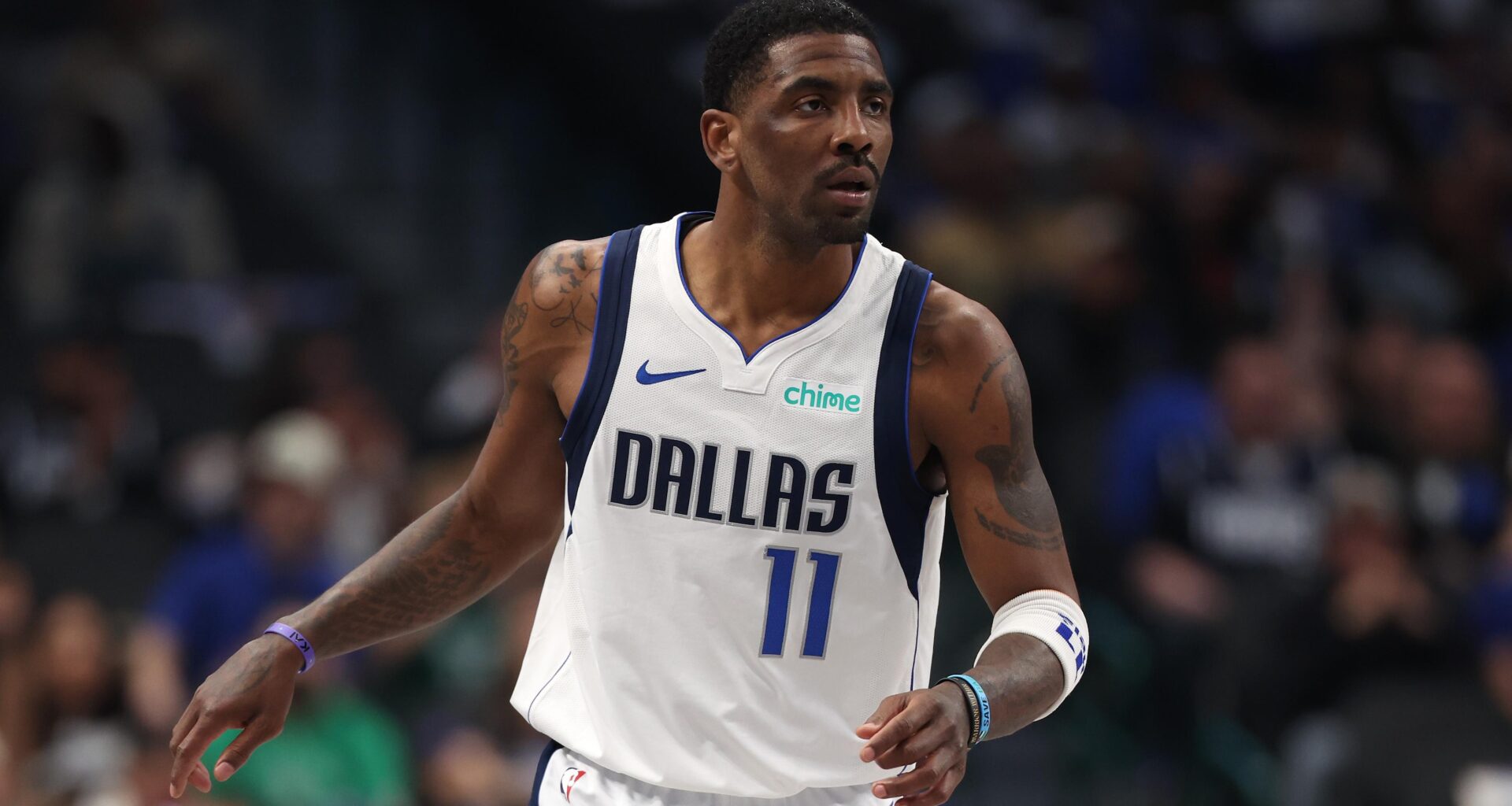
Things haven’t gone as most expected for the Dallas Mavericks since their appearance in the 2024 NBA Finals. Luka Dončić was traded to the Los Angeles Lakers in February, Kyrie Irving tore his ACL in March, and Dallas got off to a sluggish start to the 2025-26 season.
Though Dallas found some promise by acquiring Anthony Davis in the Dončić trade and landing Cooper Flagg at the top of the 2025 draft, general manager Nico Harrison on November 12. Now, it’s up the interim co-managers Michael Finley and Matt Riccardi to find their way out of this mess.
Flagg is a terrific talent who can be the future. However, he has joined a roster that Harrison had constructed to contend right away. Flipping the script and building for next season and beyond will be easier in theory than in practice.
According to ESPN’s Tim Bontemps, many around the league believe that moving Davis and Irving, accumulating draft capital, and hitting the proverbial reset button would be the best course of action.
“Moving on from their two stars by the deadline would allow Dallas to potentially duck the tax, reset its timeline and acquire future picks and players to restock an older roster with youth alongside their rookie sensation,” Bontemps wrote two days after Harrison’s firing.
NBA insider Marc Stein reported last week (h/t Bleacher Report’s Andrew Peters) that the Mavericks “intend to field” offers for Davis but are “not encouraging trade inquiries” for Irving.
For Finley and Riccardi, this is absolutely the right approach, and there are multiple reasons why. The biggest is the presence of Flagg.
The hope in Dallas is that Flagg can become the sort of centerpiece superstar that Dončić was before he was dealt. According to ESPN insider Shams Charania, the Mavericks view Irving as an integral part of Flagg’s development.
Charania said the following on NBA Today (h/t Frank Urbina of HoopsHype):
“The Mavericks value his leadership on the court, off the court, and his fit with Cooper Flagg. Cooper Flagg is going to need a point guard whenever he’s ready to be back out on the court, and you just see right now how much this team misses Kyrie Irving.”
Irving’s ongoing recovery is also part of the equation. He’s unlikely to return until early 2026 at the earliest, and the trade deadline is set for February 5. Dallas won’t have much, if any, time to showcase Irving and maximize his trade value.
An injured Irving isn’t going to bring fair market value.
Trading Davis in the current window would make a lot more sense if the Mavericks are indeed looking ahead. Davis is a top-tier player when healthy, but staying healthy has been an ongoing issue. He’s also a walking reminder of the Dončić trade—one the Mavs and their fans may be happy to send elsewhere.
Now, Dallas can’t expect the sort of return for Davis it might have gotten five years ago.
“He’s a great player, full stop. But when you consider a player at his age with his injury history, you’d also be trading for the stress of that extension,” one general manager told ESPN’s Brian Windhorst. “That plays into it.”
However, the Mavericks should get a strong return for a player who probably doesn’t fit the long-term plan and who will probably be seeking an extension after the season.
Bleacher Report’s Grant Hughes recently proposed a trade that would send Davis to the Chicago Bulls for Nikola Vučević, Coby White, Kevin Huerter, a top-four protected 2028 first-round pick and a 2029 first-round swap. This is just a hypothetical deal, of course, but it’s a reasonable one that showcases how Dallas could benefit by moving Davis.
Irving, meanwhile, would be more beneficial to the Mavs by sticking around for the foreseeable future. While a rebuild is pretty much inevitable at this point, Dallas is wise to make keeping Irving a part of it.