
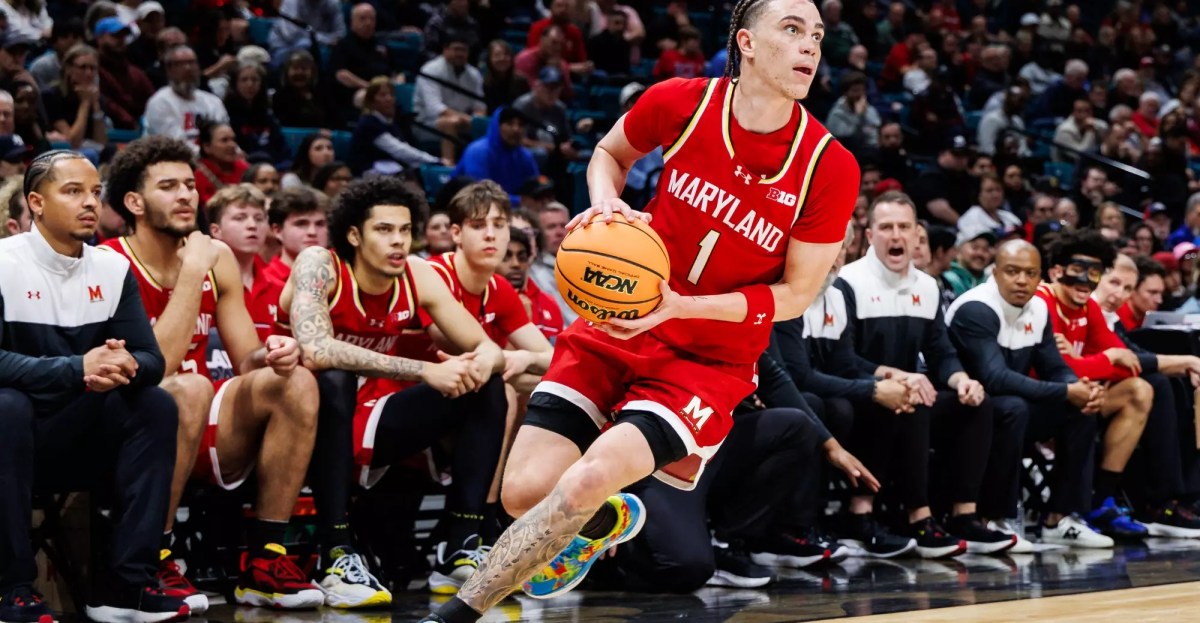
Maryland men’s basketball played its third game in as many days Wednesday, and the matchup it drew didn’t do the team any favors. No. 8 Alabama presented a high-flying, well-coordinated program that looked as though it still had plenty of gas left in the tank after a busy last two days.
The Terps lost handily to the Crimson Tide Wednesday night in Las Vegas, 105-72, wrapping up their Players Era tournament action.
Here are three takeaways from the game.
It didn’t take long for Alabama to demonstrate why it’s a top 10 team in the country. Two quick threes by the Crimson Tide helped it seize a 13-2 lead after just three minutes had elapsed. There’s a tangible difference in pace of play that many elite programs in the nation play with — Alabama demonstrated this Wednesday evening.
It was almost too simple for the Crimson Tide to pick apart Maryland’s defense, which could be most aptly described as disjointed. A combination of half court press and a shifting zone defense didn’t faze Labaron Philon Jr. and company. The ball moved with ease, and it was often the Crimson Tide’s corner 3-point shooters that benefited from the action. The Terps’ defenders were often late to shift, and that weak spot was targeted.
Alabama picked Maryland apart from downtown Wednesday, going 14-of-31 from deep. But its proficiency from beyond the arc only made things tougher on the Terps.
Philon and Aden Holloway, comprising one of the premier backcourts in the country, engineered the offense to perfection. Seemingly all of Alabama’s players had keen, split-second decision making skills. The ball would move its way around the perimeter so quickly that by the time a Maryland defender jumped to contest a pump-faked 3-pointer, the Crimson player had already driven inside, further confusing the Terps’ defensive rotation.
Alabama had a staggering 29 assists Wednesday night — that alone demonstrates its excellent ball movement.
Maryland’s offense looked slow
Maryland’s offense has been spotty this year. It’s up-and-down in terms of success from 3-point range, and Pharrel Payne can only power the Terps so far. And in comparison to Alabama’s high-flying, always-cutting, constantly-screening offense, Maryland was uninspiring.
Maryland went 9-of-27 from 3-point range. Its lack of makes were a combination of rushed shots, lack of true snipers and simply trying to play catch-up all game long. But the Terps don’t have many other options either, especially against truly high-end teams.
Head coach Buzz Williams wants his team to draw shooting fouls, but Maryland only went 7-of-11 from the line Wednesday. The Terps don’t necessarily have the high-end, crafty, athletic roster to get downhill against big-time opponents — most of those shooting fouls came courtesy of Payne around the hoop. Darius Adams did his best to operate in traffic and dribble his way through the heart of Alabama’s defense, but even he got swatted a few times around the rim.
Payne, while clearly Maryland’s best weapon offensively, can slow the team’s game down. He typically requires post feeds to get him in the action, and since he’s not a top-tier passer, the possession sometimes ends there. Alabama recognized this and did its best to work the ball out of Payne’s hands. When Payne did pass out of his low block looks, he easily found open shooters — Aleks Alston was one of the beneficiaries, cashing in on two 3-pointers Wednesday.
Make no mistake, Payne is a force. But in a shootout with Alabama, the Terps just couldn’t keep up with that style of play.
No-shows from a few key players
Diggy Coit, Myles Rice and Isaiah Watts combined for 46 minutes on the court Wednesday, but collectively scored just 10 points.
Coit came off a week in which he had a clutch 41-point outing, albeit against much lesser competition. But after a few early makes to get the Terps started, he had little impact. In fact, the senior guard sat for the first 10 minutes of the second half.
Watts, though still dealing with an injury that has kept a black mask glued to his face, had virtually no impact. He was late in rotation defensively, and like Andre Mills opposite him, often failed to contest the pervasive corner threes Alabama hoisted. Offensively, he offered a nice pump-fake to pull-up midrange bucket — his ability to hit shots from different areas and angles is a valuable skill. But he was largely invisible against the Crimson Tide.
Perhaps most puzzling was Myles Rice’s performance. He didn’t play at all in the second half and didn’t score a point all night. It appeared as though freshman Guillermo Del Pino seized a lot of the junior’s minutes down the stretch, a decision that seemed to work decently for Williams. Rice has been heavily banged up to start the season, but it will become much more of a cause for concern if he doesn’t find his footing soon.
Bottom line: the Terps will need far more than they received from their veteran guards in big games going forward.