
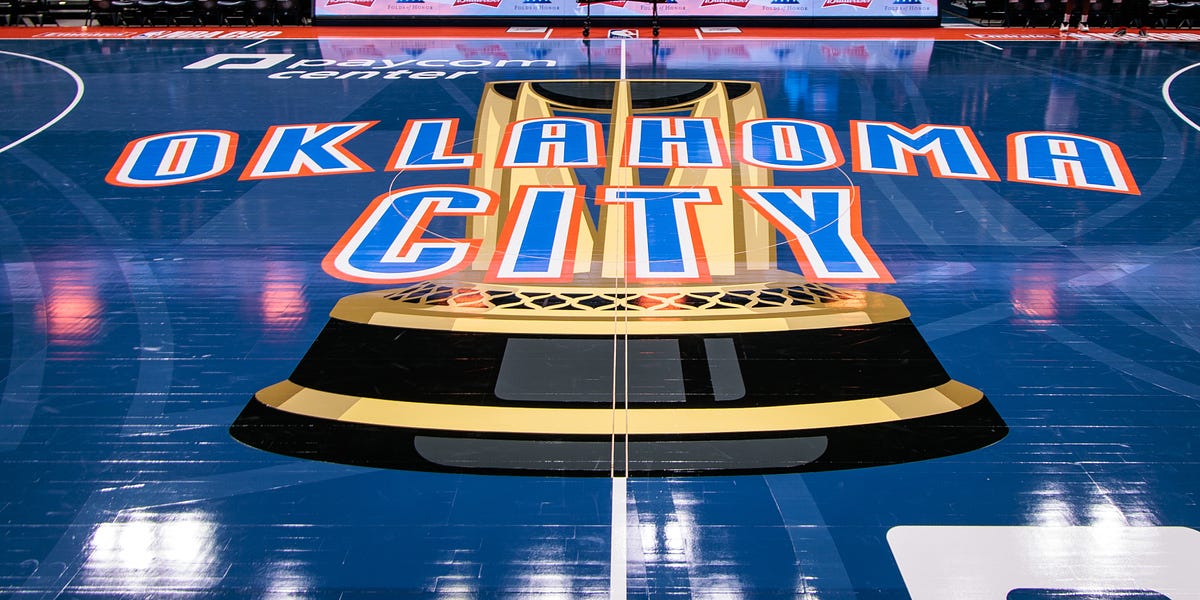
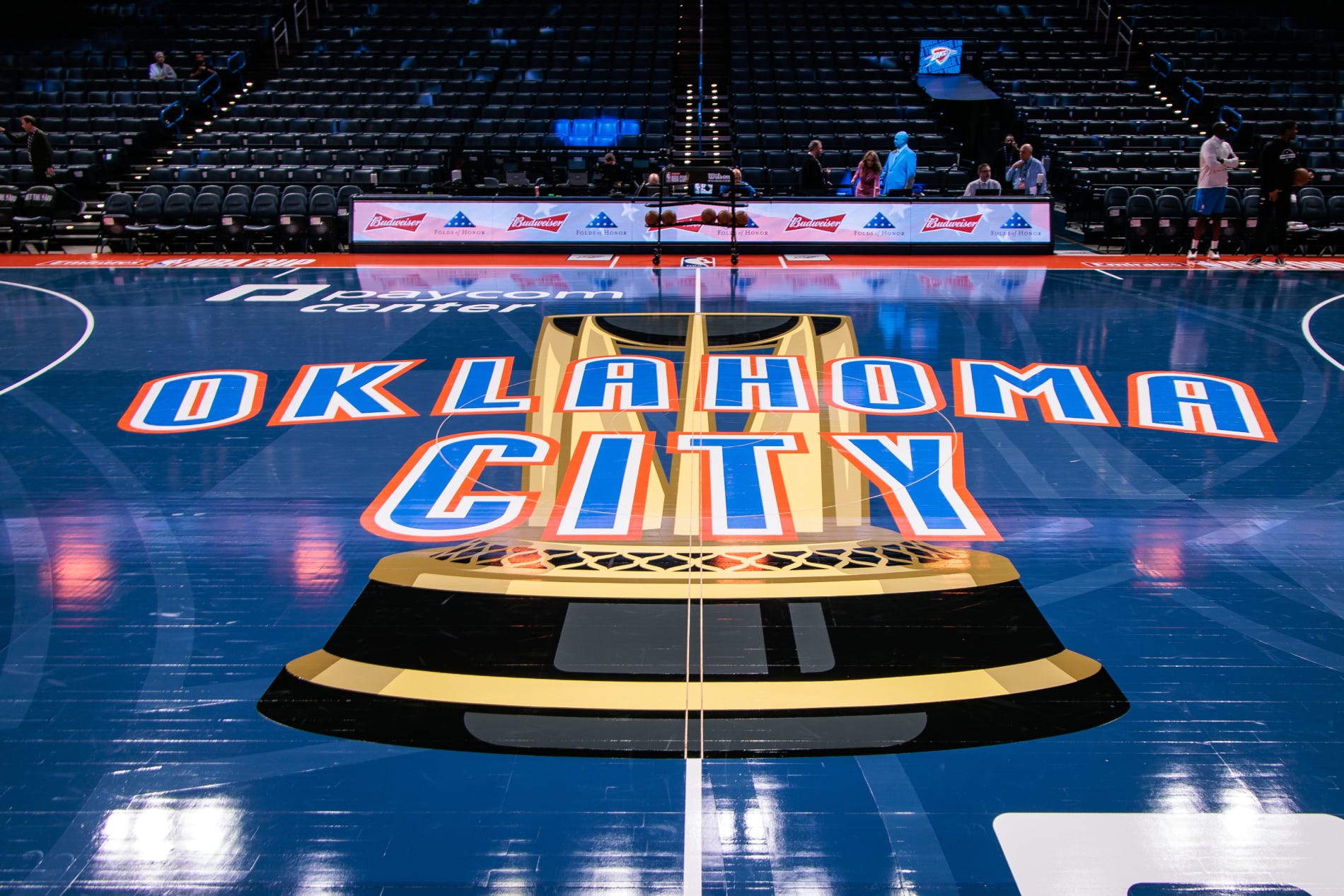
 A general view of the NBA Cup center court logo design prior to the game between the Minnesota Timberwolves and the Oklahoma City Thunder at Paycom Center on November 26, 2025. (William Purnell/Getty Images)
As the NBA Cup’s group stage wraps up tonight, we’ll finally know who makes the knockout-round bracket and what the seeds will be for the third annual edition of the league’s in-season tournament. What we still won’t know, however, is how much to truly Respect The Cup — though the way we see it might change this season.
It’s been a somewhat tongue-in-cheek, somewhat serious matter as to whether players, teams and hoops-watchers are “respecting the Cup” since it debuted a few years ago. On the one hand, it’s still a totally contrived event-within-an-event with silly courts and a made-up trophy. On the other hand, it’s nice to win if you’re going to take the trouble to play basketball games, and the league certainly wants to make this a thing. As such, teams who Respect the Cup — like the Orlando Magic and OKC Thunder — should get credit over teams — like the Sixers — who clearly don’t.
But where does the NBA Cup fit in between the normal regular season and playoffs? It occurred to me that one way to measure this is simply to use my dual-track Elo ratings — which keep running “playoff” and “regular-season” ratings in parallel for every team, to be deployed based on what game type is being played — to see whether the regular-season ratings (used for regular season games) or playoff ratings (to be used in playoff games only) are more accurate in NBA Cup games. If the games are being treated more like the playoffs, in theory those ratings would gain on the regular season ratings in predictive accuracy.
The bad news for Cup-respecters is that these are still more like regular season games than playoff games, in terms of which rating type best predicts them. In the tournament’s history, using regular-season Elo instead of playoff Elo would improve NBA Cup predictive accuracy by 3.5 percent, which is actually slightly more than the figure for all other regular season games (3.1 percent).
However, that was mainly only true in the first year of the event, 2023-24. In both 2024-25 and 2025-26 so far, the accuracy improvement by using regular-season instead of playoff Elo ratings is lower in NBA Cup games than in other run-of-the-mill regular season games.
This implies that teams may be treating the NBA Cup more like the playoffs than ordinary regular season games, even if the playoff ratings are still not the best predictor of Cup games by any means.
Furthermore, the identity of this year’s winner may add extra validation that has been somewhat lacking in the past.
The runaway Cup favorite right now in my NBA forecast model is the Oklahoma City Thunder, at 41.2 percent to win the tournament title. (Coming in at a very distant second are the L.A. Lakers at just 9.4 percent.) That’s already a huge number for the favorite of a single-elimination knockout tournament, though it is perhaps a testament to how dominant OKC has been to start the season in general.
But as I pointed out here, it is an incredible cosmic coincidence that the Thunder’s model odds to win the NBA title proper — for the second straight season — are also exactly 41.2 percent! And their lead over the No. 2 Denver Nuggets (9.8 percent) in that regard is roughly the same as their edge in the NBA Cup odds. For the Thunder, at the very least, the Cup (which we’re not sure matters) is a microcosm of the entire season (which very much matters) writ large.
And if the Thunder do win, it would represent a different kind of NBA Cup champion than we’ve seen so far. The first two editions of the tournament were won by veteran teams — the 2024 Lakers and 2025 Milwaukee Bucks who had underperformed in previous seasons (or otherwise had question marks going forward), and were hoping to use the NBA Cup as a way to validate their NBA title aspirations by showing off their ceiling when things clicked right:
Of course, neither ended up rediscovering that form later on, as both teams exited the playoffs in the first round — and the losses weren’t even all that surprising. (Both teams lost to higher-seeded playoff opponents.) To this point, we’ve actually tended to see being the NBA Cup loser as more of a real springboard looking ahead to the playoffs; Indiana made the Eastern Conference Finals following their 2024 NBA Cup title-game loss — then went to the NBA Finals last year — and the Thunder, of all teams, went on to win the NBA title after falling to Milwaukee last year.
This year’s Thunder would be the first reigning champion to win the NBA Cup, and they could also pull off what might be a rare double in winning the NBA Cup and the NBA title in the same season. This would echo the European soccer concept of the Double, in which a team wins both its main league and its biggest domestic cup in the same season. In England, this was done by Manchester City in 2018-19 and again in 2022-23, but the only other times it happened this century were Chelsea in 2009-10 and Arsenal in 2001-02 (and it’s only happened 13 times overall in nearly 140 years of being possible).
The 140th NBA Cup won’t be until 2163, so we’ll all be long dead once the list of future “double” winners gets really populated. But OKC being the first would lend a new level of credibility to the in-season tournament, both now and in the future. It still won’t ever be on the same level as the NBA playoffs proper — nor should it be — but with each real powerhouse victor who wins it, “Respecting the Cup” might finally stop being a joke and start becoming an obligation for fans and players alike.
Filed under: NBA