
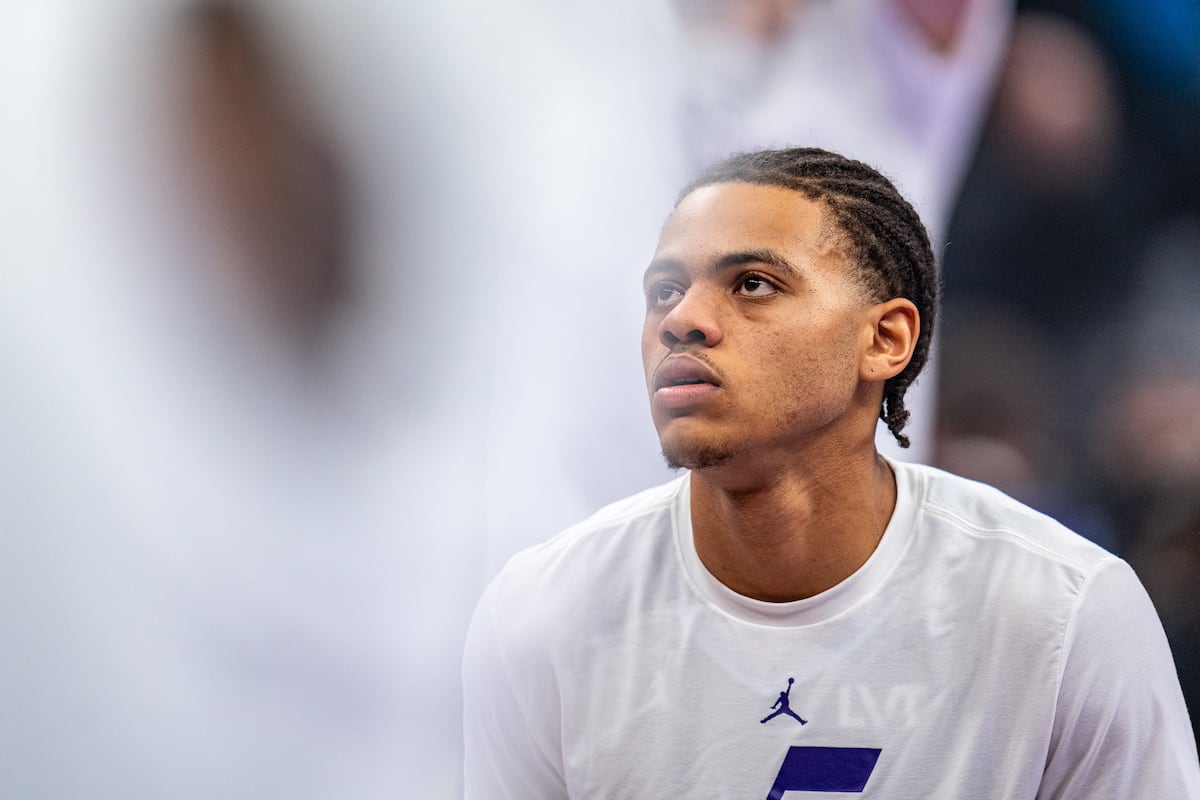
There has been a night-and-day difference in Keyonte George’s game this year.
After a 2024-25 season in which he found himself pushed to the bench because of inconsistent play at the point guard position, George has started the 2025-26 season looking like a completely new player.
All of a sudden, he’s a linchpin of the Jazz’s offense — scoring 23 points and dishing seven assists per game, joining just six other NBA players with those stats. He’s also visually much more competitive on the defensive end of the floor, earning his teammates’ trust.
Looking at George’s statistical profile, there are at least a half-dozen ways he’s improved his game this season compared to last. I figured I’d ask him directly about those elements, and what offseason work or what change in approach it took to improve them. Quotes have been lightly edited for clarity.
Finishing inside the arc
(Bethany Baker | The Salt Lake Tribune) Utah Jazz guard Keyonte George (3) goes for a lay up during the game between the Utah Jazz and the Minnesota Timberwolves at Delta Center in Salt Lake City on Monday, Nov. 10, 2025.
The numbers: George has taken far more of his shots inside the arc than last season. Last year, he shot 45% of his shots from 2-point range, and this year, he’s taking 60% of them from there. He’s also making a far higher percentage, 53% compared to 44% last season.
What Keyonte says:
“I think there’s a lot of things that go into it. Obviously, the strength aspect of it, just working on it in the gym. But then there’s live reps, and I think I’m attacking the rim at the right moments. You know, I see their five drop back, most of the time I’m going to get to the rim. It also helps when (Jusuf Nurkic) screens and Walker (Kessler) screens, and they’re rolling hard, and most of the time fives really don’t want their man to score. So if I got my man on my back more often than not, I can get to the rim.”
3-point shooting
(Francisco Kjolseth | The Salt Lake Tribune) Utah Jazz forward/center Kevin Love (42) talks with teammate Utah Jazz guard Keyonte George (3) during an NBA basketball preseason game against in Salt Lake City on Monday, Oct. 13, 2025.
The numbers: The overall numbers aren’t up, but George has been a much better open shooter (defined as when a defender is at least six feet away) and catch-and-shoot shooter this season. Last year, he made 32% of his wide-open threes, this year, he’s at 42%.
What Keyonte says:
“I’m being early with my feet, trying to hold my follow through every time I shoot it. Will (Hardy) tells me a lot about not taking shots for granted. He references Kyrie, for example, whenever he gets a wide open one, he feels like he always has the right base, the elbow under the ball, holding his follow through. Even if he misses it, you can just tell he didn’t take that rep for granted.
When I’m out on the (practice) floor or coming back at night, it’s not, ‘I got to make 10 in each spot.’ It’s maybe make three in a row. Me and my player development coach, Chris Jones, we talk about making three game reps, whether it’s contested or a guy short closes on me. My work now is more game reps than me just coming in and feeling like I’ve got to make 10 shots in the corner, 10 shots in the wing. Because I feel like, when you do that, you just get into a rhythm and then obviously it’s easy to shoot wide open shots. So I just been trying to have a contest a little bit more, just trying to get myself different looks while I’m shooting game-rep catch and shoots.”
Isolation offense
The numbers: The play-by-play tracking numbers are clear: George is a more efficient isolation scorer than last year. In 2024-25, he put up 0.81 points per possession on those plays; now he’s an above-league-average 1.00 points per possession.
What Keyonte says:
“It’s being stronger, knowing who’s guarding me, and then knowing what my advantage is against guys. And I feel like in iso situations, I’ve still got a long way to go. Sometimes I feel like I settle too much. You know, you watch a lot of these All-Star guards, they have a fine balance. They can run off 15 (points), and then all of a sudden, they might get to the paint and then make a pass to somebody the other team might not think they’re throwing it to. So I just think in those situations, understanding the balance of, if I feel like I’m hot, okay, I can get to some of the shots that I want to.
But I think also this year, I understand I’ve got something to play off of now. Whether it’s my punch dribble or the size-up between the legs. I also have a saying: win the foot war. I feel like my speed is my advantage, so I’m attacking the feet more. To talk about a clip, we just played the Lakers, I had the iso on LeBron. I kind of hit him with the ‘tween, had his back foot drop back, then kind of hit him again, and his foot dropped back again. That’s kind of what I mean when I say winning the foot war. So just trying to make, just try to create mini-advantages for myself in isos is really helping me.”
Getting to the free-throw line
The numbers: George is shooting 2.4 times more free throws per 36 minutes on the court this season, about a 10% higher free-throw rate. He’s also making a higher percentage of them, now shooting over 90% for the season.
What Keyonte says:
“I’m looking for fouls way less. Will tells me all the time: Play in a straight line, play in a straight line. Not looking for the foul, it seems like you get more fouls.
I watched (the NBA’s point of emphasis video), watched with the team, and I watched it by myself, just really trying to see what the point of emphasis was going to be on the straight line drive. I think when you play like that, it’s kind of easier for them to make that call, seeing that you’re actually going to try to score, instead of trying to manipulate them to call the foul.”
Pick-and-roll ball handling
(Trent Nelson | The Salt Lake Tribune) Utah Jazz guard Keyonte George (3) as the Utah Jazz host the LA Clippers, NBA basketball in Salt Lake City on Wednesday, Oct. 22, 2025.
The numbers: George’s pick-and-roll efficiency is up this year, from 0.83 points per possession to 0.92 points per possession. The biggest difference is turnovers: Last year, he turned the ball over in 17% of those plays. … This year, it’s only 9%.
What Keyonte says:
“Will, we watched the film of some stuff last year and some stuff this year about coming off pick and roll in that elbow area. He described it as like a quarterback in the pocket. There’s a lot of stuff going around. Guys are blocking at the O-line, but that little pocket of space you’ve got, you got to be able to feel comfortable. So when Nurk screens, or when Walker was screening, I was holding that elbow a little bit with my dribble, especially with the bigs that we have, they’re cleaning up the guard. So I really ain’t got to worry about the guard coming behind me. And then at that point, the backside guy just has to make a read. Is he gonna tag and I throw the lob to Walker or the pocket to Nurk? And if the five drops back, I’m going to shoot a layup, or just read that fill behind guy.
I’m starting to really realize that the reads are the same over and over and over again every single night. Like, every team kind of plays the same base defense. Obviously, there’s some minor changes. But I think for me, I watch so much League Pass basketball that I’m starting to pick up on, teams schematically, how they play in defense. And then I think now, if teams change defense, I’m able to adjust on the fly a little bit more. That comes with the constant dialogue with Will, Chris Jones and honestly, all the assistant coaches.
I’m constantly asking questions. Like, maybe I did turn the ball over on one team, like, okay, what you see right here? Playing Golden State, I’m asking Scott (Morrison), okay, so with Lauri in the high quad, they’re not gonna tag from the nail like they usually do, because he’s the best shooter on our team, so now I know I can get into the pocket, or maybe get to my pull up. So, like I said, playing the game within the game, it’s been helping me a lot.”
Relationship with Lauri Markkanen
The numbers: At times last season, it looked like George and Jazz star Lauri Markkanen were playing separate games. Markkanen only assisted George nine times all of last season; that number is already 10 this season, less than a quarter of the way through the year. But most playmaking goes the other direction from guard to big: George set up Markkanen for 2.0 shots per game last year. This year? 6.8 shots per game, over three times as often.
What Keyonte says:
“Yeah, me and Lauri had a long, long, like three-hour conversation at his house right before camp. We just laid it all on the floor: some of his individual goals, some of my individual goals. As far as the team: What is our goal? What would a good season, you know, look like for us? And obviously, we know there’s no expectations on our team, but I think just us talking that out was good. We constantly go to dinner on the road, we’re constantly having dialogue. Walking off the court, going on to the court, timeouts, we’re always talking to each other.
Obviously, being with him for three years now, I understand his game a little bit more, and know some of the actions, know what side of the floor he wants the ball on. I know, like, for example, even though a man might be in front of him, I know I can kick the ball up the floor if he’s right in front of me, knowing that he’s got two directions to drive. So I’ve just honestly been giving him the ball in space and kind of letting him just be him. And then the catch-and-shoots, like you already know, he’s gonna let it rise. So if I can just give him the ball in space and throw it on time, on target, he’s able to get it off faster.
I’ve got a whole ‘nother level to get to, but I’m obviously happy with my progress, not just with myself, but with the team. The results haven’t been where we want them to be, but we’re starting to realize the game within the game, and that’s when we’ll be able to get over the hump, whenever we continue to figure that out and play well.”