
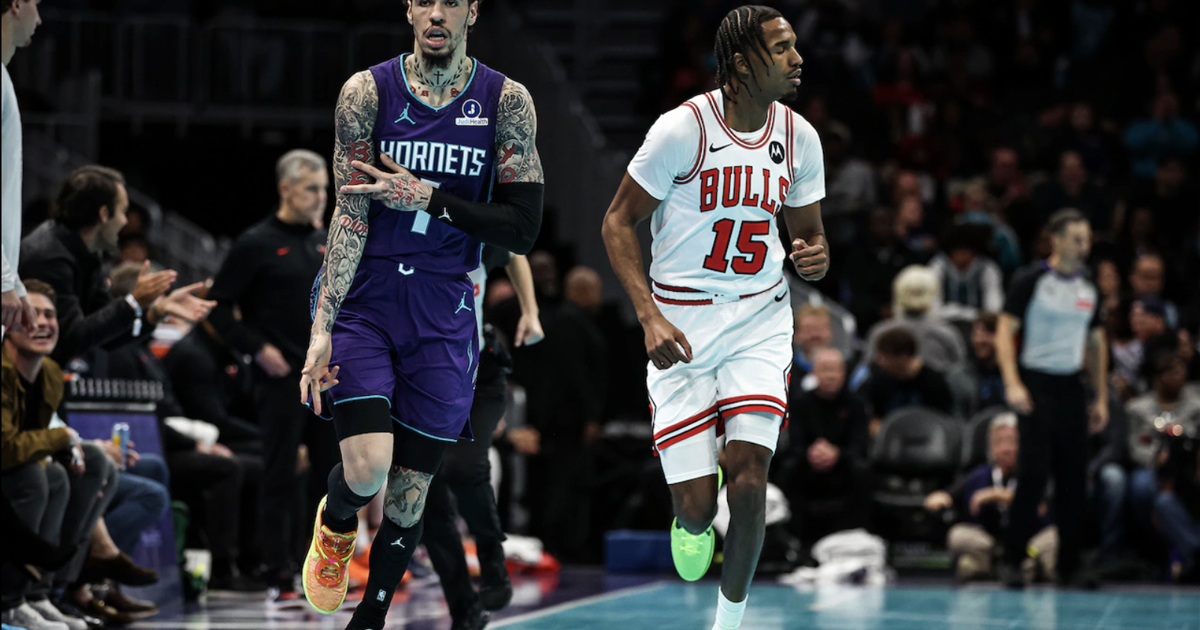
What has felt like a precious delicacy in recent Charlotte Hornets seasons finally happened this week: the team is healthy. Charlotte’s 6–14 record entering December suggests a bad basketball team, but with a full deck of players, the Hornets just aren’t one.
For years, fans have struggled to understand this team simply because it has been impossible to evaluate. The lineup the front office built rarely exists on the floor. There is always a key gap—whether it is a missing creator, a missing scorer or a missing big—and the version of the Hornets that plays never resembles the one that was planned.
This week, the front office and the fan base finally saw the lineup as it was supposed to be, and the results were encouraging.
Charlotte clearly has offensive talent, enough to keep itself in most games, but the real winning swings come from how the Hornets move the ball, stay relentless on the glass and defend both the ball and in transition. When they commit to those things, they look like a legitimate problem for opponents night to night.
Nothing but Knicks
Charlotte rolled out its opening-night starting lineup for only the third time this season, and the group looked overwhelmed on both ends against one of the best teams in their conference.
The Hornets were slow to match the New York Knicks’ physicality, struggled to contain dribble penetration and repeatedly conceded clean looks at the rim.
Down 37–31 after the opening 12 minutes, Charlotte unraveled in the second quarter, getting outscored 35–16 and heading into halftime buried in a 25-point deficit. New York stacked run after run late in the period, closing on a 20–5 surge that removed any suspense from the night.
Charlotte chipped away in stretches after the break, but the gap never truly closed, and the result was never in question.
Almost no one played particularly well for the Hornets in this one. It was a total team no-show, and it falls on Head Coach Charles Lee and his staff to have the group ready to compete. They simply were not. It was a seventh straight loss and the poorest performance of the season for Charlotte.
Buzz beats Bulls
Charlotte finally earned its first clutch-time win of the season, outlasting the Chicago Bulls 123–116 and ending its losing drought. After an entire month of close losses, the Hornets stayed composed when the game tightened and finished the job.
Forward Brandon Miller was the standout and the best player on the floor for either team. In just his fifth game of the season, he showed exactly why Charlotte has missed him so badly. He is a much-needed point of attack defender who was not perfect in this one, but gives the Hornets a real body to handle opposing top scorers.
Offensively, he thrives off the ball next to guard Collin Sexton and star guard LaMelo Ball, and can still initiate when called upon. Charlotte ran him through zoom actions, double-drag sets and short-roll touches, and he was a real dilemma for Chicago’s defense.
After giving up nine fast-break points and losing the third quarter 32–26, Charlotte responded with a 20–6 surge to open the fourth and pushed the margin to 113–100. Chicago answered with a 10–1 run to trim it down, but a turnaround from forward Miles Bridges along with a pair of free throws and an excellent block by center Ryan Kalkbrenner closed it out.
Charlotte’s late comeback stuns Toronto
Down 12 with under six minutes left in the last game of the week against the Toronto Raptors, Charlotte finally played its best basketball when it mattered most. A defensive-leaning lineup raised the urgency, and the Hornets mounted a late push led by Bridges, Kon Knueppel and Sexton.
Knueppel hit an extraordinary no-hesitation corner three to tie it at 104 at the end of regulation. In overtime, Bridges took control, attacking every mismatch and forcing rotations. He finished with a season high 35 points on 13 for 23 shooting, including 16 in the fourth quarter and overtime, and carried the Hornets in a way few players on this roster can.

Forward Miles Bridges drives to the basket in the Nov. 29 matchup against the Toronto Raptors.
Courtesy of the NBA
It marked the Hornets’ first overtime victory in more than a year and their second consecutive clutch-time win.
It cannot be overstated how terrific Sexton was in this one. He closed the game, picked up full court on defense for most of his minutes, disrupted ball handlers and still had the energy to organize the offense.
His hand-eye coordination, constant rim pressure and competitive spirit, which Lee often praises, are invaluable to this group.
The league leader in fast break scoring, Toronto logged seven in the first quarter before Charlotte finally shut down the transition lanes. Across the final three quarters and overtime, the Raptors managed only six fast break points on one for eight shooting. That defensive turnaround was the key to a Hornets win in this one.
The good
Bridges balling: It is easy for critics to point to Bridges as the face of why Charlotte is viewed as a non-serious organization. The off court situations during his time with the Hornets, the stretches of overly casual play and the perception that his scoring is empty calories that does not translate to winning basketball have shaped that narrative.
Some of those criticisms are fair, but Bridges has been very impressive so far this season for Charlotte.
He was the Hornets’ most consistent player last season, and he has opened this year with a level of maturity and leadership that stands out. On the youngest roster in the NBA, and as the longest tenured player in the locker room, Bridges has carried an immense responsibility when Miller and Ball have been out, keeping Charlotte in games it had no business competing in.
He has embraced the job of being the steady hand. His defense has been better, he has helped make Charlotte one of the best rebounding teams in the NBA, he is constantly asked to guard the best wings on the floor and he leads the team in minutes.
It is easy to say what Bridges is not, but what cannot be argued is that he is always available and has given everything he has to this team so far.
Offense trending up: When looking at Charlotte’s offensive metrics league-wide, the Hornets sit around league average in nearly every category except turnovers, where they currently rank in the bottom 10.
Charlotte’s assist percentage has climbed steadily over the past week and now sits at No. 12 in the NBA, a notable jump as the roster has finally been intact.
If the sample size of a healthy Hornets group continues to grow, expect that ranking to rise even further. And with Ball, Miller and Knueppel all available, the expectation should be a general boost across every offensive statistic.
The not-so-good
Lacking LaMelo lift: Before Charlotte’s two recent wins, where he did not shoot well either, Ball’s shooting numbers were brutal. In his first five games after returning from injury, he averaged 16.6 points, 5.0 rebounds and 7.6 assists, but shot just 32.5% from the field and 21% from three. A player with Ball’s talent and salary simply has to be better.
The encouraging part is that his process has improved in the victories. Ball has leaned on his teammates, made the right reads for most of his minutes and has not forced the offense to run exclusively through him.
Star guard LaMelo Ball drives in a previous matchup.
Emmanuel Perkins/Niner Times
That has to be the blueprint. Ball does not need to be a hero scorer every night like in past seasons, but he does have to shoot the ball better, and he will if he continues to trust the right play and allow teammates to create advantageous looks for him.
Up next
The Hornets will head to Brooklyn to begin a three-game road trip against the Nets on Dec. 1 at Barclays Center.