
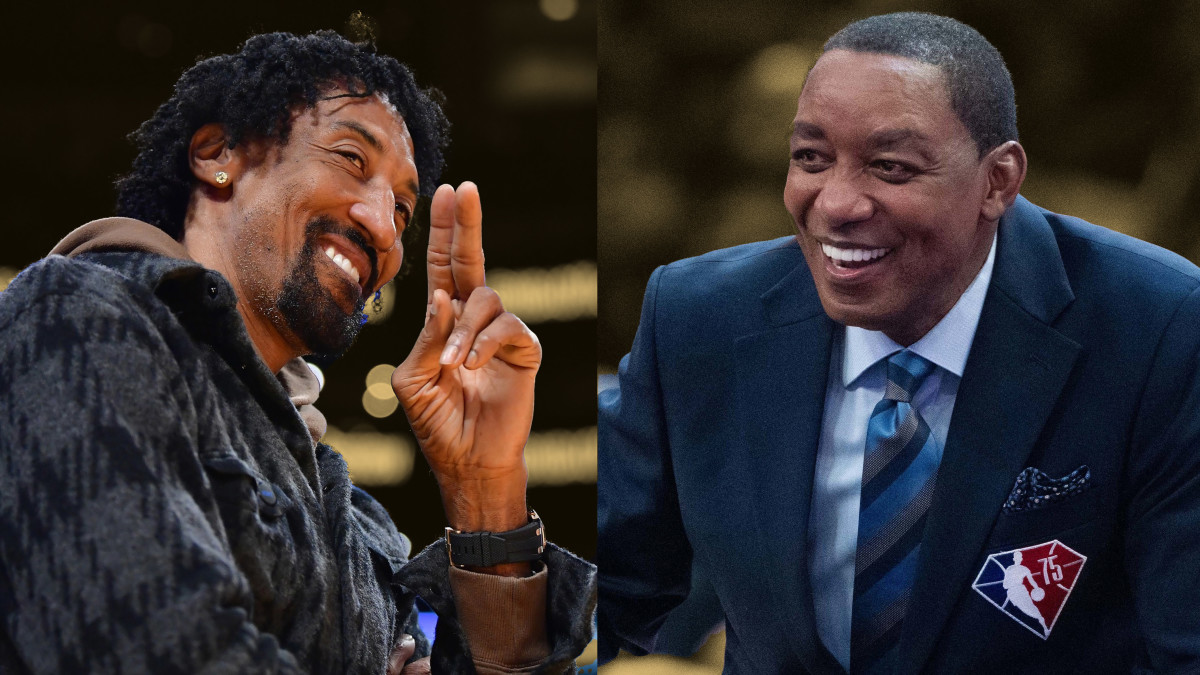
For some, there was nothing to like about the late 1980s Detroit Pistons.
By the time they were clawing their way to back-to-back NBA championships in 1989 and 1990, they had already cemented a reputation that was less admired and more endured.
Advertisement
The air around their leader — Isiah Thomas — turned admiration into animosity across locker rooms in the league. He is widely recognized as one of the best point guards in history. Yet somehow, he stood at the center of a long-standing cold war with several of the biggest stars of that era.
Pippen’s dislike of Thomas
His talent was undeniable. But for a player so gifted, so clutch, so central to one of the fiercest teams of the era, the wall of dislike from other legends that surrounded him has never truly come down.
One of those was Scottie Pippen.
“I grew up that if I don’t have nothing good to say, I don’t say nothing,” Pippen said. “Nothing good is gonna come out of you asking that … I don’t respect him, so I don’t have anything good to say about this guy.”
Advertisement
Pippen’s discontent with Thomas had simmered since their playing days — most notably during the heated Chicago-Detroit rivalry that defined Eastern Conference basketball in the late ’80s and early ’90s.
Chicago was repeatedly bullied out of the playoffs by Detroit until 1991, when the Bulls finally broke through with a sweep in the Eastern Conference finals.
It was during that series that the Pistons, led by Thomas, famously walked off the court without shaking hands, a gesture that only deepened the grudge. For players like Pippen, that moment was an unsportsmanlike conduct, a lack of grace, a refusal to acknowledge being outplayed. Pippen lost any form of respect he had towards Thomas.
Thomas, as the face of that Pistons team, became the embodiment of the cold shoulder. Even when the league moved forward, the bitterness remained frozen in place.
Advertisement
Pippen’s teammate, Michael Jordan, and his dislike of Thomas is well documented — so much so that many believed his influence kept Thomas off the 1992 Olympic Dream Team.
Holding grudge
Charles Oakley, one of the most respected enforcers of the ’90s, was known for his physical dominance and willingness to protect teammates at all costs. He stood as a moral compass in locker rooms across the league. To him, Thomas was not the best of guys to have close.
“He’s a great point guard, and I think he should have been on the Dream Team and all that,” Oakley said. “But there’s just something about him, I can’t trust him.”
Advertisement
That statement cuts to the core of the Thomas dilemma. Trust. For all his accolades and court brilliance, Thomas perhaps never truly earned the trust of some of his peers. He scored over 18,000 career points and led his franchise through its golden era. But that never translated into warmth from fellow stars.
The exclusion from the Dream Team brought that to light. That roster — Pippen, Jordan, Magic Johnson, Larry Bird, Charles Barkley, Patrick Ewing, Karl Malone, John Stockton — was more than a collection of stars. It was a brotherhood. And though Thomas statistically deserved a spot, the chemistry committee seemed unanimous in their silent veto.
Thomas was often described as too calculating, too political in the way he navigated the NBA world. He had public fallouts not just with Jordan and Pippen, but with Johnson as well — who remains a very close friend to the Pistons legend.