
Yes, the calendar has only just flipped to December. But in Nets World, it’s never too early to talk about the NBA draft!
After Brooklyn made history last June by becoming the first team ever to select five rookies in the first round, fans have already turned their attention back to Tankathon and the top prospects in the 2026 class.
As the pre-draft scouting cycle ramps up, we’ll be diving into everything each week here in “The Long Forecast” on NetsDaily, including the biggest risers and fallers, a full breakdown of one blue-chip prospect, a sleeper section highlighting under-the-radar names who could fit Brooklyn’s timeline, links to the latest mock drafts and a weekly watch guide with the exact matchups, tipoff times, and players Nets fans should be locked in on for the upcoming slate of games.
Now let’s get into it, shall we?
To open his first season at the University of Houston, Flemings has put up numbers that are video game-esque.
Through eight games, the Texas native is averaging 15.3 points, 3.6 rebounds, 5.0 assists, and 1.3 steals in 30.6 minutes per game. He’s shooting a blistering 60.8% from the field and an eye-popping 52.4% from three, the kind of efficiency you usually only see when someone forgets to raise the difficulty slider in NBA 2K.
He’s a smooth mover with a natural knack for getting to the rim, but what makes Flemings pop on film is how effortlessly he sets up everyone around him. At 6’4” and 190 pounds, he’s explosive and shifty enough to blow by defenders, yet he plays with a controlled pace that makes him look very poised in a collegiate-level offense.
While he was projected at No. 19 overall by the Miami Heat in Jeremy Woo’s latest mock draft for ESPN, if he continues to play at this rate, coupled with the fact that he is set to turn only 19 years old in January, he could certainly make his way into lottery consideration.
Sarr’s early numbers don’t tell the full story of his freshman impact at Duke.
Through eight games, his stat line isn’t striking: 7.5 points, 4.1 rebounds, and one assist in 20.9 minutes off the bench, shooting 44.4% from the field and 35.7% from three. But those numbers barely reflect the defensive impact and upside he has brought to Jon Scheyer’s rotation.
Sarr’s blend of shot creation and stingy defense, paired with the fact that he’s only 19, makes him one of the most intriguing high-upside three-and-D wings in this draft class.
Sarr’s offense is still a work in progress, but that part of his game can be developed at the NBA level. What makes him so appealing now is his defense, which is NBA-ready, and that tends to push prospects up draft boards. He profiles similarly to Illinois’ Carter Bryant, who went No. 14 to the San Antonio Spurs in June’s draft.
Yessoufou, a 6’5” wing, has struggled to find his footing early this season, especially when it comes to scoring with any real ease or efficiency.
Entering his first year at Baylor, he was billed as a big-bodied, downhill wing who could overwhelm defenders at the rim. The tools are still there, such as his burst and open-court speed, but translating that athleticism into consistent production remains his next step.
Over six games at Baylor, he has averaged 15.5 points on 40.7% shooting from the field, while knocking down 27.3% of his 3-pointers, alongside 6.0 rebounds, one assist, and two steals throughout 30 minutes.
It is easy to become enamored with Yessoufou’s upside, and there is certainly time to turn his slow start around, similar to what V.J. Edgecombe accomplished last season. Still, the early returns of his freshman campaign are not very promising.
While Thomas, another 6’5” shooter, has flashed plenty of upside to open the season, he’ll need to tighten his shot selection and boost his overall efficiency to build a convincing lottery resume.
His decision-making and passing have trended in the right direction, but the early portion of his freshman campaign has been anything but spotless for the Pittsburgh native.
Through seven games, including just two starts, Thomas is averaging 17.6 points on 41.6% shooting and 34.5% from three, along with 4.6 rebounds, 3.9 assists, and 1.6 steals.
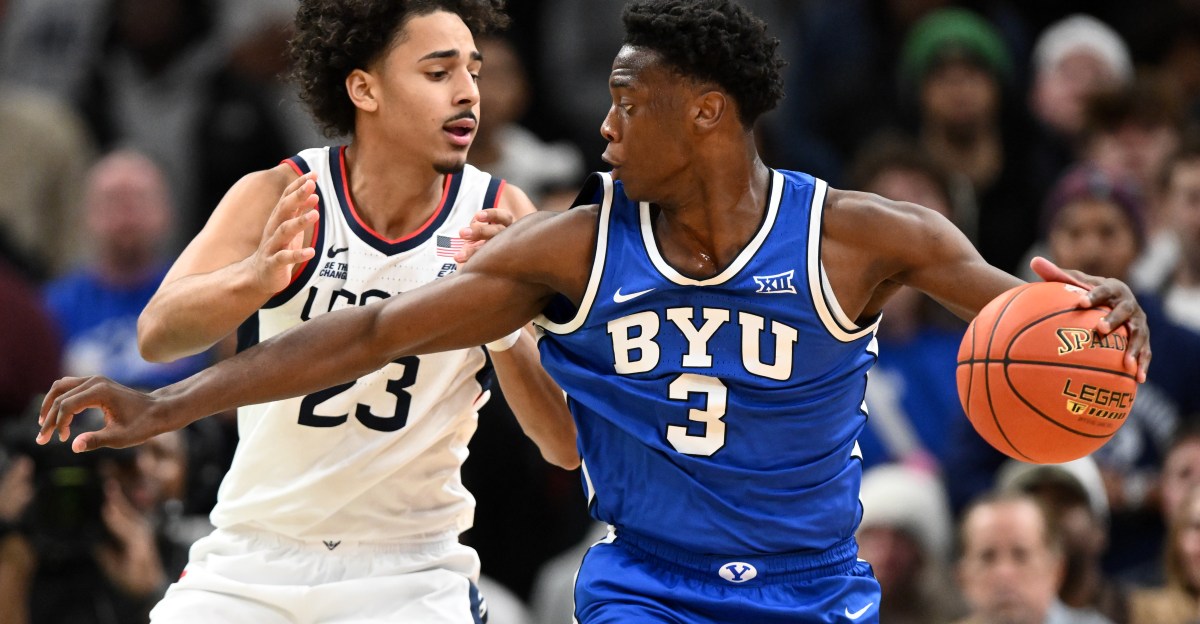
Dybantsa has wasted no time establishing himself as one of the most impactful freshmen in the country. Through the opening stretch of his first season at BYU, the 6’9” wing is averaging 19.0 points, 6.4 rebounds, and 2.3 assists in 30.7 minutes, shooting an efficient 52.3% from the field and 37.5% from three.
Those numbers alone put him in rare company for a first-year player, but the way he produces them is what jumps off the page.
Dybantsa scores from every level, which makes him so valuable. He has powerful downhill drives, smooth mid-range pull-ups, and accurate spot-up threes. The 18-year-old has already become a mismatch almost every trip down the floor at the NCAA level.
The bottom line: Dybansta has looked every part of a generational talent, and if he continues to play at this rate, he could go No. 1 overall in June.
Standing 6’5” and 200 pounds, Saunders has steadily grown his game throughout his BYU career.
After earning the Big 12’s Most Improved Player award last season and securing first-team All–Big 12 honors, he’s taken another leap this year. Playing alongside star prospect AJ Dybantsa, Saunders is off to a terrific start.
Through seven games, the Utah native is averaging 20.1 points on 51.1% shooting from the field, while also knocking down 43.1% of his attempts from three-point range, along with 5.7 rebounds, 2.3 assists, and two steals in 32 minutes per game.
He’s known for relentless work habits, leadership, and consistently representing BYU’s program the right way both on and off the floor, while also possessing an extremely high basketball IQ.
One of the main reasons he hasn’t appeared on many draft boards is his age; Saunders is already 24, a noticeable contrast to the 18 and 19-year-old headliners who typically dominate early draft conversations.
Even so, if he continues at this pace, he could absolutely play his way into second-round consideration for Brooklyn. He fits the Nets’ pattern of targeting high-character prospects, and his production makes him hard to ignore.
DeVries is the kind of prospect who slips past the usual draft talk but always seems to win over scouts as it pertains to a second-round pick. The 6’7”-foot-7 Indiana wing is having his most complete season yet, averaging 17.9 points, 5.4 rebounds, and 3.4 assists while hitting 44.1% from three.
He’s not an explosive athlete, but he is a very wise decision-maker. DeVries can shoot off movement while also guarding multiple positions on defense.
For Brooklyn, he’s the definition of second-round value: a big wing who can really shoot, won’t force bad shots, and understands team basketball.
This week’s watch guide
Here is a list of games fans should tune in to this week.
Tennessee vs. Syracuse: December 2, 7 p.m. tip-off. Look out for Tennessee’s Nate Ament.UNC vs. Kentucky: December 2, 9:30 p.m. EST tip-off. Look out for UNC’s Caleb Wilson.BYU vs. CA Baptist: December 3, 9 p.m. EST tip-off. Look out for BYU’s AJ Dybantsa and Richie SaundersIndiana vs. Louisville: December 6, 2:30 p.m. EST tip-off. Look out for Indiana’s Tucker DeVries.Auburn vs. Arizona: December 6, 10:30 p.m. EST tip-off. Look out for Arizona’s Koa Peat.