
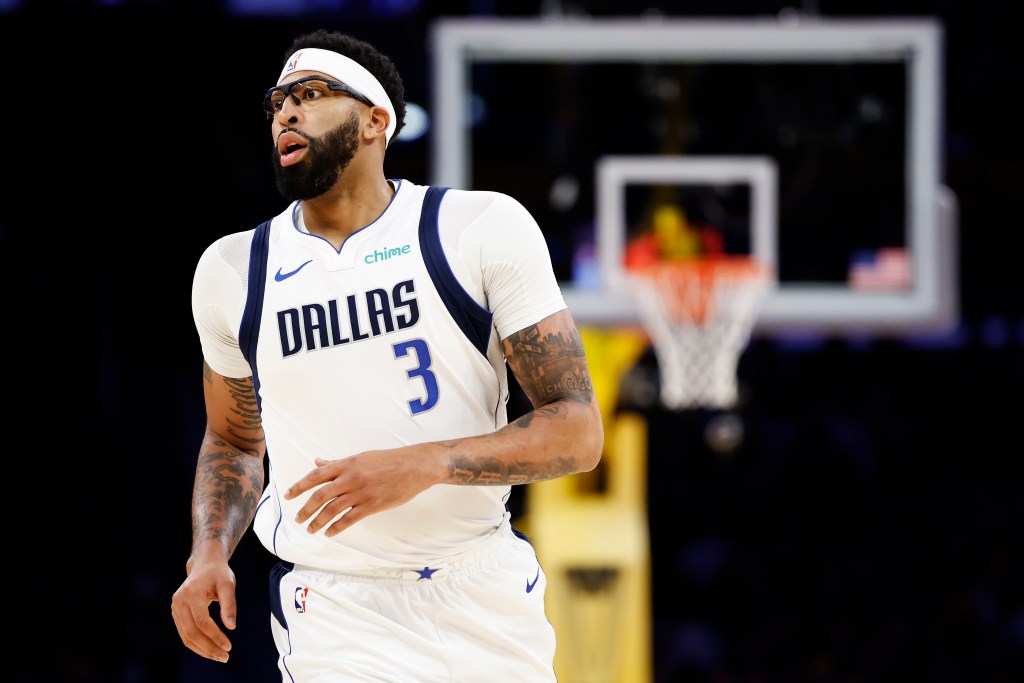
ORLANDO, Fla. — The Chicago Bulls are nearing a fork in the road.
The first week of December isn’t a particularly meaningful stretch of the NBA season. Teams have played enough games to make sweeping statements about their success and playoff expectations. End-of-season award banter has begun in earnest. But the trade deadline — and all the drama that comes with it — is still more than two months away.
But not in Chicago.
The Bulls are in free fall at 9-10, standing empty-handed after burning up all the goodwill created by their 5-0 start. And according to an ESPN report, that desperation has pushed the Bulls to discuss internally options to trade for Dallas Mavericks big man Anthony Davis.
The concept of a Davis trade is no surprise in Dallas, where the Mavericks are mired in the debacle that began when now-fired general manager Nico Harrison traded Luka Dončić to the Los Angeles Lakers in February. The trade partner for a Davis deal is the biggest question, especially in Chicago, where it’s unclear if — or how — Davis could pull the Bulls back up the Eastern Conference standings.
Davis is a proven defensive superstar. He’s a Chicago native. And his addition immediately would redefine the Bulls’ weakest area. But is this the right time for a homecoming? For the Bulls, it all comes down to a price — and their willingness to change directions.
The Bulls are uninterested in trading the key members of their young core — Matas Buzelis, Josh Giddey and Coby White — for a star like Davis, a source confirmed. They believe deeply in building a balanced roster around the development of the young trio, with rookie Noa Essengue potentially entering the fold in the future.
The Bulls front office knows its plan requires at least one of those young players to develop into an All-Star-caliber centerpiece. The Bulls believe they already struck on one in Giddey, who is averaging 20.5 points, 10 rebounds and 9.3 assists this season as he makes a case for a potential first-time All-Star selection. But that hasn’t been enough to power the Bulls past a dismal defense.
Here’s the main issue: The Bulls can’t stop anyone at the rim. Not a guard. Not a big. Not a wing. Opponents are scoring 44.2 points per game in the restricted area — the most in the league. Even when the Bulls get their offense going or get lucky with an opponent’s cold night from the 3-point arc, rim protection remains a gaping crack in the team’s basic foundation.
Starting center Nikola Vučević certainly isn’t slowing opponents at the rim, but in many ways he’s only a passenger to the pummeling the Bulls take in the paint due to their flimsy perimeter pressure. Still, the presence of a true shot stopper who can affect attempts at the rim would stop the bleeding long enough for the Bulls to figure out where to go next on defense.
This is where Davis could come in. If they want to survive the season, the Bulls need to make a change in the post, and Davis is a five-time All-Defensive player and three-time league leader in blocked shots. Although he didn’t earn an All-Defensive selection last season, he posted a 108 individual defensive rating and the fourth-best block rate (6%) in the league.
The only downside to Davis as a player is his durability. He has missed 105 games over the last four seasons, which translates to 68% average availability. He has been sidelined for 15 of the Mavericks’ last 16 games because of a left calf strain. These injury concerns wouldn’t necessarily prevent a team from making a deal for Davis, but they would inform his price on the trade market.
Setting that price would be a tall task for Bulls executive vice president of basketball operations Artūras Karnišovas. But unlike prior years, the Bulls are in a decent position to negotiate.
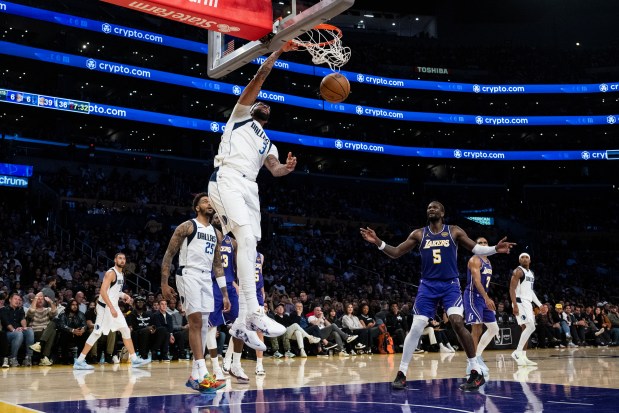 The Mavericks’ Anthony Davis dunks during the first half of an NBA Cup game against the Lakers on Nov. 28, 2025, in Los Angeles. (AP Photo/Kyusung Gong)
The Bulls own their future first-round picks, plus an additional protected first-rounder from Portland that could convey this summer if the Trail Blazers make the playoffs. White, Giddey and Buzelis are off the table, but the supporting cast of players such as Ayo Dosunmu is attractive enough to provide both outgoing salary and trade value.
Still, this type of action isn’t typical for Karnišovas. He has made only one midseason trade — moving Zach LaVine at the 2025 deadline — in the last four seasons. Trading for Davis would go against the central ethos that Karnišovas articulated for the Bulls in February, when he preached the importance of building parity across the roster rather than taking big swings on stars.
“There are different structures that you can try to get to a championship,” Karnišovas said at the time. “There are two to three star players and then a lot of role players. Or you can build it as nine to 10 very good players.”
For most of this season, the Bulls have taken the “nine to 10 very good players” track. It has been — to put it bluntly — a harrowing journey.
The team’s imagined depth hasn’t been enough to sustain even short-term success. One or two small injuries can knock the entire season off track. Even when White and Giddey combine for 50 points, it doesn’t matter.
The Bulls need help. But changing course to pick the other path — the one much more traveled, that’s focused on superstars and the success they bring — would mark a serious change. It would mean admitting failure. And it would force Karnišovas to break from the mold of recent years while taking one of the biggest risks of his tenure in Chicago.
There’s no rush. February is far away. But as the new year approaches, the end of one road or the other is coming nonetheless.