
 By
By December 4, 2025
Photo: Nell Redmond / AP
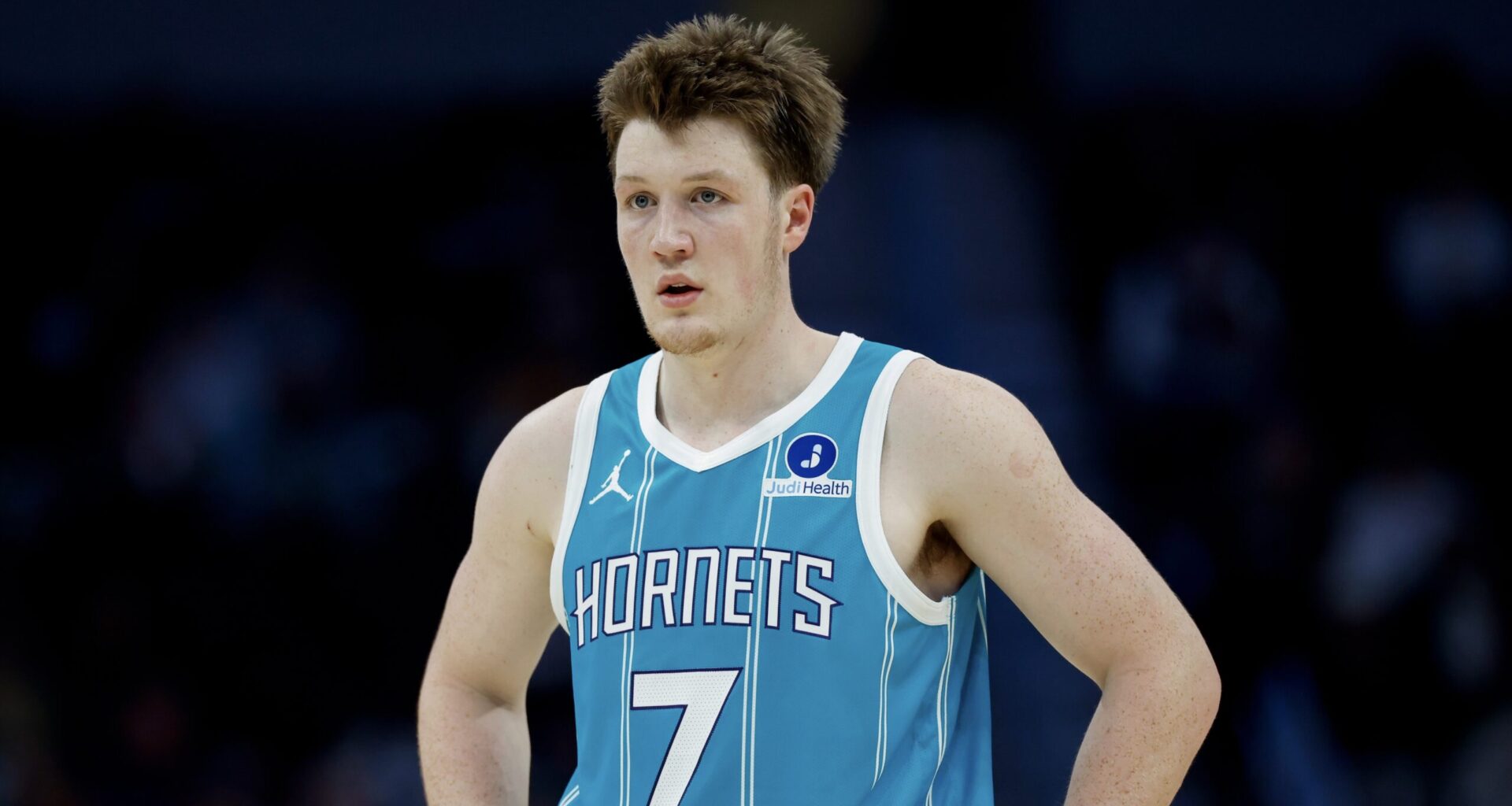
After Charlotte’s rookie class led the Hornets to their first-ever Summer League championship, that early chemistry has clearly carried over, with all four rookies contributing so far this season.

Kon Knueppel and Ryan Kalkbrenner have been starters since opening night, Sion James has worked his way into the lineup, and Liam McNeeley has already proven more valuable than Tidjane Salaun, last year’s first-round draft pick. It’s not just that the rookies are getting minutes — they’ve been some of the Hornets’ steadiest players this season.
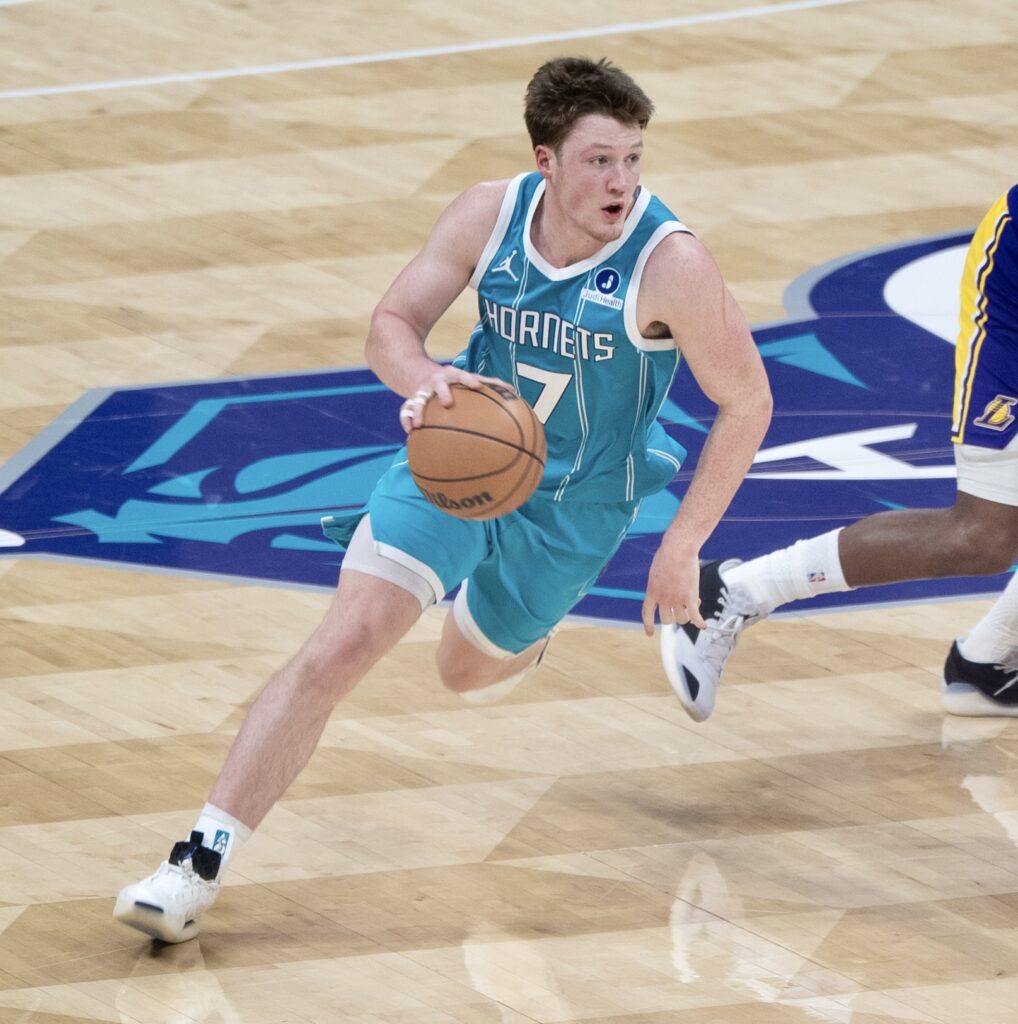 Charlotte Hornets first-round draft pick Kon Knueppel won Rookie of the Month for October and November. Photo: Kurt Shackelford / CLTure
Knueppel made NBA history with 69 made three-pointers in his first 20 games, the most ever to start a career. Kalkbrenner is shooting 80.6% from the field over his first 20 games and currently ranks third in blocks per game across the league.
If Knueppel, Kalkbrenner, and James keep this up, Charlotte could have three players named to All-Rookie teams — something that hasn’t happened since the 1997-98 Cavaliers.
Here’s how they’ve done it, and what to watch as the season unfolds.
Kon Knueppel
While his former Duke teammate and No. 1 pick Cooper Flagg has had a solid start in Dallas (they both won Rookie of the Month in October and November), Knueppel looks even sharper than he did last season at Duke. He’s constantly floating into open space, using crisp footwork and a quick release to knock down threes at a 40.7% clip.
But calling him just a catch-and-shoot guy doesn’t do him justice. Knueppel plays with great feel — he rarely forces bad shots, moves the ball quickly, and even sets solid screens in the pick-and-roll to free himself or his teammates. He adds value to every aspect of the Hornets’ offense, the kind of player who makes everyone around him a little better.
Defensively, he’s quietly been one of Charlotte’s best, and head coach Charles Lee has already praised him as “one of our best on-ball defenders.” Knueppel uses his strength, positioning, and prep work to his advantage:
“For a player like me who maybe lacks some athleticism, that stuff is ultra important… like knowing which way a guy tends to drive,” Knueppel said in a postgame press conference.
There’s still room to grow. His handle has been a little loose under pressure, and he’s been turnover-prone when driving into the paint. He admitted after the Utah game that picking up the ball while dribbling through traffic has been “a little bit of an adjustment” from college. But he’s shown an impressive ability to learn and adapt, nearly recording a triple-double with nine assists against the Lakers just a week later.
Ryan Kalkbrenner
Coming into the season, Charlotte’s center rotation looked like one of the thinnest in the league. A few weeks in, that storyline already feels outdated — mostly because of rookie Ryan Kalkbrenner.
The early second-round pick has started every game so far, and while Charlotte’s team defense has been inconsistent, Kalkbrenner has been a steady presence inside. At 7’1 with a 7’6 wingspan, he’s been one of the best shot blockers in the league to start the season, using his length and timing to clean up other people’s mistakes at the rim.
Ryan Kalkbrenner keeps shining
📊 Tied 2nd in the NBA in blocks
📊 2nd rookie in franchise history with 4+ blocks in three-or-more consecutive games pic.twitter.com/KkhP5ZZl5k
— Charlotte Hornets (@hornets) November 6, 2025
Kalkbrenner already looks like a defensive anchor — the kind of big who helps his teammates defensively by organizing the floor and effectively communicating coverages. He’s shown a real feel for the pick-and-roll, containing guards just long enough to recover back to his man. For a rookie, especially one playing heavy minutes, that’s rare.
His offense has been simple and efficient. Kalkbrenner is leading the NBA in field-goal percentage, mostly on dunks, lobs, and short rolls to the rim. He doesn’t play for flash or stats, never taking a bad shot, and has even found success running set plays designed for him after timeouts. What stands out most is his coordination — and while he sometimes appears to move awkwardly (by his own admission), he has shown good hands, catching almost everything, even when the pass is off-target or in traffic.
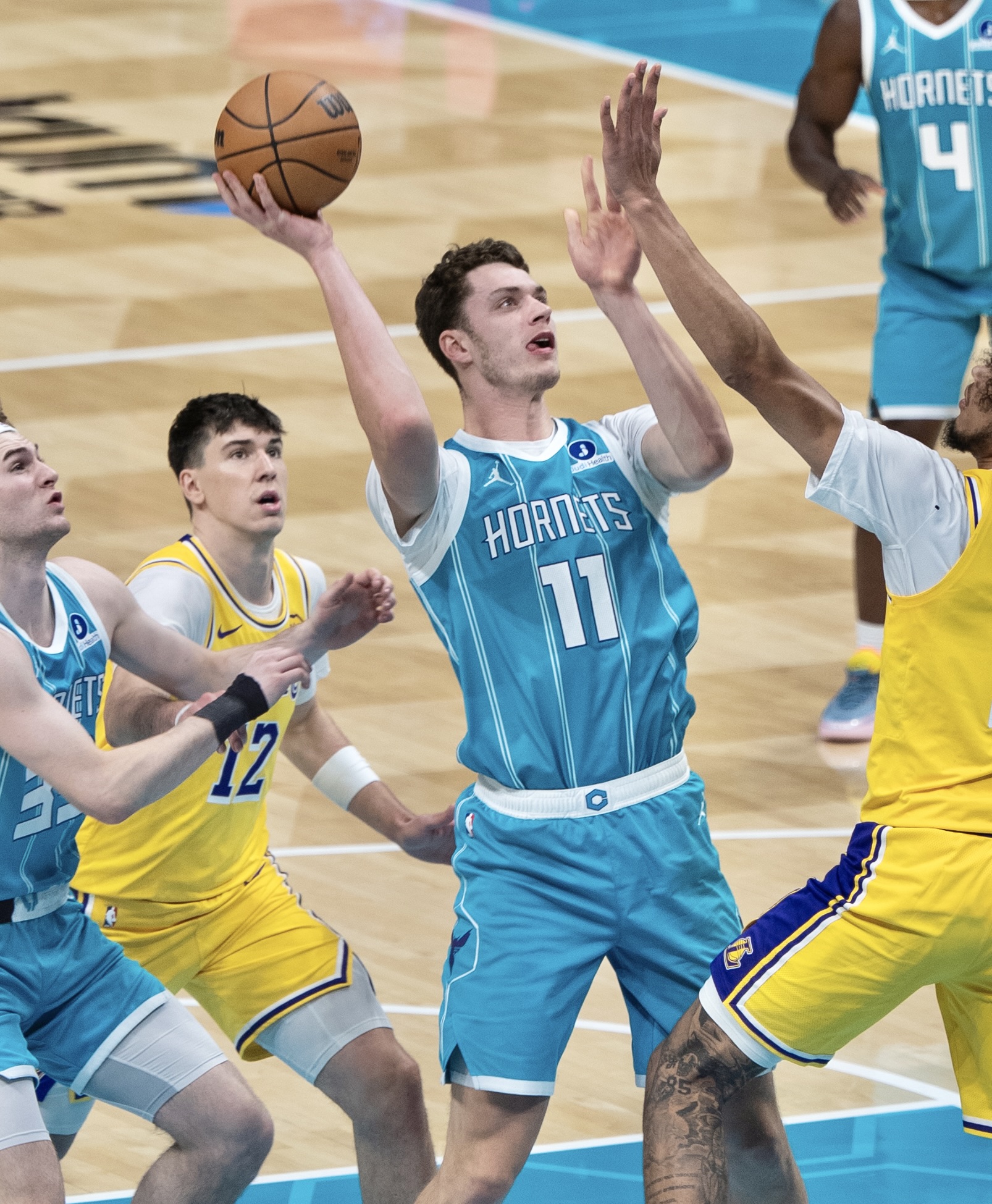 The Hornets’ rookie center, who has filled a major gap as a rim protector, currently leads the NBA in field-goal percentage and ranks among the top three in blocks. Photo: Kurt Shackelford / CLTure
Rebounding has been more of a work in progress. He’s not pulling down huge numbers, but Charlotte’s team rebounding has been one of their biggest strengths. His strong box-outs have helped others grab rebounds. It’s the kind of unselfishness that doesn’t show up in a box score but matters over 82 games.
The next step will be proving he can hold up against stretch bigs and perimeter-heavy teams. Against the Lakers, Charlotte opted to start Moussa Diabate in the second half as Reaves and Doncic looked too comfortable against Kalkbrenner’s drop defense. That’s the adjustment curve for a drop-coverage big like Kalkbrenner, who has limited versatility in how he can be deployed.
Is Kalkbrenner Charlotte’s starting center of the future? It’s too early to say, but at the very least, he looks like a highly capable back-up as a rookie, far surpassing the expectations.
Sion James
Of Charlotte’s four rookies, Sion James entered the season with the least buzz. But Josh Green’s shoulder injury opened the door for him to see the court early, and he hasn’t looked back since. On a team full of perimeter players with defensive limitations, James has quickly carved out one of the most valuable roles in basketball — a reliable 3-and-D wing.
The box score doesn’t capture James’ defensive impact. He’s not piling up steals, blocks, or rebounds, but watch a Hornets game and his junkyard-dog mentality jumps off the screen. He plays with a physical edge, refusing to be screened, boxing out bigger opponents, and taking on matchups from Tyrese Maxey to Luka Doncic. For a rookie to be trusted with those assignments is a clear vote of confidence from Charles Lee.
Hornets rookie Sion James is 13-of-17 on catch-and-shoot threes through 7 games pic.twitter.com/t6ARA9DKJQ
— Brett Usher (@UsherNBA) November 4, 2025
After starting the year shooting lights out, James has regressed closer to his college career average of 36% from beyond the arc, currently sitting at 38%. Still, he’s shown encouraging shot preparation and confidence. He also has a steely determination to bulldoze through contact and, despite being right-handed, finish with his left at the rim.
When Josh Green eventually returns from his offseason shoulder surgery, his presence could complicate James’ minutes. His turnovers and scoring are both trending in the wrong direction, and his defense doesn’t feel as impactful as it did earlier in the season. However, having both Green and James available should give Charlotte 48 minutes of solid point-of-attack defense.
SION JAMES TIES THE GAME AT 100 🚨
THE HORNETS WERE DOWN 17 IN THIS GAME.
WHAT A COMEBACK.
Watch on NBA League Pass: https://t.co/OVU657LjC5 pic.twitter.com/iB4G3ciSaI
— NBA (@NBA) November 30, 2025
Every good NBA team needs a player like Sion James — a versatile defensive enforcer who can space the floor and scale his offensive role up or down depending on what’s required. Think Lu Dort, Christian Braun, Aaron Nesmith, or Dillon Brooks. If James can continue to develop and approach the level of any of those players, Charlotte may have unearthed a key building block.
Liam McNeeley
McNeeley, the 29th pick in the 2025 draft, like Knueppel, entered the league as a one-and-done freshman, so it’s no surprise he’s a little behind Sion James and Ryan Kalkbrenner (who both played five seasons in college) in terms of readiness. He’s had the smallest role of the rookie group so far, averaging 13.5 minutes per game, mostly entering the rotation when Brandon Miller is not playing. But he has made the most of the opportunity, overtaking Tidjane Salaun in the rotation and seeing his playing time steadily increase.
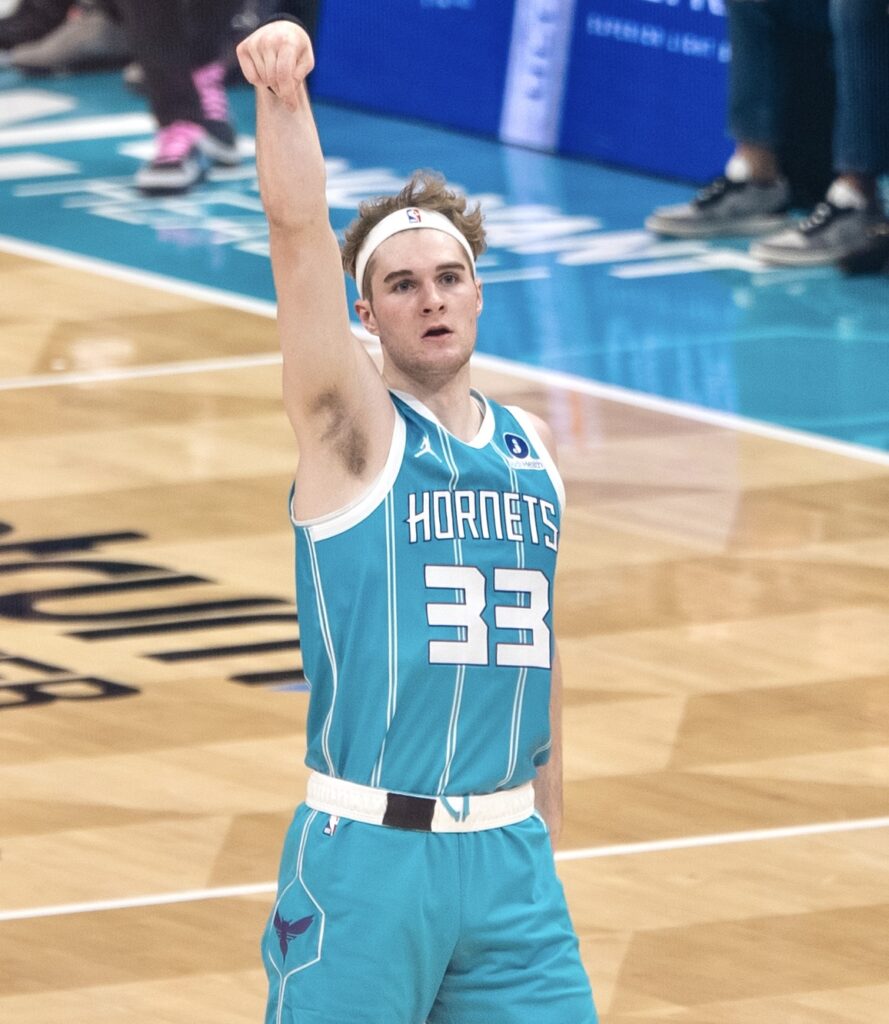 Picked 29th overall, rookie Liam McNeeley is averaging 13.5 minutes per game through 16 games and is shooting 37.8% from three-point range. Photo: Kurt Shackelford / CLTure
His decision-making on offense continues to trend upward. He is showing real patience, taking what the defense gives him, drawing fouls at an impressive rate, and creating for others with the kind of vision you don’t usually see from a six-foot-seven wing.
After a slow start, his three-point shot — which remains his primary weapon — has begun to fall as he settles into the pace and physicality of the league. He is attacking closeouts with control, finding open teammates, and showing an ability to draw contact and get to the free-throw line. Dating back to his time at UConn, scoring efficiently inside the arc, from mid-range, and at the rim has been a weakness. That remains the key area for him to grow offensively.
An encouraging glimpse of Liam McNeeley’s defensive versatility.
Just look at who he guards on this possession. pic.twitter.com/1TxOT2pm9E
— James Plowright (@British_Buzz) October 16, 2025
Defensively is where McNeeley has been pushed hardest by Charles Lee, and the early returns are encouraging. Lee trusted him to close the game against the Lakers and praised his approach afterward:
“I liked his energy. A lot of the time I tell the young guys, it’s not about scoring,” Lee said in a postgame press conference. “If you miss a shot or make a shot, I’m more concerned about your competitive spirit.”
While Charlotte’s position in the standings may look familiar, the energy around the franchise feels anything but. This rookie group has injected a sense of hope and identity that has been absent in recent years.
Whether or not they hit that milestone, one thing is clear: Charlotte finally has a young core worth investing in, with every night offering another glimpse of what this group may become.

Read next: