
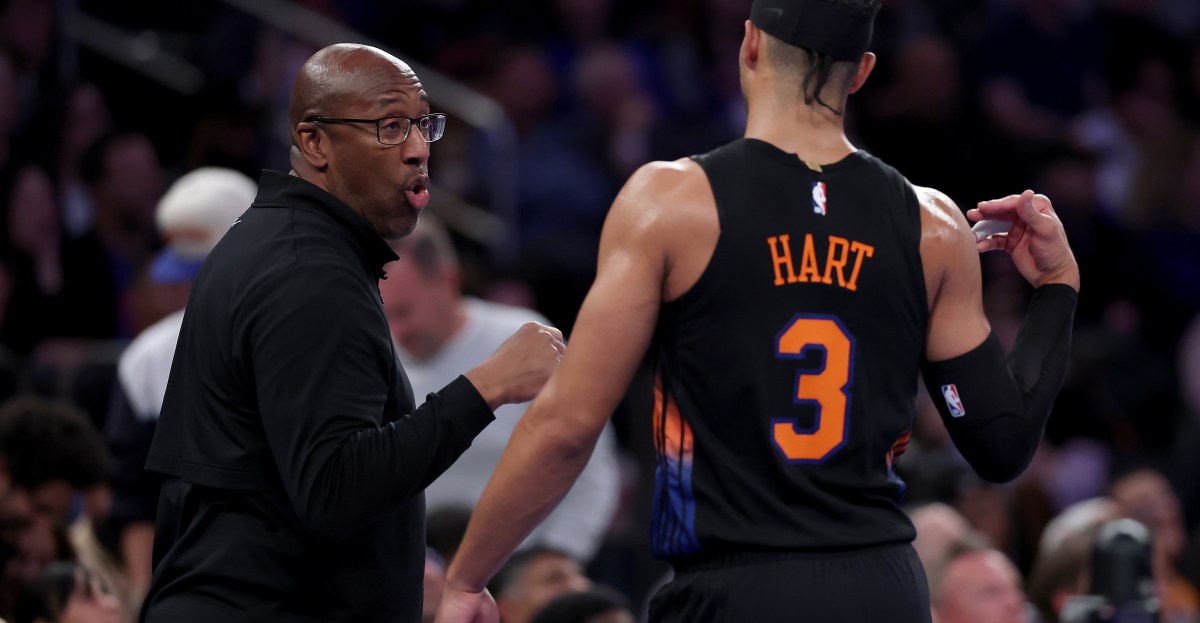
The way the Knicks are built, things will never be fully cohesive without their best defender. While OG Anunoby has reportedly resumed taking contact in practice and is inching closer to a return, the Knicks are likely going to slow-play him, not risking things in an 82-game season.
So in the meantime, the Knicks have to deal with what they’ve got. That task became especially more perilous when Landry Shamet hurt his shoulder two weeks ago, thinning the Knicks’ depth to the point that Tyler Kolek got out of the doghouse.
For the most part, the Knicks have held serve without Anunoby, currently being 6-3 in nine games without him. While they’ve benefitted from a soft part of the schedule, they’ve also defeated the Bucks and the Raptors, two teams who figured to take advantage of a smaller Knicks team with their leading scorers being big wings (Brandon Ingram and, of course, Giannis).
But there’s been a pattern, win or lose, in the last few games for the Knicks. Starting with the blowout win over the Raptors, the Knicks have jumped out to jaw-dropping early leads, only to squander them, either fully or partially.
11/30 vs TOR: up 48-24 in Q2, Raptors go on 22-3 run and eventually pull within 3 in Q3.12/2 @ BOS: up 39-25 in Q2, Celtics go on 12-0 run, eventually take 18-point lead after 3.12/3 vs CHA: up 41-21 in Q2, Hornets go on 26-9 run to pull within three in just seven minutes
Of course, these can be just the ebbs and flows of an NBA game, but if you look deeper, it’s predicated on the lineups being run.
There are three lineup no-nos in the modern NBA. You don’t run a lineup that’s too small against most opponents, you don’t run spacing nightmare lineups, and you don’t keep your two best offensive players on the bench at the same time.
The Knicks have run all three of these no-nos at times this season, but the first and third ones have been a big issue in that three-game stretch.
Despite their weaknesses defensively, there should never be a lineup without Jalen Brunson or Karl-Anthony Towns on the court. Yet, we’ve seen brief spurts where the Knicks utilize a lineup with neither, and it predictably doesn’t work. The Knicks’ on/off stats with KAT and Brunson (removing garbage time) are pretty evident.

PBP Stats
The Knicks have an elite offense, as long as one of them is out there. They’ve only played 15 meaningful minutes without either when both are available, and it goes about as you expect. Even if you add in games where one is unavailable, it’s more of the same.
That issue, however, isn’t the most prevalent. Mike Brown knows he can’t rely on lineups with neither for more than a few possessions, so the focus shifts to the supporting cast.
In these last three games, the Knicks have deployed a starting lineup of Jalen Brunson, Deuce McBride, Mikal Bridges, Josh Hart, and Karl-Anthony Towns. That lineup, in 55 total minutes, has bludgeoned teams to a net rating of plus-30.1, powered by an unstoppable offense (148.7 ORtg) and crisp passing (3.9 assist-to-turnover ratio).
But what happens in those other minutes? The second-most common lineup is the traditional unit that starts the second quarter, where Towns, Hart, and McBride stay on while Jordan Clarkson and Tyler Kolek relieve Bridges and Brunson. That lineup, in 16 minutes, has been horrifically bad, posting a miserable minus-32.1 net rating.
Those are the only two five-man lineups to accrue more than six minutes in that stretch, but we can look deeper and see which players are stumbling when paired together. The worst pairings? They’re when the Knicks play a brand of super small ball that also involves a smattering of bad defenders.
Kolek and Clarkson, as the two main backup guards, played 30 minutes together in this sample and got crushed (minus-35 net rating). Kolek paired with Hart produced even worse numbers (minus-42.4 in 24 minutes). Don’t get me started with the eight brief minutes he shared the floor with Brunson, which produced an unbelievable defensive rating of 229.4 and a net rating in the negative triple digits.
There were four brief minutes of Kolek, Clarkson, and Brunson that, predictably, had generationally bad numbers. There were also rough numbers when Kolek and Clarkson were paired with either Towns (minus-14.6 in 22 minutes) or Mitchell Robinson (minus-50.8 in nine minutes).
So what’s the fix in all this? It might just be to be smarter in how the team plays Deuce McBride and Mitchell Robinson.
On a team full of small guards, you need to prioritize the one who can defend. McBride, especially with his recent hot shooting, has been a key contributor on this team and should be utilized in a way to break up lineups that contain Clarkson and Kolek. There’s also a way to help counteract the team’s struggles with size by utilizing Mitch more with KAT instead of exclusively as a second-unit big.
There was a reason Mike Brown decided to move Robinson to the bench, and he’s been overwhelmingly successful in that regard, but since Robinson’s benching, he’s rarely used the two bigs together. In the first two games, the two got crushed in 15 combined minutes, to the point where it seems to have slightly scared Mike Brown. Yet, in the two games since, they’ve seen tremendous success with both on the floor.
Even with Robinson missing Wednesday’s game due to load management, the Knicks got good results with Ariel Hukporti teaming up with Towns for five minutes before he proceeded to be the quickest Knick to foul out since Michael Beasley eight years ago.
Ultimately, there’s no perfect fix. Unless Mike Brown gets haunted by the “Ghost of Thibs’ Past” and shortens the rotation to play the excelling starters even more, this will probably continue to happen. With big games upcoming against Orlando and Toronto (NBA Cup edition!), Coach Brown will continue to have to tinker.