
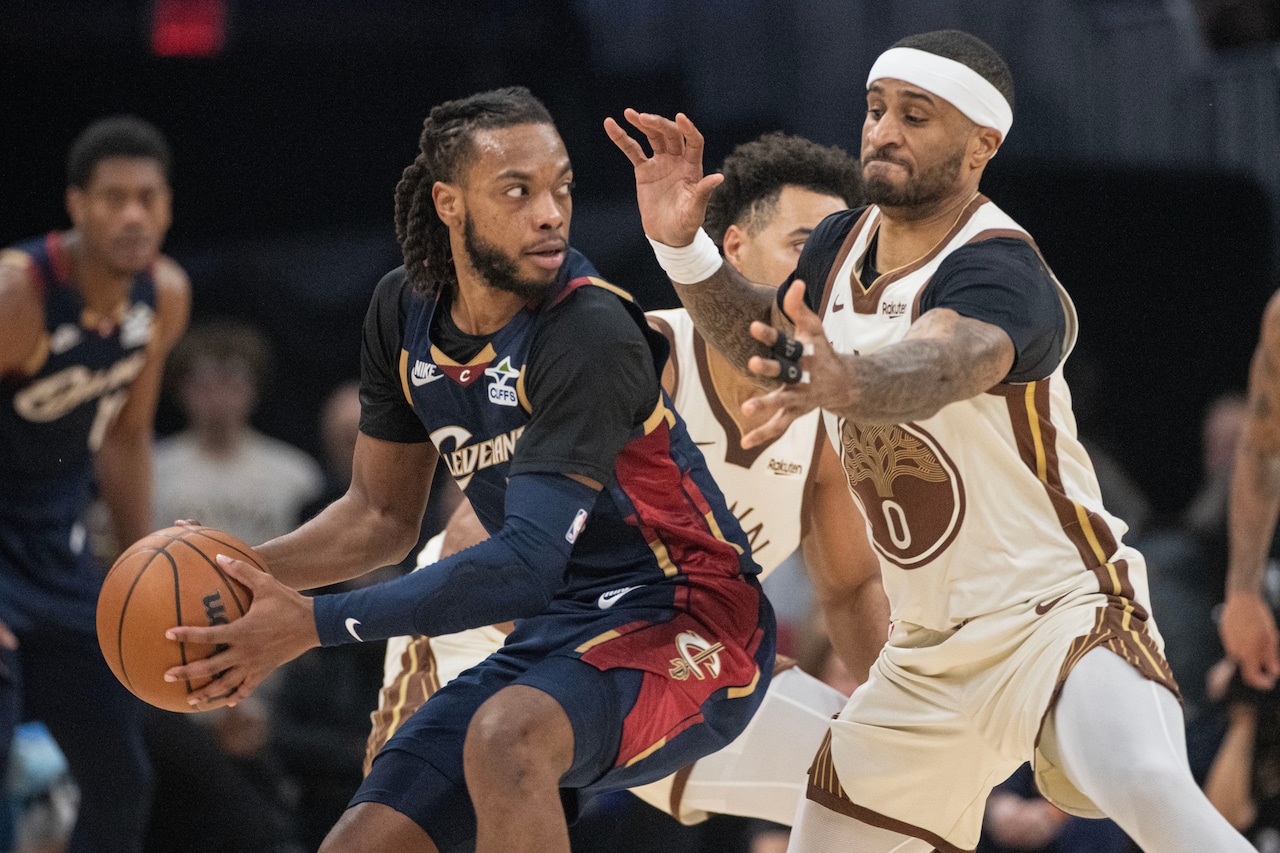
CLEVELAND, Ohio — The Cavs dropped a stunning 99-94 decision to what essentially amounted to the Golden State Warriors’ G League team.
The shocking defeat, which came on the heels of what should have been a momentum-building win against San Antonio, sparked an unusually heated debate on the latest episode of the Wine and Gold Talk podcast.
Host Ethan Sands and cleveland.com beat reporter Chris Fedor found themselves on opposite sides of a fiery discussion about whether this qualified as Cleveland’s worst loss of the season — revealing deeper concerns about the team’s championship aspirations.
“I completely disagree. I think this was their worst loss of the year,” Fedor declared emphatically, challenging Sands’ suggestion that poor shooting, not effort, was the primary culprit. “They were nine point favorites on their own home floor against the Santa Cruz Warriors on the heels of their second-best win or best win of the season. And they trailed for 35 minutes with Darius Garland in the lineup, with Donovan Mitchell in the lineup, with Evan Mobley in the lineup. I don’t know how it’s worse than that.”
The Warriors entered Saturday’s contest with perhaps the NBA’s longest injury report. No Stephen Curry. No Draymond Green. No Jimmy Butler. Instead, the Wine and Gold were toppled by a collection of two-way players and backups, most notably Pat Spencer, who outdueled Garland throughout the night.
Fedor didn’t mince words about what this loss represented: “You have three All Stars in your lineup. You have the most expensive roster in the history of the NBA. You cannot lose that game to that group of Golden State Warriors.”
What made the defeat particularly disheartening was its timing.
Cleveland had just delivered a much-needed performance against San Antonio the night before. The vibes had been positive — music blasting in the locker room, jokes flowing, and renewed talk about playing with joy after a team meeting. All that momentum evaporated against Golden State’s skeleton crew.
Sands, while acknowledging it was a disappointing performance, countered that it wasn’t Cleveland’s worst showing this season.
To him, the alarming part wasn’t effort — it was variance.
“This was a product of [the Cavs] simply couldn’t make shots,” Sands said. “Even when they were getting to the rim. They were having problems getting the ball to go through the hole. It was not a lackluster effort. It didn’t feel like they didn’t have the hustle, at least on the offensive end. They won the rebounding battle, they won the turnover battle.”
The Cavs shot just 42% on field goals in the paint despite taking 56 attempts there and connected on a dismal 23.8% from 3-point range.
Sands argued that Cleveland’s true “worst” losses this season share one defining trait — controllable failures of effort. Saturday, in his view, didn’t fit the description.
He even pointed to specific moments earlier in the schedule that registered as more concerning.
“If I’m looking at the schedule and I’m looking at what the energy level was for some of these contests. I thought the Boston Celtics game was bad. I thought the Atlanta Hawks game was bad. … To me, there’s different shades of what the Cavs haven’t been able to do and that that was more so teams attacking their weaknesses and teams trying to manipulate the game and dictate the pace of the game. It didn’t feel like the Warriors dictated the game today. It just felt like the Warriors made more shots than the Cavs did.
“…If we’re looking at the worst game that the Cavs have played, the Toronto Raptors game … that’s one of the ones that I would point to when I would think about what they could have controlled. That’s the biggest thing to me, controlling what you can control and dictating an outcome rather than if you have a bad shooting night, which every team does.”
The contrast between Fedor’s frustration and Sands’ interpretation added weight to the larger theme: Cleveland’s problems this season are no longer simple or singular.
The debate highlighted a concerning trend for a Cleveland team that entered the season with championship aspirations but now sits at 14-11. For context, last year’s 64-win Cavs squad didn’t suffer their 11th loss until March 16th.
As the team heads into a five-day break, both hosts agreed on one thing: something fundamental needs to change about the Cavaliers’ approach. The question remains whether this loss will serve as a wake-up call or simply another disappointment in an increasingly frustrating season.
Want to hear the full, heated debate and more insights into the Cavs’ struggles? Listen to the complete Wine and Gold Talk podcast episode for all the unfiltered analysis and what might come next for Cleveland after this embarrassing defeat.
Here’s the podcast for this week: