
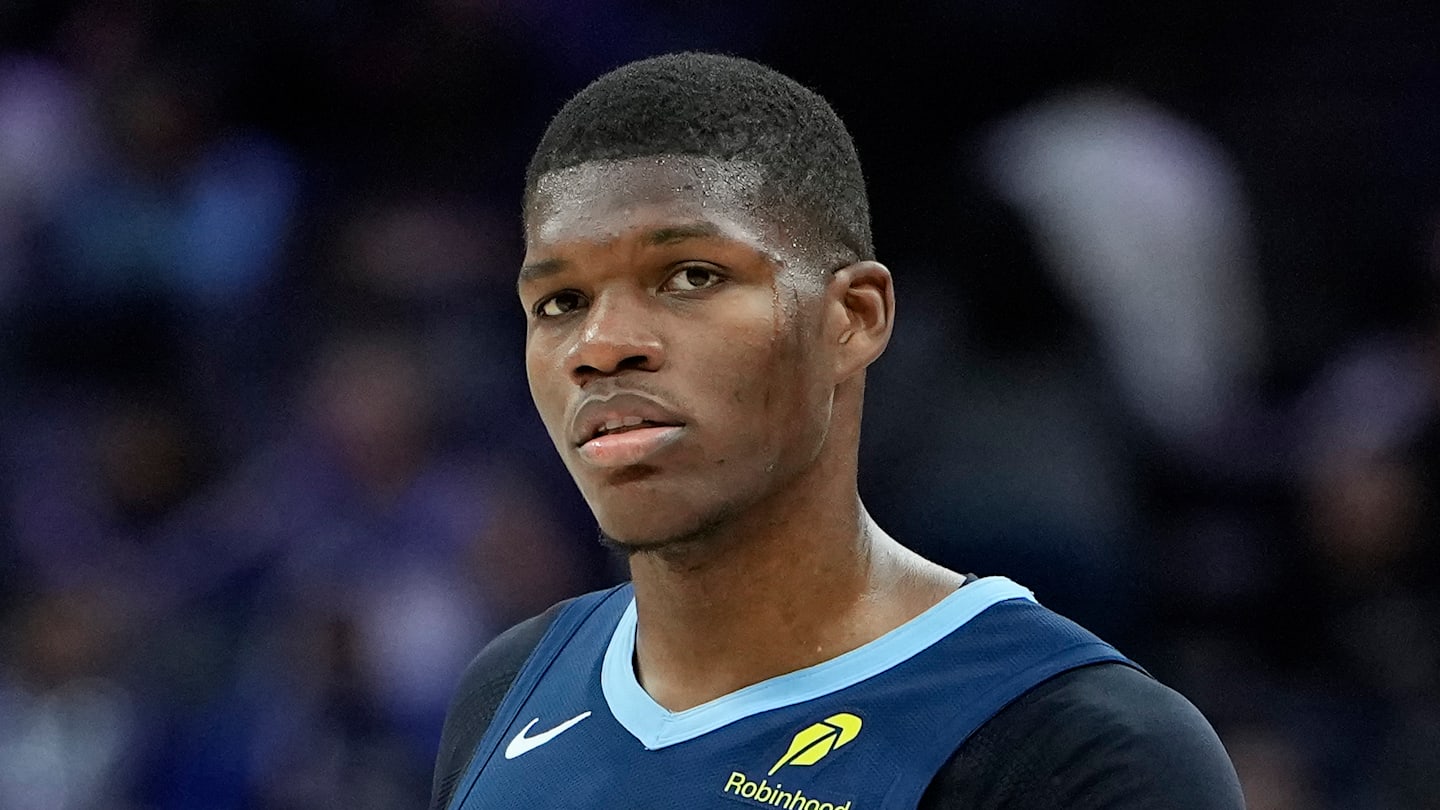
It’s way too early to definitively declare a winner and loser of this bold draft trade between the Memphis Grizzlies and Portland Trail Blazers, but Memphis is already reaping the benefits on its end.
Grizzlies rookie Cedric Coward is coming off a career-high 23 points, 14 rebounds, and five assists in their most recent win over the Los Angeles Clippers. He’s currently ranked fourth on the Kia Rookie Ladder, behind only Kon Knueppel, Cooper Flagg, and the rising Jeremiah Fears. On the season, he’s averaging 13.4 points, 6.2 rebounds, and 2.7 assists on 45/33/86 shooting splits.
Despite the career night, Coward’s shooting has cooled off as of late, as he connected on just 30.7% of his three-point attempts in November. Still, the up-and-down production is to be expected of a rookie, regardless of how much collegiate experience they’ve had. Most importantly, Coward is still showing an ability to impact winning on nights where his shot is off. He’s already a sound perimeter defender with flashes of Kawhi Leonard in terms of his versatility, wingspan, and quick hands.
Cedric Coward’s hot start increases opportunity cost of Blazers’ Yang Hansen gamble
In retrospect, this would’ve been a perfect fit for a Blazers team that has established its defensive identity with its moves this offseason. Offensively, Coward’s floor-spacing ability would’ve given the Blazers a significant boost, helping open up drive lanes where Deni Avdija and Shaedon Sharpe are at their best as well.
That’s the next step in the evolution of Portland’s rebuilding roster. Avdija and Sharpe have the two highest usage rates on the team, and with them emerging as the primary offensive initiators, the Blazers must now do everything they can to surround them with shooters — especially considering how bad Sharpe has been in that department this season at under 25%.
The Blazers took a gamble on a projected second-round prospect, Yang Hansen, who has a tantalizing ceiling arguably higher than Coward’s, especially given he’s two years younger. However, the fact that Hansen hasn’t been able to consistently crack interim head coach Tiago Splitter’s rotation, despite the multitude of injuries, shows how imperfect this fit is for Portland.
The Blazers are a team that wants to play fast on both ends, picking up the length of the court defensively and turning their stops into transition opportunities. We saw at the beginning of their season, with a healthier team, how effective that identity worked as the coaching style aligned perfectly with the strengths and weaknesses on the roster.
In a vacuum, we don’t mind spending a first-round pick on Hansen. He already possesses a rare playmaking ability as a center, and that skill set, which few centers have in the league, suggests he has a ceiling higher than most if he can refine other aspects of his game. But the ceiling for Hansen seems to be using him as an offensive hub, similar to Nikola Jokic in Denver, and he’s not good enough to justify Portland running its entire offense through him at this point in his career.
That’s going to be the main thing going forward: how Hansen’s skill set is able to translate to a lessened role in terms of his shooting, screens, rim protection, and rebounding. Maybe one day he does become good enough to run the offense through, and we’ll even get to see the vision for him as a playmaking center come to fruition.
Right now, the seamless theoretical fit looks to be Coward. But it’s also too early to say who was the better pick. The Blazers didn’t make this decision based on who fits better in their first year. Hopefully, this situation changes as Hansen gains more experience in the NBA.