
The Phoenix Suns came into this past offseason armed with a pocket full of corporate buzzwords. Identity. Vision. Alignment. The mission was clear: build a roster that could support something sustainable, then try to grow a culture inside of it.
Through the draft and the moves that followed, I started carrying my own buzzwords into the season. Patience. Short-term greed. Long-term greed. Development. If you have read my work on Bright Side since last summer, you have seen those words pop up more than once.
I have always believed that if you are going to commit to a real process, you have to live with the process. No shortcuts. No panic buttons. No fast forward. The short term has to be swallowed if you want to reach the long term. And the backbone of all of it is patience.
That patience is starting to wear thin. Because it feels like we are approaching the moment where the next lever should be pulled, and I would prefer it were pulled faster than I initially desired.
All offseason, my stance has been simple. Development needs tiers. If you actually want to put a rookie in a position to succeed, you do not rush them into the deep end. You have a G League team for a reason. Use it. I have looked at this season as a six-month runway. The first two months should belong almost entirely to fundamentals. Reps. Film. G League minutes. Any NBA run during that stretch should be mop-up duty only.
That is not a strategy designed to delay growth. It is a strategy designed to protect it.
It does two things at once. It protects confidence because you are not throwing a rookie into high-leverage situations where one bad stretch can stick in their head. At the same time, it gives the organization space to lay down the foundation of the culture it claims it is building. The first two months of a season are about tone. Habits. Expectations. Rookies playing meaningful minutes too early muddies that process.
It is also how the Suns trapped themselves in the lottery hamster wheel for almost a decade. Every year, it was the same plan. Play the kids. Develop on the fly. Lose loudly. Rinse. Repeat. Short-term development kept cannibalizing long-term greed. And the culture never had a chance to stabilize.
In my own little theorem, the next two months, roughly Christmas through the All-Star break, that is when you start to drip the rookies into the rotation. Maybe it is 15 minutes a night. Maybe it is 5 in the second quarter and 7 in the third. The point is the foundation is set, they have logged real reps with the G League, the confidence has started to grow, and now you introduce them to the real thing in controlled doses. Real NBA minutes. Real situations. Real film. And that film becomes the tool that coaches like Jordan Ott can actually use to guide development.
The final stage is the last two months. That is when the minutes open up to 25 a night. That is when the training wheels come off. How far you go depends on the standings. If you are chasing a playoff or Play-In spot, you might tighten the reins a bit. Short-term greed still matters. Wins still matter.
So why drag you back through all of this again? Why revisit the philosophy? Because the patience part is getting tested. By my own timeline, we are only a few weeks from what I would call ‘phase two’. So maybe this is me jumping the gun. Maybe this is me leaning forward in my chair too early. But all of it circles back to one simple question.
What does Nigel Hayes Davis do right now that positively swings a basketball game?
On paper, he is a clean audition. He brings maturity. He brings a calm brain. This team needs that. This team values that. His road back here matters. The last time he played in the NBA was in 2018 with Sacramento. He was 23 years old. Now he is 31. Seven years overseas. Seven years of grinding. And now he is back in the league, trying to grab this moment with both hands.
Through 17 games, it is hard to argue that the moment is being seized.
He is at 1.5 points in 8.9 minutes. He is shooting 33.3% from the field. He is at 8.3% from beyond the arc. That is 1-of-12 from deep, and he hasn’t hit one since October 24. And in the minutes he has played, the Suns are -64 with him on the floor. Worst on the team.
I am rooting for Hayes Davis. I want him to succeed. His story impresses and inspires. It is built on resilience and stubborn belief, and the reminder that if you keep working, you can earn a second door back into the room. He has that door open right now. There is a real opportunity in front of him.
But when you watch him play, the mind starts to wander. You start asking if this is still the best use of those minutes for the organization. Because the way he plays right now feels rushed. The ball hits his hands, and it becomes a hot potato. The shot does not settle. The base is not set. The confidence never quite arrives. Instead of squaring up and letting it fly, everything feels sped up, like he is trying to give the ball back to the game as fast as possible.
The result is what the numbers already told us. Poor shooting from a player who was a 39.5% three-point shooter internationally.
And that is where my patience starts to grind a little.
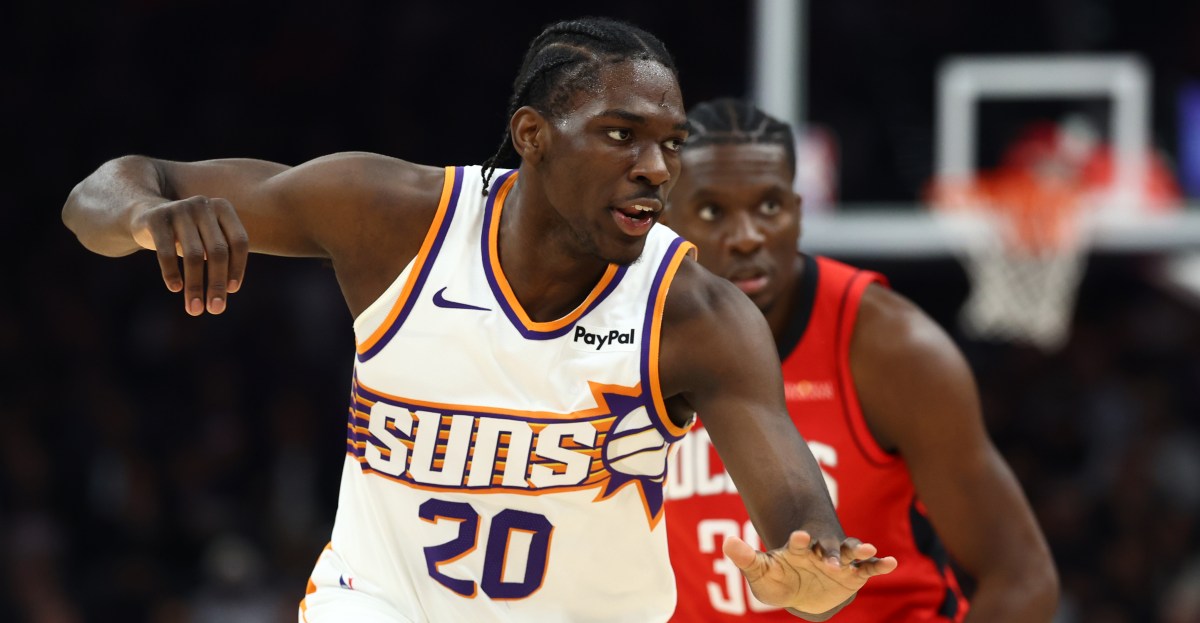
Rasheer Fleming still has work to do. You see it in the small moments. The spacing in transition. The hesitation on where he should be standing. The game still looks fast to him at times. That is fine. That is youth. That is how this works. But at this point, I would rather live with those 8.9 minutes going to Rasheer than to Nigel.
I am not saying the same thing about Khaman Maluach. He is 19. Big men take longer. That part of the process still needs air. But with Rasheer, I think it is time. He has the two things you cannot teach. Length and athleticism. And after watching him go for 27 points and 13 rebounds and knock down a game-winning three last week with the Valley Suns, my curiosity is trumping my patience.
This is not a critique of Hayes Davis as a person. He got his shot. He has had his runway. He has not kicked the door down. And now the youth is standing right behind him, tapping on the glass.
Because when Rasheer steps on the floor, the energy changes. That wingspan looks like it could block off a hallway. He is from Camden, New Jersey. The Camden Condor might be born right in front of us. And I think it is time to find out what that really looks like under NBA lights.