
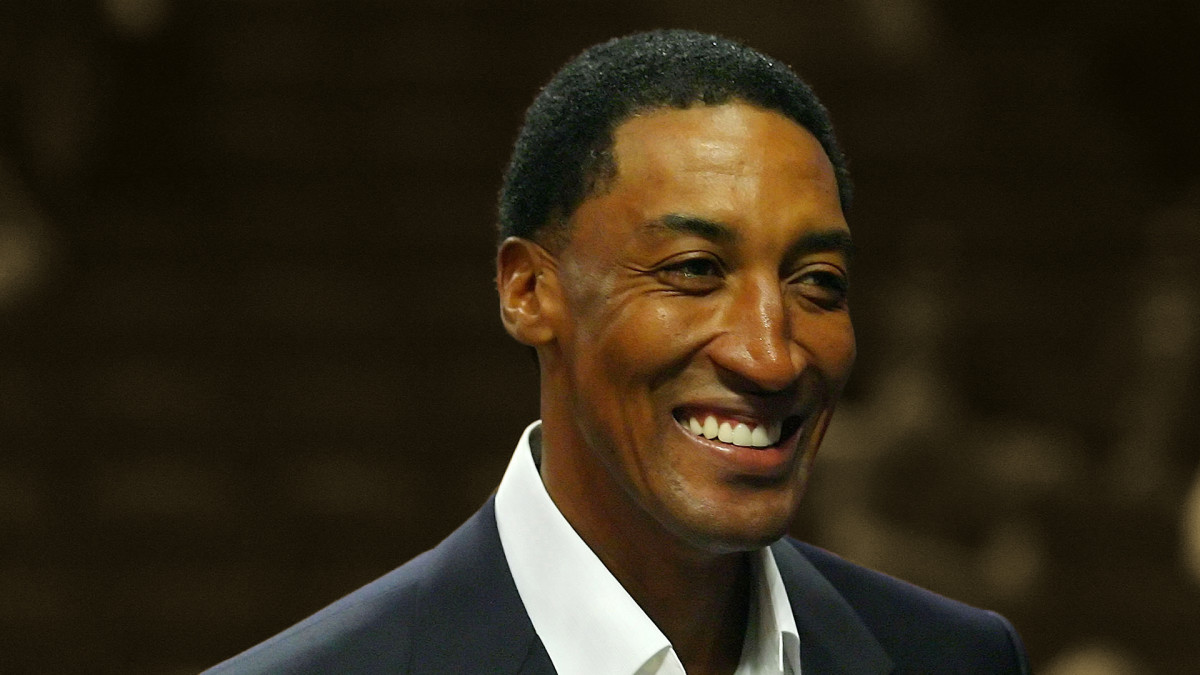
One of the biggest controversies of the 1990s took place inside the Chicago Bulls‘ locker room. That might sound surprising considering they were probably the most dominant team of all time, driven by Michael Jordan and Scottie Pippen, but the truth is that there was a lot of tension in that locker room.
Many believed Pippen would have been an MVP-caliber player on any other team, but he dedicated himself completely to team success, which ultimately resulted in six championships from six NBA Finals appearances. However, the 6-foot-8 forward was not paid in proportion to that success.
Advertisement
The fact that in the 1996–97 season he was only the sixth-highest paid player on the team, while Jordan was earning a then-record-breaking $33 million, ate away at Pippen from the inside. That dissatisfaction peaked after winning the sixth Larry O’Brien trophy, when the championship core broke up and Pippen went to the Houston Rockets.
“Well, this is great, Hannah, I tell you, it’s a situation that I have waited through my career but you know I am obligated to a contract and I felt obligated to finish it out and give my best and just show people it’s not playing for the money all the time but it’s the love you have for the game. Even before Michael announced his retirement, I knew I was taking a different route than returning to Chicago,” Pippen said after signing with the Rockets.
Pippen was one of the main reasons for the NBA gaining popularity in the 90s
The five-year, $67,2 million contract certainly helped after he had earned around $35 million over 11 seasons up to that point, which clearly suggested how underpaid he had been relative to his on-court impact, even though that money was still significant.
Advertisement
But Scottie was a victim of a different NBA era, when players signed longer-term contracts. He specifically was locked into a seven-year deal he signed after winning the first title with the team from the Windy City. That contract was worth about $19 million over seven seasons, averaging a little over $2.6 million per year, while his new Rockets deal paid him about $13 million per year.
Team owner Jerry Reinsdorf warned Pippen about his extension back in 1991.
“I told him when he was getting ready to sign this deal that ‘Halfway through it you’re going to think you’re underpaid, especially since we front-loaded it,'” Reinsdorf told Sam Smith of The Chicago Tribune.
Advertisement
“His answer was, ‘You’ll never hear from me.’ I told him I didn’t believe it, but he promised that would be the case. I know he’s underpaid. Sometimes I make good deals and sometimes I make bad deals,” he added.
Pippen got paid, but didn’t reach championship heights ever again
Still, in 1991, no one could have predicted that the meteoric rise of the Bulls would take the league’s popularity to another new and unseen level, bringing massive new sponsorship deals. Of course, MJ was the starting point, but without Pip’s contribution, “His Airness” never would have reached the heights he did.
Advertisement
From that perspective, Pippen surely felt he was one of the main reasons for everything that was happening around the organization and the league itself, but he was stuck in a deal that, from today’s perspective, was far below standard.
With the Rockets, he finally got paid for everything he had done throughout his career, but he never again reached the heights he had with the Bulls.
This story was originally published by Basketball Network on Dec 8, 2025, where it first appeared in the Off The Court section. Add Basketball Network as a Preferred Source by clicking here.