
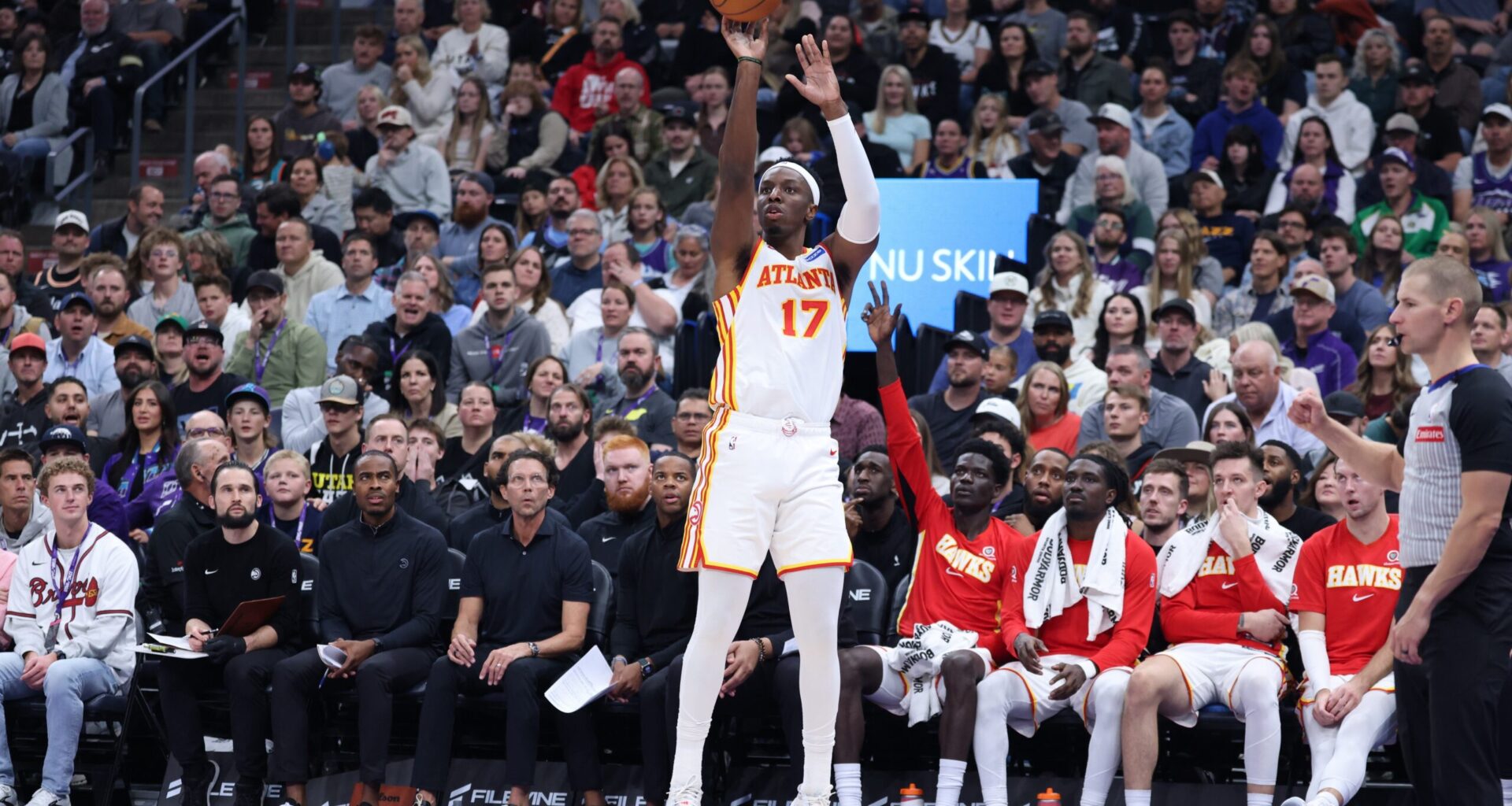
The Atlanta Hawks have been waiting for the day Onyeka Okongwu stopped being viewed only as an energy big and started looking like a complete modern big man. That moment is arriving now. As his jumper becomes more reliable and his confidence grows, he’s shooting more with no hesitation, turning speculation over Okongwu’s stretch big upside into a real, nightly weapon.
For years, Okongwu’s value was rooted in classic blue-collar work. He set bone-rattling screens, rolled hard to the rim, battled on the glass, and protected the paint. Those strengths are still there, but his game is expanding. With each catch-and-shoot jumper he takes, Okongwu’s potential as a stretch five begins to reshape how defenses have to guard the Hawks.
When bigs can no longer camp in the paint and ignore him on the perimeter, the floor opens up. Drivers see larger gaps, cutters have clearer lanes, and kick-out reads become easier. That is the difference between a traditional five and a modern big who can shoot. Okongwu’s growth nudges him firmly toward the second category and makes his potential as a floor spacer a central part of Atlanta’s offensive identity.
Okongwu’s Stretch Big Upside Elevates the Hawks
The impact shows up most clearly in pick-and-roll and pick-and-pop actions, where he’s now shooting 35% from three on 4.3 attempts per game. Instead of always diving to the rim, Okongwu can now pop to the three-point line or settle into the midrange. Defenders are forced to choose between sticking to him on the perimeter or helping on the ball. Either decision creates a problem. When they stay home on Okongwu, ball-handlers gain more freedom to attack. When they help off him, he gets clean looks that showcase his perimeter shooting as a scoring option.
This evolution also adds layers to the Hawks’ playbook. Handoff actions, ghost screens, and five-out sets all look different with a big who can shoot. Okongwu can fake a screen and pop out, or slip a pick and still be a threat from outside. Those wrinkles keep defenses guessing and turn Okongwu‘s stretch big upside into a constant source of pressure.
Two-Way Anchor and Long-Term Modern Big Identity
Defensively, his foundation remains strong. Okongwu can switch onto smaller players, hold his ground at the rim, and rebound through contact. Nothing about his stretch big upside takes away from that. Instead, it gives him more ways to impact the game after stops. When the Hawks run in transition, he can trail into a pick-and-pop, spot up as a release valve, or drift to the corner for a three instead of living only in the dunker spot.
The front office also benefits from this development. A big who can defend in space, finish inside, and stretch the floor is one of the most valuable archetypes in today’s NBA. With the Okongwu stretch big upside becoming real, Atlanta gains more flexibility in roster building. He can fit next to a traditional center, pair with another forward, or anchor smaller lineups without compromising spacing.
Long term, this growth changes how opponents game-plan for the Hawks. Teams can no longer treat Okongwu as a non-shooter they can help off of every possession. The more he hits those open jumpers, the more respect he demands. As that happens, the Okongwu stretch big upside goes from a subtle bonus to a key reason Atlanta’s offense feels harder to guard.
Ultimately, this transformation is about repetition and belief. Every time Okongwu steps into a jumper in rhythm, he reinforces that this version of his game is here to stay. Defenses will adjust slowly at first, then all at once. When that tipping point comes, the Hawks won’t just have an energetic big who does the dirty work. They’ll have a true modern stretch big, with the Okongwu stretch big upside fully realized and unlocking a more dangerous version of their offense.
© Rob Gray-Imagn Images