
The 2025-26 Washington Wizards have two main problems that keep them from winning:
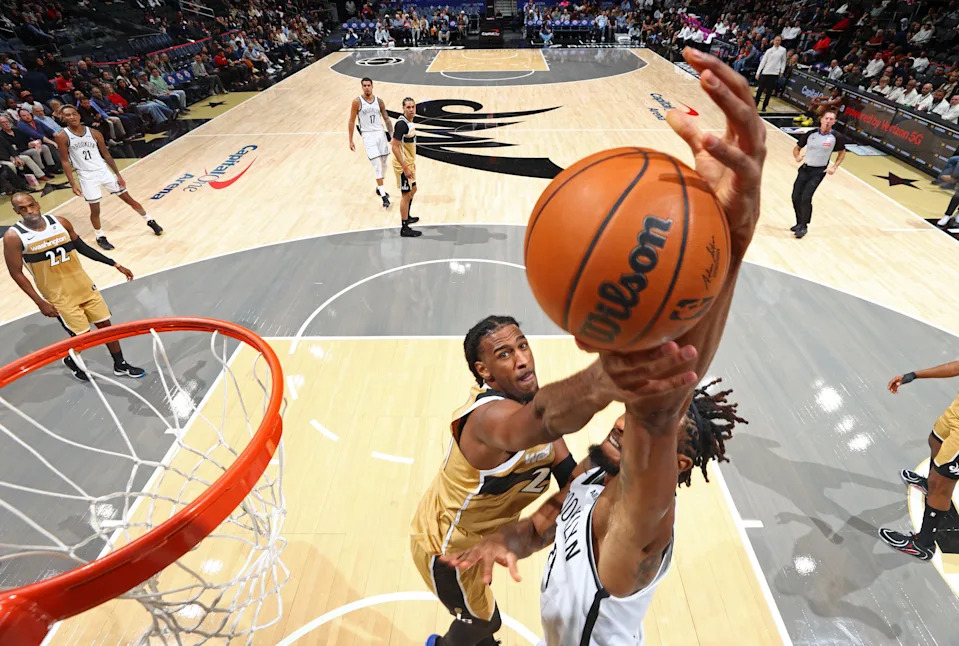
Wizards big man Alex Sarr protecting the rim with a block.
Aside from that, they’re…well…bad at most of the other parts of the game. But hey, someday in the future, maybe they won’t be bad at everything.
Advertisement
By the way, the list above was in rank order. They’re 30th in defensive rating — 2.2 points per 100 possessions worse than the 29th ranked New Orleans Pelicans, and an astonishing 19.4 points per 100 possessions behind the top ranked Oklahoma City Thunder.
As would be expected for what could well be the worst defensive team in NBA history, the Wizards have a lot of weaknesses on the defensive end.
Chief among these is that they don’t take anything away from the offense. One of the insights from us stats and analytics goobers is that the game’s most valuable shots are from close to the basket, from the free throw line, and from the three-point line. Per NBA tracking data, the Wizards allow the second most field goal attempts inside six feet, the sixth most three-point attempts, and the 10th most free throws.
Note: The above numbers are per game, which I don’t like much, but the NBA makes it kind of a pain to work with their data.
Advertisement
The Wizards are also at the bottom in forcing turnovers. And obtaining defensive rebounds.
In other words, opposing teams mostly get the shots they want — in part because the Wizards can’t make them commit turnovers. When they miss, they have a good chance of getting the offensive board and resuming the possession. And through all that, the Wizards foul frequently, giving opponents lots of high-efficiency free throws.
And, the news kinda gets even worse. Those throbbing forehead veins and hoarse voices sported by head coach Brian Keefe and his gallery of assistants is due in no small part to the team’s horrific transition defense. According to NBA tracking, Washington allows the third most opponent transition possessions (23.8 per game) and have the league’s least effective transition defense (allowing 1.28 points per possession).
The Wizards are allowing 30.4 points per game because they don’t get back and guard someone. The inability to force turnovers shows up here too — Washington is 30th in forcing transition turnovers. The numbers tell us that if the other team gets into transition, they have a 91% chance of getting a shot (field goal attempt or free throw). Given Washington’s league worst 66.3% transition defensive efg%, it’s going to be a good shot, too. Opponents score about 56.5% of the time in transition — another league worst for Washington’s defense.
Advertisement
Everything is not bad with the Wizards defense. Alex Sarr leads the league (by a wide margin) in shots defended at the rim, and opponents shoot about 12% worse when he’s the closest defender. This positive shines an uncomfortable spotlight on…well…nearly everyone else. It’s nuts that so much defensive burden is being dumped on the 21-year-old second-year big man. The guy needs help.
Teams around the league are finding different levels of defensive success with varying tactics. Oklahoma City Thunder is the clubhouse leader and might bookend Washington’s “worst ever” status by being “best ever.” The Thunder do it with a swarming, pack-the-paint designed to keep opponents away from the middle and the rim.
They do some really cool stuff other teams are copying like pre-helping (bringing the weakside “low man” into the paint where he’s in better position to gang up on any dribble penetration or cutters. They then zone the weakside and ask their guys to close out hard if there’s a skip pass or ball reversal. The first principle is to protect the rim — they’re willing to live with allowing a few more threes.
They also hack like crazy, generate tons of steals, force turnovers, and generally make life miserable for opponents. I want to emphasize that the OKC defense is still predicated on making the other team miss shots. Even with all their ball pressure and jumping of passing lanes, opponents get a shot (or get fouled) on 85% of possessions. The Thunder have the best defense primarily because of their league best 51.1% defensive efg.
Advertisement
The point here is not to compare the Wizards with the Thunder, but to make a suggestion by way of analogy. That suggestion: try to take something away from the opponent. Pick something and simplify. Say, “no middle” and do it, even if you’re giving up some threes, even if you have to foul, even if it looks bad sometimes.
Or make it something else. Set a goal of limiting the opposition to 20 three-point attempts in a game. Decide you’re going to get 15 steals as a team. Do. Something. To. Succeed.
This brings me to the team’s offense and a momentary digression. I have a son (now grown) who was an elite musician. His progress took off when his teacher — a professional musician — taught him how pros practice. When you hear your favorite musician play a pyrotechnical, virtuosic solo, or perfectly execute a concerto, their performance was built methodically.
That method: break the piece into chunks, play the chunks slowly until each one is perfect, and then speed it up. Stitch them together and lather-rinse-repeat until you’re over tempo (playing it even faster than you will live), and then back it off to the performance speed. If you ever go to a strings festival and it sounds like whales singing to each other, it’s because the performers are in the early stages of this process.
Advertisement
Anyway, the point here is that the Wizards famously want to play fast. They’re fourth in possessions per 48 minutes (the standard measure of pace), tracking says they have the third highest average speed (fourth fastest on offense, sixth fastest on defense), and they have the fifth fastest trigger in the league (measured by seconds per possession).
While I know that “playing fast” is The Official Way To Do Things when you have a young team, I’ve never really understood why. Young guys run well? Have energy? What?
My first issue with deciding in advance that This Team Will Run is that it presupposes an answer without asking the question whether this is the right tempo for this team. Analytically, there’s no merit to playing faster (or slower). There have been good and bad offenses and defenses from teams that play fast or slow or in-between.
My personal belief after tracking efficiency vs. pace over more than a decade is that it just doesn’t matter. Teams should try to play at a pace where they’re comfortable and can execute their offensive and defensive schemes — where they can be quick but never hurry, as John Wooden famously said.
Advertisement
One under-discussed aspect of playing fast is that it requires fast decision-making. There is literally nothing about anyone on the Wizards roster is well-equipped at this point in their careers to make good decisions at the speed required to be successful.
I think this struggle to make decisions at speed shows up in a variety of ways:
29th in transition offensive efficiency
27th in transition free throw attempts
29th in transition turnover rate
Including all possessions, they’re 30th in turnover rate, and 26th in offensive shot quality.
Keefe preaches ball movement (another basketball activity that isn’t necessarily meaningful), but they make the third fewest passes per game and they’re just 25th in productive passing (passes that are potential assists).
Advertisement
I don’t want to downplay the overall efficiency boost that comes with transition possessions, but that boost typically comes from making good decisions while having some kind of advantage (numerical or matchup). But my sense is that many of the Wizards youngsters are still in that playing like whales singing to each other phase, and that they’d benefit from an emphasis on making the right play rather than making a fast play.