
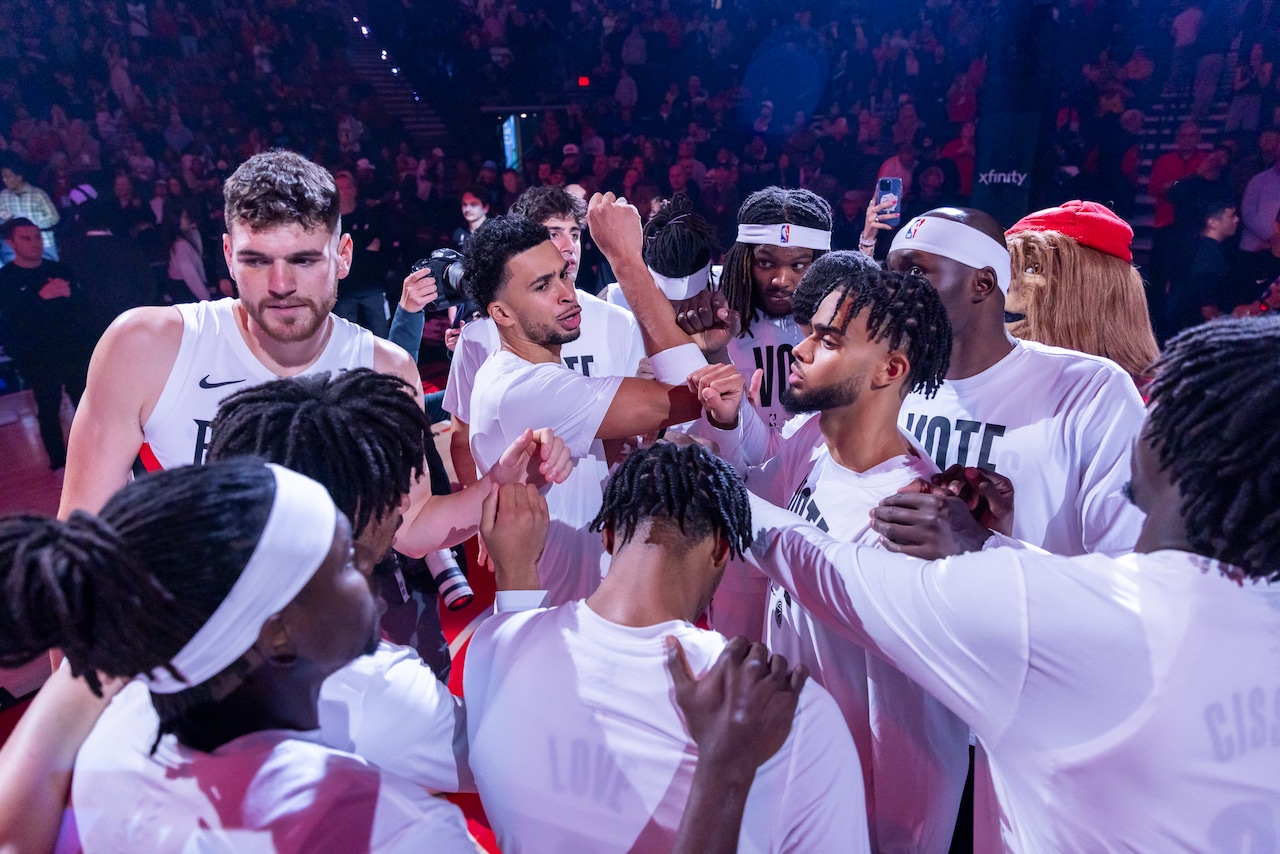
TUALATIN — When the doors to the Portland Trail Blazers’ practice facility opened Tuesday afternoon, reporters were greeted with a curious thing:
Silence.
There was no booming music, no echoing whistles, no squeaking shoes, no bouncing basketballs.
There was not the usual array of bustling post-practice activity, which typically includes individual shooting, small-group film review and occasional two-on-two competition.
Instead, there was just an empty, soundless gym.
And while it was a surprise, it was also rather fitting, symbolizing one of the most pressing issues troubling this young and developing team.
“One of the biggest things (for us) is being able to speak to each other on the court,” Blazers forward Toumani Camara said. “It’s very quiet out there at times and … even though we have some tough losses here and there, (we can’t) get away from what we’ve been doing and our togetherness and stuff like that.”
After a promising 5-3 start to the season, the Blazers (9-15) have nose-dived, managing just four wins over the last 16 games.
The schedule, which has been the most difficult so far in the NBA, has been vicious. The home-road split, which has included just nine games at the Moda Center, has prevented acting coach Tiago Splitter from holding practices. And, of course, a ludicrous run of injuries has emerged as the No. 1 issue plaguing Portland.
But the No. 2 issue — even if it’s a distant second — seems to be communication. Or rather, a lack thereof.
The Blazers don’t call out screens as often as they should. They don’t always shout defensive adjustments, like whether Splitter has shifted them from man-to-man to zone or vice versa. The bench doesn’t always bring enough energy. And when someone needs a kick in the keister, when it’s time for a Blazers player to challenge his teammate, the challenge doesn’t always happen.
“We’ve got to speak up,” Splitter said. “All those little adjustments on the court sometimes (have) to be made by them. I cannot dictate everything that’s going on from the bench. It’s too far. So they’ve got to do those little talks in the court. That’s why we’re asking them, ‘You guys got to speak more. You guys got to demand from your teammates in a good way to get better.’ Those types of talks in the game are important and we are trying to get better at that.”
So why the miscommunication?
For starters, the Blazers’ most vocal leaders, veteran point guards Jrue Holiday and Damian Lillard, have been sidelined with injuries. Lillard is expected to miss the entire season recovering from Achilles surgery and Holiday hasn’t played since Nov. 14 because of a right calf strain. Other vocal veterans like Robert Williams III and Matisse Thybulle have also been sidelined for extended stretches, joining a lengthy injury list that has seen 10 different Blazers miss a combined 117 games.
It has unexpectedly forced a cluster of young two-way players and end-of-bench contributors into prominent roles. As they develop and grow more comfortable with expanded roles, communication has been the least of their worries, which often shows in the heat of the moment on the court.
What’s more, the Blazers’ roster is not exactly littered with outspoken personalities.
“I think we have a lot of introverted people, people that are very intelligent,” Camara said. “We’ve just got to force ourselves to speak a little bit more. I’m not saying we don’t speak at all on the court. But we can definitely improve in that area and I think that’s something that can push us to the next level.”
The quietness tends to surface most when the challenge is most extreme — when the shots aren’t falling, when the defense has lapses, when an opponent is surging on a big run. Instead of confronting the issue and fighting it collectively aloud, the Blazers tend to retreat inward and push through the challenge within.
When asked if there was a moment on the Blazers’ recent four-game trip when the silence stuck out, Camara said there were moments whenever the team faced a “struggle.”
“I feel like Detroit … we were very quiet,” he said. “I think Memphis we were very quiet. And then you have other games like Cleveland, we weren’t more talkative, but I feel like our attention and energy was a little bit different. So I feel like sometimes being able to talk to each other and stuff like that is going pick up those lax (moments).”
It’s been a point of focus for Splitter and the Blazers’ coaching staff, who relentlessly raise the issue seemingly every chance they get, including during timeouts in games, during pregame and postgame film sessions, during shootarounds and during meetings.
The Blazers have largely been competitive amid their struggles — 15 of their 24 games this season have featured “clutch-time” minutes, when the score is within five points in the final five minutes. But they’re just 6-9 in those games.
In these close games where two or three possessions decide an outcome, even the smallest of things — like communication — can be the difference between a win or a loss.
“I think we’re very good guys and everybody’s put a lot of pressure on himself,” Camara said. “I feel like communication kind of helps get your mind off you, kind of (helps you) focus on whatever you have to do in the moment …
“I try to be one of the big talkers, whether it’s on the bench, during timeouts or in the game. Defensively, I try to communicate everything that I’m doing, whether it’s being on help side or everything that I see. I feel like it kind of takes me away from being too self-focused, too self-centered and putting too much pressure on my performance.”