
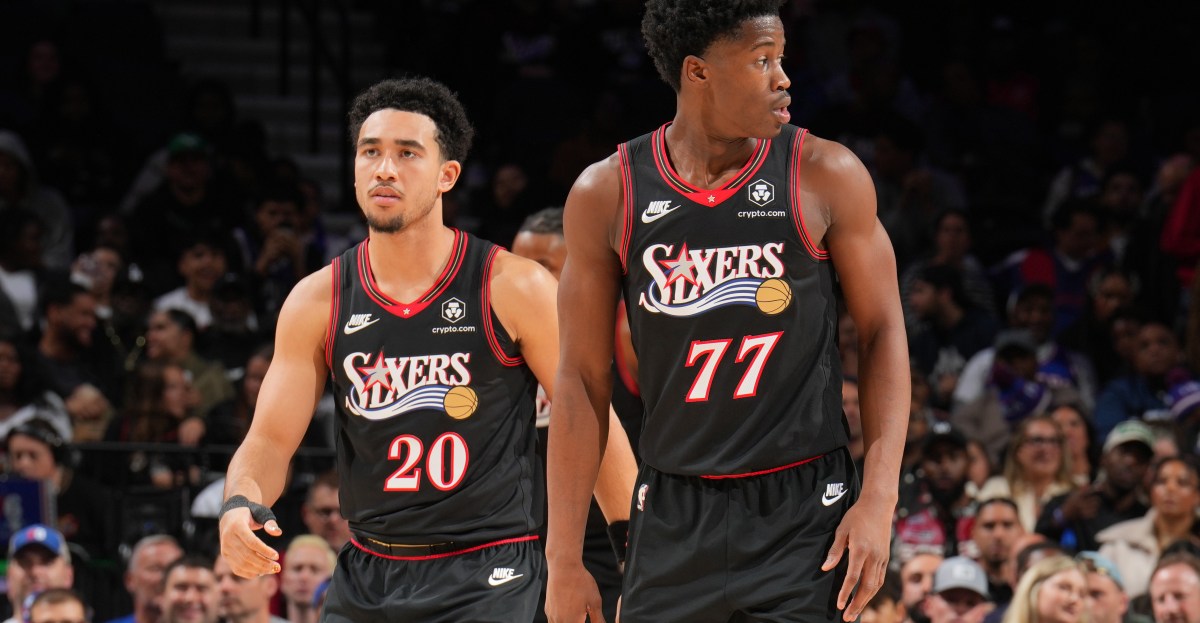
Anyone watching Jared McCain in his first few games of the season could tell he was still dealing with the lingering effects of the thumb and knee injuries that kept him out of action for 11 months. The bulky brace he wore on his knee restricted his mobility and he could not buy a jumper to fall. There’s no better stat to turn to here than the simple fact that he was scoreless in the first four games he appeared in this season.
How shaky he looked impacted how much Nick Nurse trusted him to be on the floor, creating a negative feedback loop of not making enough of an impact to stay on the floor, but not getting enough minutes to get in any possible rhythm. After playing 15 minutes in his first game back, McCain would not play more than 10 minutes in a game for a whole two weeks.
A two-game stint in the G-League with the Delaware Blue Coats to get his feet under him seems to have done exactly that. McCain’s averages still aren’t close to what he put up when he burst on the scene as a rookie, but he’s now averaging 7.5 points playing 18 minutes a night, doing so on 38.1% field goal shooting and 35.7% from three-point range.
He’s put together performances that look more and more like his brilliant, shortened rookie campaign, but is still the odd man out when it comes to the Sixers’ four guard rotation of himself, Tyrese Maxey, VJ Edgecombe and Quentin Grimes.
After playing over 20 minutes in seven straight games, McCain only played 12 minutes in a loss to the Los Angeles Lakers, a loss in which the 35% from the field shooting Sixers were desperate for someone to put the ball in the hoop. Nurse cited concerns over McCain’s ability to hang defensively against a team as big and long as the Lakers.
Those are valid concerns. McCain’s size and lack of quickness have always presented challenges for him to stay in front of guys. Working his way back up to game speed after missing so much time hasn’t helped either, it’s seeped its way onto the offensive end as well. Per Cleaning the Glass, McCain is taking 8% less shots at the rim from a season ago, dropping him from the 67th percentile in his position group to the 40th.
Even after filtering out his 0-for start, he’s been much less effective in the midrange compared to a season ago. He’s shooting 29% from that part of the floor as opposed to 46% last year, again, a big jump down in percentile.
While this is all true, he has really started to look more like himself as he’s gotten more run. Filtering games since he’s actually hit a shot, that midrange percentage is up to 35%.
This puts the Sixers at an interesting crossroads: McCain’s physical profile leaves him the least trusted by the coach, but his shooting skillset is a necessity, especially to ease the load of the league’s leader in minutes, Maxey.
The key to figuring out this conundrum may lie in the second unit, though it will come with a lot of growing pains. Something the Sixers have gone to with Maxey on the bench since they’ve had (close to) all their guys on the floor is the show being ran by Edgecombe and McCain.
It’s been exciting to see that lineup work, not only because of the real-time growth between two of the franchise’s potential most important long-term pieces, but also because of the extra rest it’s been able to give Maxey in games.
McCain made a great example of this with the 20-point game he dropped on Nov. 28 against the Brooklyn Nets, but take it with all the grains of salt given the opponent.
Another example was the eight-point stretch he had in the second quarter in that loss to the Lakers. His time running the offense gave Maxey the chance to sit a couple extra minutes, but a big reason is a variable the Sixers cannot rely on as much, and that’s Joel Embiid being available.
Even on a night where he shots 4-of-21 from the field, in another season where he hasn’t looked as physically dominant, Embiid has still drawn an incredible amount of attention from opposing defenses. There’s perhaps no other Sixer with the proper feel, relocation skills and shooting ability to take advantage of Embiid’s gravity. How hard he gets Austin Reaves to bite and get himself wide open here is a great example of that.
Lineups with McCain and Edgecombe so far do not have the best metrics. The Sixers have a -5.4 point differential with those two on the court and a big reason is the 100.7 points per 100 possessions they’ve scored, which would be the in the league’s worst percentile.
The numbers of most frequently used lineup with those two however look great, and that lineup happens to feature Embiid, someone’s who typically started quarters this season as part of his minutes restriction.
The lineup of Embiid, McCain and Edgecombe along with Grimes and Jabari Walker have a +29.8 point differential, scoring a blistering 123.5 points per possessions. Of course it’s worth remembering the tiny 17 possession sample size there’s been of said lineup.
Still, McCain continues to look more like the version of himself from a year ago the more minutes he gets, and it’s clear he knows how to play off of offensive talent. With the team’s offensive rating cratering every time Maxey leaves the floor, McCain’s role as leading the second unit offense should be clear.
It won’t be an easy balance to strike, trying to win games right now while letting two players younger than 22 years old carry so much responsibility. It’s a big ask of Edgecombe as well, whose shooting has come down to earth since his torrid start to his career.
Giving these two the reigns with Maxey on the bench may not help the Sixers win the most games this season. McCain will certainly struggle with defensive assignments more than someone like Grimes. Edgecombe may never develop into the complete offense player he’s shown flashes of, but it’s time for the Sixers to start finding these things out.
With the two players on this roster making 57% of the team’s salary as unreliable as ever, the Sixers need to continue shifting their priority in this direction.