
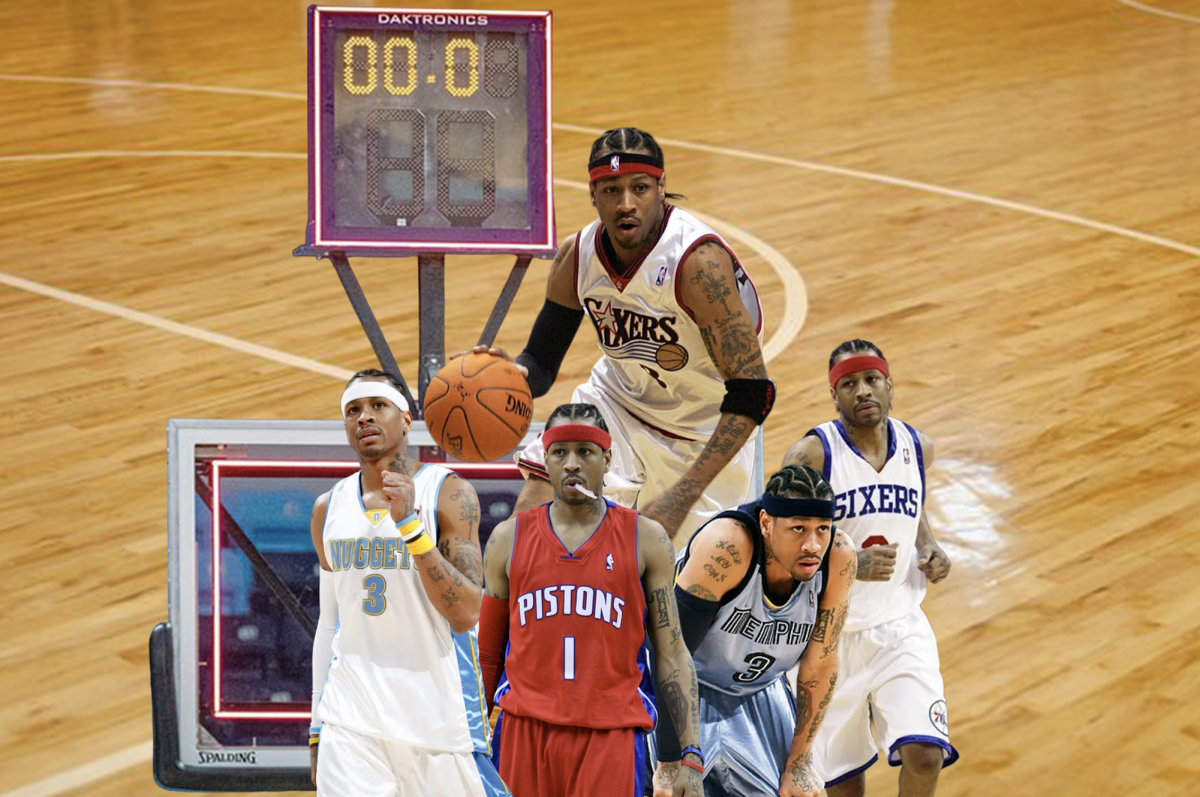
I remember as a kid seeing pictures of my favorite players wearing different jerseys from other teams that I never knew they played for. Some that stuck out to me were Brian Dawkins who played for the Denver Broncos, Emmitt Smith who played for the Arizona Cardinals and Patrick Ewing on the Orlando Magic. As I watched them in their odd colors, it never made sense to me why these legends would play a couple extra seasons when they could retire while they still had their dignity, being remembered as the great players they were. It struck me as something that I would never do if I was in their position.
Crowds cheered his name, he’s the face of the NBA. He led his team to 56 wins, the second-best in the league. Just 26 years old, averaging 31 points per game along with five assists and three steals. He won MVP in the 2000-01 season and had finally come into his own after being drafted in 1996 with the 1st overall pick from Georgetown University.
If you haven’t guessed already, this player is Iverson, the Philadelphia 76ers legend during the 2000-01 season. Iverson led a fruitful career and played phenomenal basketball for the Sixers for a decade before eventually being traded as his relationship with the team soured. Soon after, in his age 32 season, Iverson became a solid second option for the Denver Nuggets, averaging 26 points per game and being named an All-Star.
After beating some of the best stars in the league, like Vince Carter and Ray Allen in the playoffs, he led the Sixers to the NBA Finals to play the juggernaut Los Angeles Lakers. Despite losing 4-1 in the finals, Iverson’s legacy would be cemented in greatness forever. He was a superstar on and off the court, becoming a pop culture icon before social media was around. He was on top of the NBA world, and it seemed as if this high would never end.
Unfortunately for Iverson, he took a steep decline in his second year playing for Denver and would eventually be let go due to the lack of playoff success with co-star Carmelo Anthony. Denver decided to move on from the aging Iverson, sending him to a young Detroit Pistons team. While in Detroit, Iverson hit a roadblock. Every team so far that he played on, he was a key contributor, playing 35+ minutes a night. But, once he got to the Pistons, they asked him to come off the bench. Iverson refused, later saying, “I’m not a bench player. I’m not a sixth man.” Iverson wanted no part of that, believing himself to still be an All-Star caliber player. He would later be released from the Pistons, then playing out his twilight years with the Grizzlies, until finally retiring with the 76ers in the 2009 season.
The end of Iverson’s career was marked with drama and loss. He refused to just be a “locker room guy” and wanted to be “the guy” like he was in the Sixers. He wanted to be “the guy” for every team so he could lead them to the finals just like he did in 2001.
That is what brought me to Iverson, as a case study, to ask the question: should NBA veterans commit to the leadership role, or should they still fight to be the top guy? Father Time is undefeated, yet, players like Iverson continue to think they can beat the clock.
Even one of the greatest NBA players of all time fell victim to the trap of playing too long. In 2001, Michael Jordan came out of retirement to play for the Washington Wizards after being their president of basketball operations. Jordan averaged a modest 23 points per game on 22 shots per night, with his field goal percentage being barely above 40%.
He ultimately was “the guy” on a bad Wizards team that won 37 games, but Jordan was clearly not his old self. And what was the point? To put up bad numbers instead of leaving your legacy as retiring on top of the NBA with a threepeat?
The NBA is currently running rampant with aging superstars who refuse to give it up, including players like Russell Westbrook and Klay Thompson. We don’t have to look any further than current Sixers small forward Paul George for a true downfall. NBA fans can see George’s decline, a player once known for his high-flying ability is now relegated to a 3rd, maybe 4th option on a just okay Sixers team who currently have a record of 13-10.
George is averaging 14 points per game and shooting 42% from the field. If he wasn’t being paid $52 million a year, he would most likely not be a starting player in the NBA anymore.
Some players just don’t know when to call it quits.
Players that were offered the role of a veteran leader have had more success with the fans and the team in the end. Power forward Udonis Haslem played for the Miami Heat for 20 years, going from a contributing big man for 12 years to essentially a player-coach in his last eight.
This is an example of what Iverson could have done. Retiring with the team that drafted him instead of trying to beat Father Time—a feat which has only proven fruitful for one LeBron James.
Every superstar will come to the decision that Iverson had to make: take a step back and lead the team from the bench, or go somewhere else and try to live out the glory days. However, at the end of the day, that’s not the real choice, it’s whether or not a player wants to accept that their time has come.