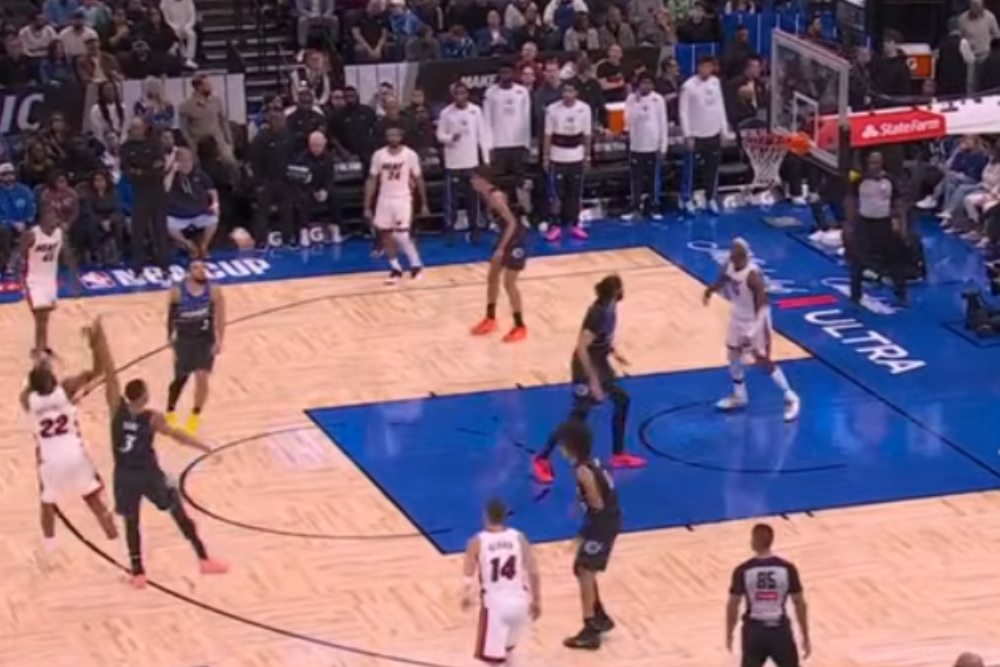
Desmond Bane’s explosive fourth quarter propels Magic past Miami in NBA Cup quarterfinal thriller
The Orlando Magic punched their ticket to Las Vegas on Tuesday night, weathering an early storm before ultimately subduing the Miami Heat 117-108 in an NBA Cup quarterfinal clash that showcased both teams’ resilience and revealed their vulnerabilities.
After surrendering the game’s opening 15 points and watching Miami’s offense ignite with surgical precision, Orlando mounted a methodical comeback anchored by Desmond Bane’s spectacular 37-point eruption. The Magic’s victory, secured despite the absence of injured star Franz Wagner, sets up a semifinal showdown with either the New York Knicks or Toronto Raptors on Dec. 13.
Bane’s Brilliance Overcomes Early Deficit
What began as a nightmare scenario for Orlando—missing their first seven shot attempts while Miami blazed to a commanding 20-4 advantage—transformed into a clinic of offensive adjustments and defensive tenacity. Bane, who struggled initially with two missed 3-pointers, caught fire spectacularly, connecting on four consecutive attempts from beyond the arc during a pivotal third-quarter stretch.
His 37 points, complemented by six rebounds and five assists, marked his third such performance over the past six games, establishing him as Orlando’s most reliable offensive weapon during Wagner’s absence. The high-ankle sprain that will sideline Wagner for an extended period threatened to derail the Magic’s NBA Cup aspirations, but Bane’s versatility proved more than sufficient.
Carter’s Interior Presence Fills Wagner Void
Wendell Carter Jr. delivered precisely the type of efficient, high-impact performance Orlando desperately needed. The center converted six of eight field goal attempts for 14 points while controlling the glass with 10 rebounds, providing the interior presence that kept Miami’s defense honest and created spacing for Bane’s perimeter assault.
Playing without Wagner forced head coach Jamahl Mosley to reimagine Orlando’s offensive identity on the fly. The Magic’s 50 percent shooting from the floor reflected their adaptability, particularly during a blistering second quarter when they connected at a 61.5 percent clip to erase Miami’s early advantage.
Miami’s Three-Point Shooting Collapses
The Heat’s offensive implosion from beyond the arc proved catastrophic. After Tyler Herro, Norman Powell and company established early rhythm with paint penetration and transition opportunities, Miami’s outside shooting disintegrated in the second half. The Heat connected on just two 3-pointers after halftime, finishing a dismal 8-of-33 (24.2 percent) from distance for the game.
This perimeter inefficiency compounded Miami’s broader struggles. The Heat have now dropped four consecutive games, a skid that coincides with opponents’ tactical adjustments. Teams have increasingly deployed zone defenses and clogged the paint, deliberately slowing Miami’s league-leading pace (105.42 possessions per game) and limiting the transition opportunities that fueled their hot start.
Defensive Adjustments Determine Outcome
The Magic‘s defensive scheme in the second half strangled Miami’s offensive flow. By packing the paint and forcing contested jump shots, Orlando disrupted the Heat’s rhythm and prevented the fastbreak points that had characterized their early-season success. The deliberate pace frustrated Miami’s preferred tempo, leading to stagnant possessions and poor shot selection.
Both teams entered the contest tied for fifth in the NBA in defensive rating (111.8), and Orlando’s ability to sustain defensive intensity through the fourth quarter ultimately proved decisive. While Herro and Powell each tallied 12 points to pace Miami’s balanced first-half attack, neither could generate consistent offense when the game tightened down the stretch.
Paolo Banchero’s Quiet Night Masked by Team Success
Orlando’s star player, Paolo Banchero, endured a forgettable opening quarter, failing to convert a single field goal and managing just two points in the period. His struggles highlighted the challenge of compensating for Wagner’s absence, yet the Magic’s depth and Bane’s offensive explosion rendered Banchero’s slow start ultimately inconsequential.
The victory demonstrated Orlando’s maturation as a playoff-caliber squad capable of winning without their full complement of stars. As the Magic prepare for their semifinal matchup in Las Vegas, they’ll carry momentum from a gutsy road victory that required contributions across the roster and showcased their defensive versatility.
For Miami, the loss extends a troubling trend. The Heat must rediscover their perimeter shooting touch and adjust to opponents’ defensive tactics before their early-season promise dissolves entirely.
Source: USA Today