
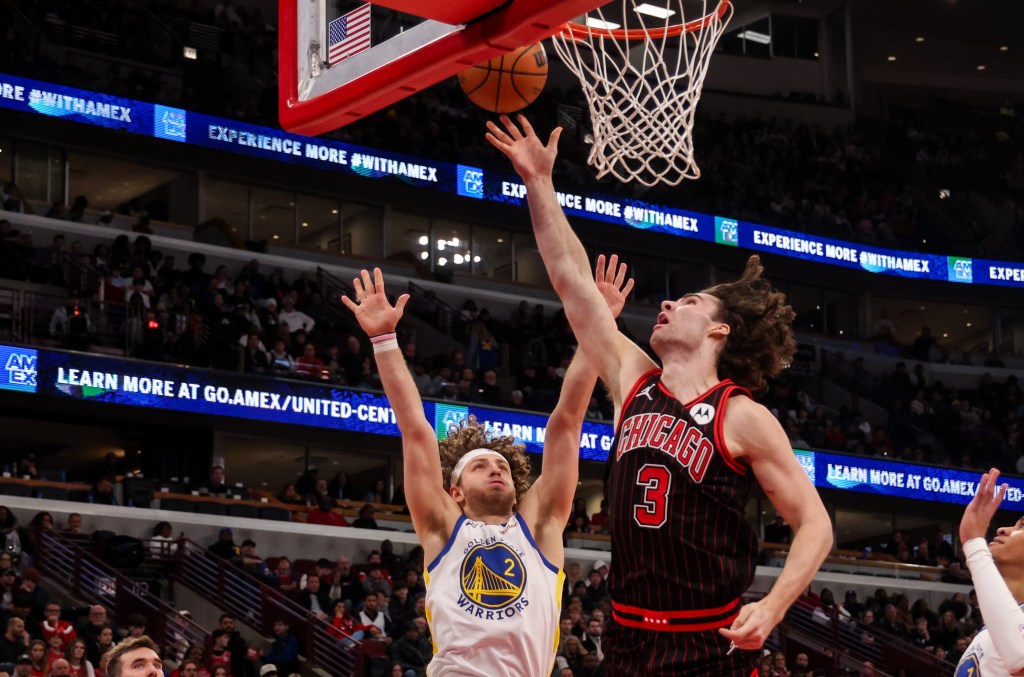
By the fourth quarter of a 125-120 loss to the Orlando Magic on Dec. 1, Chicago Bulls coach Billy Donovan was baffled.
The Magic seemingly had a hex on both baskets. At one end of the court, they couldn’t miss from close range, shooting 77% inside the restricted area.
And somehow that wasn’t the Bulls’ greatest problem. Because on their end, they couldn’t finish within the restricted area if the entire game depended on it — which it did.
Maybe it wasn’t a hex. Maybe Goga Bitadze had figured out how to shape-shift, stretching his already expansive arms like taffy to envelop the air around and above the Magic’s rim. Or perhaps the Magic were gifted with some preternatural ability to predict a shot’s trajectory before it was released.
Those would have been more helpful explanations for how the Magic blocked 11 Bulls shots, snuffing out their hopes of winning by dousing their scoring at the rim.
It would be one thing if this had been a freak occurrence, one of those nights when an opponent enters a flow state on defense. But that’s not the case for a Bulls team that’s losing a grip on what should be its greatest strength on offense.
The Bulls take the second-most attempts (32.5 per game) in the NBA within the restricted area, the 4-foot half-circle that represents the highest-value shots on the court — yet those shots aren’t falling with enough regularity. The Bulls’ 59.9% shooting percentage in the restricted area is the worst in the league.
That doesn’t mean those shots are worthless. Because of the high volume, the Bulls still score 39 points per game at the rim.
But if they shot at even the league-median percentage within the restricted area, that scoring would spike by five points per game. For a team that has tallied half of its losses in clutch situations, that margin is crucial.
The Bulls can’t change their game plan. Getting downhill is the beginning and end of their offensive ethos. But until those shots start falling — and stop getting blocked — the offense will continue to stall.
“We have to get to the rim,” Donovan said. “That’s how you get fouled, that’s how you get offensive rebounds. But the decision-making when we get there has got to be better.”
Not built for the air
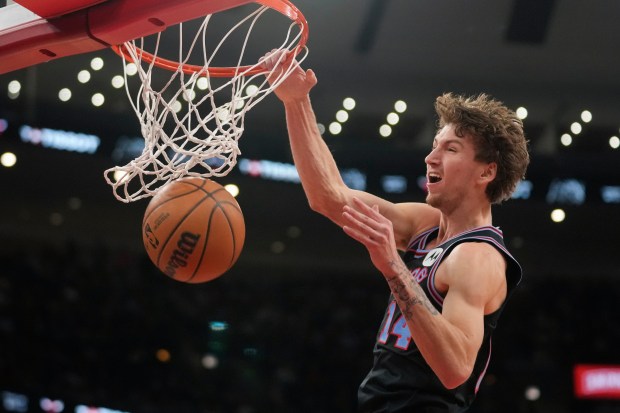 Bulls forward Matas Buzelis dunks the ball against the Pacers on Dec. 5, 2025, at the United Center. (AP Photo/Erin Hooley)
Jarace Walker went right, so Matas Buzelis went left.
That’s one of the easiest formulas for Buzelis to find his way to the basket. Overstep in one direction, see if the defender takes the bait and then sprint like hell before the defender turns back to see his mistake.
The window stayed open for a quarter of a second in a Nov. 29 game against the Indiana Pacers. But Josh Giddey had seen it, threading a pass just shy of Walker’s hip to lead Buzelis toward the rim. Buzelis grabbed the ball, cocked it behind his head and threw down a one-handed slam that has become his trademark.
The dunk is standard fare for Buzelis. But it’s an overall anomaly for the Bulls.
Heading into Friday’s game against the Charlotte Hornets, the Bulls have only 59 dunks in 23 games. That’s barely half the league average of 115.5, a little past the quarter-mark of the season. Only 10 teams had recorded fewer than 100 dunks through Wednesday — and the Bulls are the only team that hasn’t cracked 60.
Dunking isn’t a prerequisite for success. Some of the lowest-volume dunking teams are also the most successful — for instance the New York Knicks (17-7), who have balanced a sub-100 dunk total with their trigger-happy 3-point shooting, which ranks fourth in the league.
But for a team like the Bulls that is trying to live (or die) in the restricted area, this lack of vertical finishing is a clear weakness. A dunk isn’t just a sure-fire method of finishing a shot — it’s also an aggressive way to force opponents to contest and draw more fouls.
Like many of the Bulls’ central woes, this is a reflection of roster construction. The Bulls aren’t built to play above the rim.
Starting center Nikola Vučević was never a particularly bouncy big. Now in his 15th season, he has dunked only twice. The backcourt of Giddey and Coby White doesn’t bring the athleticism to regularly challenge at the rim. Buzelis (17) and reserve forward Julian Phillips (12) have combined for nearly half of the team’s dunks.
“It’s hard for me to speak on because I don’t ever dunk, so I don’t really know what it feels like,” Giddey said with a laugh.
This is a structural issue, which means it won’t be resolved this season. The Bulls can do more to get players such as Buzelis and Phillips above the rim — particularly by capitalizing on their off-ball movement, which can create lanes to the rim via back-door cuts when the offense is humming. And the return from injury of backup centers Zach Collins and Jalen Smith might marginally boost their dunking volume.
But for the rest of this season, the Bulls are resigned to the task of figuring out how to score at the rim without regularly getting above it.
“We don’t have high-flying fives like some other teams do — and that’s OK,” Giddey said. “We find other ways to score.”
Making better decisions
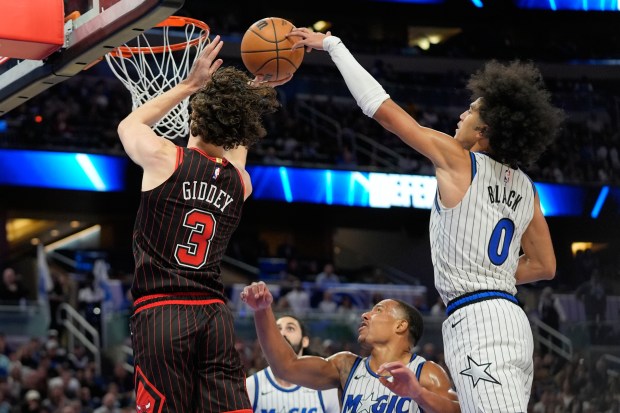 Magic guard Anthony Black blocks a shot by Bulls guard Josh Giddey on Dec. 1, 2025, in Orlando, Fla. (AP Photo/John Raoux)
The process starts with figuring out why they’re missing so many layups and jumpers in the restricted area.
Donovan attributes many of the shooting inefficiencies to the Bulls’ decision-making before the shot even goes up. He noted how wings and guards tend to pick up their dribble too early, forcing them to decide whether to shoot or pass while suspended in air rather than anchored on two feet.
This is a particular weakness for Giddey — and one he acknowledges. He summed up the issue simply: “We’re taking the tough ones.”
Opponents average 6.3 blocks per game against the Bulls. This isn’t entirely surprising — teams that take a higher portion of their shots at the rim also will experience a higher volume of blocked shots. But games like that loss to the Magic highlight how this tendency to get blocked can smother the Bulls’ chances inside.
When the Bulls get downhill, they need to either evade defenders to get off their shot or incite contact to draw a foul. They struggle to execute either option. That means a higher turnover rate and lower-quality looks — both at the rim and on the perimeter, where spray-out 3-pointers should be a welcome release valve.
“Sometimes we make really, really great decisions, and there’s other times where we’ve got to be better at that,” Donovan said. “That’s where we’ve got to get to work.
“We’re doing the right things in terms of getting there, but it’s those split-second decisions — ‘Do I shoot? Do I stop? Do I spray it out? Do I pass it to the next guy?’ — and that’s an area we’ve got to get better.”
Even when they aren’t falling, the Bulls can’t stop taking shots at the rim.
Many of the Bulls players have safety-blanket shots, comfortable go-to options for young players still figuring out “their spots” on the court — an often elusive concept for an NBA player. But these are also often low-variable, low-reward shots.
Giddey loves a running, one-handed, shot-put floater from the free-throw line. Patrick Williams prefers his turnaround jumper. Buzelis falls back on a step-back jumper. Donovan has spent the better part of five years imploring his young players to give up these midrange shots for the greater good of the team. It hasn’t taken.
These shots might feel good, but in reality they’re too inefficient to rationalize bailing on a chance to attack the rim or kick back out for a look from the perimeter.
Sure, the Bulls shoot below 60% in the restricted area. But that’s still their highest-percentage shot on the floor. Their accuracy drops below 50% on non-restricted-area paint shots and below 40% for non-paint midrange shots. Even the corner 3 — the second-most valuable look on the court — is only a 40% option.
“The best shot in the game — besides the free throw — is at the rim,” Donovan said. “In the NBA, you’d say every single time you’re in the restricted area, it’s a good shot.”
But until those “good shots” start falling, the Bulls will remain stuck without a clear outlet to revive their scoring.