
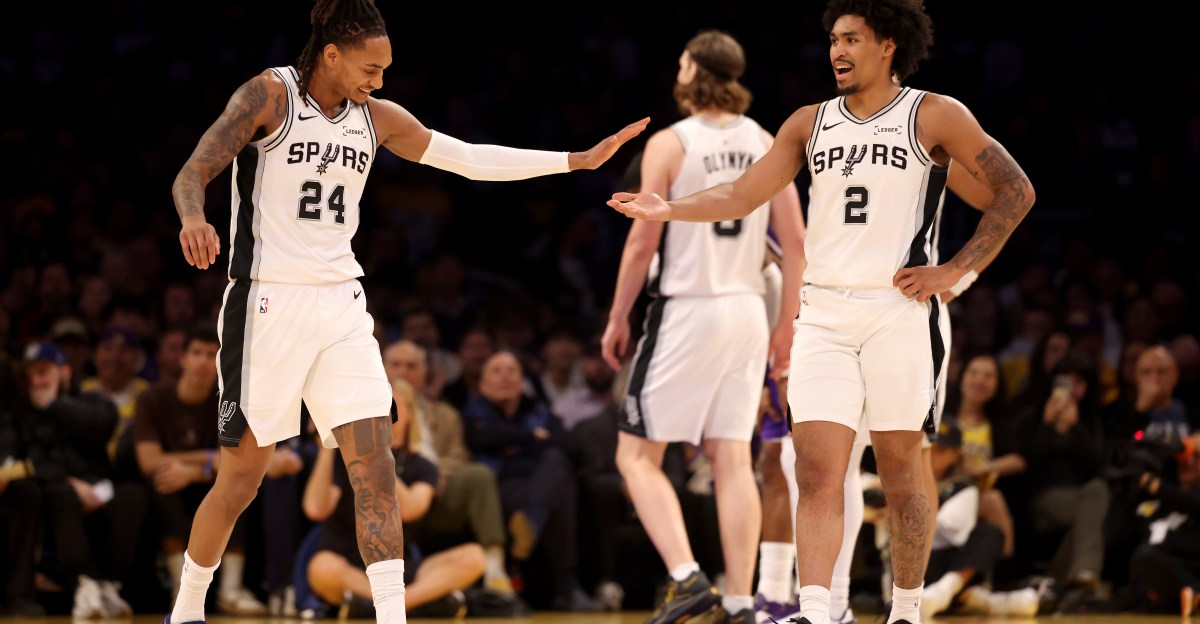
Thanks to my buddy Mike, a fellow hooper of some local renown, I was able to attend the Spurs’ 2025 Emirates NBA Cup quarterfinal game against the Lakers Wednesday night. I was forced to miss my own Wednesday night game, but how often is my team in town for an Emirates Cup Game? (Once.)
One underrated benefit of attending games live and in person is you don’t have to worry about your home recording of the game running out before the end of the game. That happened on Monday night for the Spurs game against the Pelicans which I watched on what we used to call “tape-delay”. The timing was amazing, in a bad way, largely because both teams shot about 100 free throws in the fourth quarter (stats not official). Dylan Harper scored with 9.1 seconds left to put the Spurs up 133-132. As NBA teams almost always do (we did not when I was playing or coaching), the Pelicans immediately took a time-out. Within thirty seconds, my screen went black like the ending of The Sopranos. I still have not seen the last 9.1 seconds of that Spurs game. I also have not figured out the ending of The Sopranos. (Apparently, the Spurs won, but that is what lawyers call “hearsay” because I did not see it myself.)
All that could have been avoided had the Pelicans immediately in-bounded the ball after Harper’s basket, something NBA teams should do much more often than they do. (Under Pop, the Spurs often did.) When I coached, we would take the ball out and go if there were 6 seconds or more on the clock. That is often better than going against a team that uses “your” time-out to set up their own defense. For those of you scoring at home, 9.1 seconds is technically “more” than the 6 seconds rule.
Ironically, it appears that the Pelicans’ play after the time-out with 9.1 seconds left was virtually the same as they could have done if they simply took the ball out-of-bounds after Harper’s go-ahead basket. This is the description from PTR’s Marilyn Dubinski:
After Harper hit an acrobatic layup to give the Spurs a one point lead with 9 seconds left, (James) Borrego drew up about the worst play imaginable. They threw the ball way back into the backcourt, then had Jose Alvarado sprint down the court with the ball. He almost had an open lay-up but threw it back out to (Derik) Queen for an open three at the top of the arc. The problem? Queen is shooting 11% from three for his career, and it clunked off the front of the rim.
I would like to think that my teams would know better than to pass the ball to the 11% guy to attempt the winning basket. And that my 11% guy would know better than to be at the three-point line calling for the ball.
One other thing about the Pelicans game. While I was watching, I realized that New Orleans is stuck with two of the worst professional sports teams in the country. The Pelicans are now 4-22 (the worst in the West), and are being outscored by more than 10 points per game. The other New Orleans “professional” team, the Saints, are 3-10, in last place in their division. Shockingly, neither have the worst record in their respective leagues because they somehow both won their most recent games — Pelicans over the Trail Blazers last night, and the Saints beat Tampa Bay on Sunday.
That was such a big deal that the Saints quarterback (some guy named Tyler Shough) gave a live interview during the game on the local broadcast of the Spurs game. Taylor — sorry, Taylor — seems like a nice guy, but before I saw the interview, I would not have recognized him if he stood directly in front of me. Taylor is listed at 6’5”, so I would have pegged him as an NBA shooting guard with good range, not a starting NFL quarterback. But he was a starting QB in the Saints win over Tampa Bay the day before the interview – and he was still very jazzed about the rare Saints win. (Please note the clever “jazz” reference while talking about New Orleans.)
Enough rehashing the game against the dregs of the NBA heiracrchy. Let’s talk about the Cup. While I was initially skeptical about an in-season tournament which ends in December, I have come around on the concept because I think the players care about it. The players appear to see he Emirates Cup as something different than a normal game during the 82-game slog of an NBA regular season game. For fans who don’t get to go to every game, each game those fans attend is something special. I am not sure the players feel the same.
Another game in another city after another late-night plane ride can become tiresome. But throw in the funky courts, a possible trip to Vegas and $500,000 to each player on the winning team? Yeah, that raises the stakes and the excitement. And for a team like the Spurs, which hasn’t lived through the intensity of the NBA playoffs for several years, even the pseudo-playoff intensity of this weird in-season tournament can only be a good thing. Will we remember who won the 2025 Emirates Cup a year from now? Perhaps not, but for the moment and in the moment, it does mean…something.
While on an early morning bike ride the morning of the game, my Apple Watch flashed a text from my friend TD (no, not Tim Duncan): “Sorry about Wemby”. Wow, that sounded ominous. Had he suffered a more serious injury while rehabbing? Or something worse? It turns out that TD was just saying he was sorry Victor Wembanyama would not be playing against the Lakers. Compared to the alternatives I had imagined as I raced home to my cell phone, that was good news. Though not as good as if Victor would have played.
And it turns out the Spurs held Victor out of the Lakers game, perhaps because they didn’t think he would be necessary to beat the Lakers. Vegas disagreed, making the Lakers 4.5 point favorites, playing at home against a Victor-less Spurs team that had just barely beaten the woeful Pelicans. FanDuel ran an ad in which Bill Simmons said, “I can’t see the Spurs without Wemby beating the Lakers”. Spoiler alert – the Spurs beat the Vegas spread and Bill saw the Spurs without Wemby beat the Lakers.
Whenever I go to a Spurs game in Los Angeles, I keep a special eye out for other Spurs fans. Perhaps because this game was not on the normal NBA schedule, this was the lowest percentage of Spurs fans I have seen, both outside and inside the arena. Though I did see a darling 3-year old girl in a Wembanyama jersey looking at this very moving statue of the late Kobe and Giana Bryant. Yes, I know I should have also taken a picture of 3-year Wembanyama, but she was moving too fast.

I assume that most of you reading this, whether in LA or San Antonio, either saw the game or read about it already, so this will not be a game recap. But I will mention some highlights from the vantage of someone sitting in good seats close to the floor. As everyone knows, the Spurs built a good lead in the second quarter. However, that lead was down to ten when LeBron James had a flashback to 2013 LeBron and dunked all over Luke Kornet. That dunk was right in front of us with 56 seconds, cutting the lead to eight.
The volume in the arena, which had been pretty low as the Spurs began dominating the game, suddenly went from a 3 to a 10. When LeBron then blocked a shot by De’Aaron Fox at the other end, the volume went to 11. Marcus Smart then hit Austin Reaves cutting to the basket and the noise level went to 12 – until Kornet (who had just been dunked on seconds earlier and the slowest guy on the floor) ran the length of the floor to block Reaves’ shot. The noise level went down to a 6, and then back to a sullen 4 when Fox scored in transition, and to even more sullen and muttering 2 when Harrison Barnes stole a lazy Luka pass and then dunked with 13 seconds left in the half. (I could find a a video of the entire sequence past Kornet’s block, but check out the extended highlights from the 9:35 to 10:08 mark.)
After all that, the lead had gone from a possible 6 when Reaves got the pass to 12 when the half ended. I told my unhappy Laker fan Mike that the Kornet block would be the play of the game if the Spurs held on to win, which they essentially did with an 6-0 run to start the second half, pushing the lead to 18.
Another observation from Mike’s good seats: looking out onto the floor, we could see that the Lakers were forced into bad defensive match-ups on virtually every Spurs player. Because the Lakers’ starters don’t include a true point guard, Reaves was the sacrificial lamb asked to guard the much faster Fox. LeBron was often matched on the other guard, either Castle or Harper. In related news, Castle scored 30, and Harper scored 13, many on drives past whichever Laker was trying to stop those drives. And I haven’t even mentioned Luka Doncic matched up on Devin Vassell, or the fact that the Spurs would set some screens to trade in one slow Laker defender to get a Luka match-up. The Lakers essentially start three power forwards (on defense), an off-guard (Reaves) and some center. As a result, the Spurs wound up with 7 players in double figures, with Vassell just a basket away with 8 points.
The Spurs’ depth also meant that these talented young fast players could go full speed all the time, on both offense and defense. No Spur played more than 33 minutes, and eight played more than 22. The slower Lakers played Luka and Reaves 40+ minutes, while 40-year old Lebron played 36 minutes – more than the 27 minutes played by 21-year old Stephon Castle. Coincidentally perhaps, Castle scored more than a point a minute while on the floor, while Lebron scored 19 in his 36 minutes.
I haven’t done a Fun with Box Scores edition for a while, but the box score for this one calls out for at least a short edition. For the game, the Lakers and Spurs both made 43 shots, on 49% and 50% shooting. The Spurs went 17-38 from three, the Lakers 16-37, 45% to 43%. The Spurs had 9 offensive rebounds, the Lakers 8, and the Spurs had only one less turnover. Sounds like the game should have down to the wire, right? What is the missing stat? Free throws. The Spurs took 13 more free throws, made 12 of those extra free throws, and won by 13 points. Why did the Spurs get all those extra free throws? The Lakers could not stop the faster team from getting to the rim, and many of those drives led to Laker fouls and two free throws each time (or one free throw to complete an and-one). Many of the Spurs fouls were non-shooting fouls, such as fighting through screens.
A bunch of Lakers fans decided to beat the traffic and vacated the arena with about 7 minutes left during a time-out with the Spurs up 118-99. Those who made the early departure missed a mini-run fueled by Marcus Smart lighting it up from three (words I have never before written), but that rally sputtered out, and Mike decided to also vacate after Castle’s three-pointer put the lead back to 14 with 1:41 left. My PTR contract required me to stay to the end. I would have stayed anyway. I was then able to walk through the hallways surrounded by unhappy Lakers fans, proudly being the only one wearing my stylish Spurs quarter-zip and a Spurs hat purchased at the San Antonio airport.
Among all those people, I was the only one happy with the game’s outcome. And it felt good.
I decided not to think about the fact that the Spurs had just won the right to play the 24-1 OKC Thunder, who won their quarterfinal game by 50 points. Two days later, I am still trying not to think about Saturday’s game. We may just need Victor for that one.