
In the evolving world of amateur sports, the three-letter acronym NIL has begun rewriting the rulebook.
Short for “name, image and likeness,” it has opened the door for monetization at all levels of athletics.
A financial revolution once seemingly only available for college athletes, NIL is making its way into high school gymnasiums and fields with athletes across the U.S. growing their brand before stepping foot on a college or university campus.
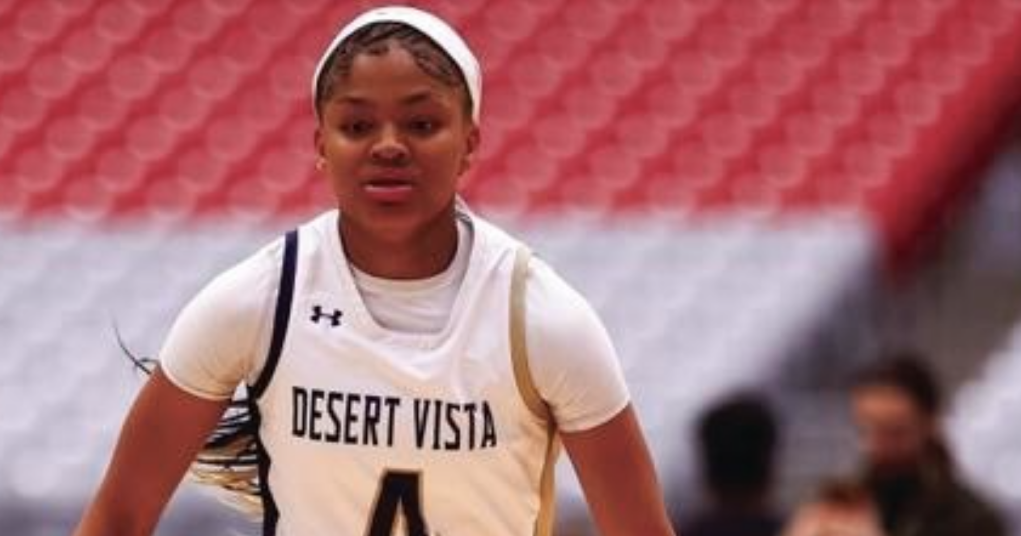
At the center of this shift in Phoenix is Zaire “Cherri” Hatter, a 14-year-old basketball star from Desert Vista High School who has already begun navigating the life of a high-profile athlete.
Hatter represents the new world of youth athletics – a world where Hatter can reach new heights while staying true to herself.
Paving the way
It is terrain that University of Arizona basketball player Jada Williams knows well.
She was the first female high school basketball player to sign a national NIL deal when she was at La Jolla Country Day School in San Diego and continues to reap the financial benefits from companies including Spalding and Gym Shark.
Collegiate athletes once competed for either pride or scholarships. But as collegiate sports evolved into a multi-billion-dollar industry, the model began to shift.
In 2021, after years of legal battles among athletes and the courts, a landmark Supreme Court decision came in the NCAA vs. Alston case. As a result, the NCAA adjusted its rules to allow athletes to receive compensation through NIL deals.
Discussions began around NIL eventually trickled down to high school and now, at least 42 states and the District of Columbia allow high school athletes to profit from NIL.
The Arizona Interscholastic Association officially approved NIL activity for high school students, allowing students to profit under strict guidelines.
Arizona high school students are prohibited from wearing school uniforms or logos or have any affiliation to the school in any NIL activities.
“It has added another layer of support and education we need to make sure we address these student-athletes, we have to make sure they are aware of the AIA bylaws,” said Jared Walther, assistant principal of activities at Desert Vista.
“We educate our coaches with the bylaws and help them navigate it with the kids.”
The support system
Hatter’s emergence as one of the top high school athletes – and the top girls state basketball athlete in the class of 2028 – has placed the sophomore guard at the forefront of the Arizona NIL youth movement.
She is already in line for NIL opportunities while also fielding Division I offers from programs like Alabama and Maryland. She recalled her excitement when she received that first offer.
“It was exciting, because it confirms that my hard work has paid off so far,” Hatter said. “I definitely still have a lot of work to keep getting better.”
While she enjoys the spotlight at a young age, she is aware of the responsibility that comes with being a high-level athlete. The pressure of living up to the hype comes with its own challenges, but she keeps her mind focused.
“I still have three years left of high school, I am making sure I continue to get better each day,” Hatter said.
Maintaining a positive mindset on and off the court at times can be tricky and hard to manage for young athletes. Having her mother by her side has been one of the keys in her success so far.
With her mother working as an equipment manager for the Desert Vista team, the long afternoon sessions that extend into the evenings become easier.
“It is a big-time commitment, but I enjoy the process of juggling school, and basketball,” Hatter said.
Another piece of the puzzle is Desert Vista coach Erin O’Bryan, a former university of Arizona women’s basketball player, who understands Hatter is rare and provides guidance based on her own experiences.
“Cherri’s work ethic is unmatched, she puts in hours upon hours in the weight room, on the court, and in the training room. She is dedicated to becoming the best player she can,” O’Bryan said.
“Cherri has a very high ceiling, and she has high expectations for herself. She could end up being the most highly sought-after player in Arizona.”
The praise does not change Hatter’s personality. O’Bryan mentioned that the era of NIL has not changed any team dynamics.
Hatter’s acknowledgment extends beyond just the court for Walther, who sees how well she handles the pressure at her age.
“For being only a freshman and having these expectations placed on her, she has gone with the flow and not let any of it disrupt her usual day to day life,” Walther said. “She continues to do well in the classroom even with her basketball responsibilities.”
Beyond the court
The pressure of NIL reaches beyond just the financial aspects and collegiate recruitments – they also influence mental health.
Lindsey Markwell, a lecturer at Arizona State University in the Movement Sciences Programs with expertise in sport psychology and mental performance, noted:
“When sport becomes the only thing a youth athlete does or the only thing others talk to them about it can lead to single-performance based identity. Their self-worth becomes tied to how well they perform.”
In most cases, sports such as basketball involve a year-round commitment, where most players do not get a break.
In Hatter’s case, it is vital to have a strong support system where the enjoyment of being a kid isn’t lost.
Luckily, she has exactly that from her mom to her sister to all coaches and teachers. Everyone in her life is there to support her and see her grow a a person as well as an athlete.
“When supported well, early commitment can build resilience, discipline, and confidence,” Markwell said. “Balance, autonomy, and having a voice in their schedule makes all the difference.”
For Desert Vista girls basketball, the show is not all just about Hatter. She is a beacon that shines brightest for the team and inspires each person to give it their best.
As leader on the court, Hatter’s passion and love for the game echoes across the locker room and classroom.
“Cherri gives our team confidence, she is reliable and plays well every time she steps on the court,” O’Bryan said. “She upholds the culture of toughness and winning.”
Like child actors, NIL athletes tend to be thrust into adult conversations and spaces while still developing mentally and emotionally. They are learning to market themselves and perform under pressure before they can even legally drive a car.
“Athletes are branding themselves at 14 or 15, constantly curating how they’re seen,” Markwell said. “That pressure to always perform – both in real life and online – is a lot for anyone, let alone a teenager.”
Unlike child stars in Hollywood, students like Hatter are expected to attend school, take tests and homework like everyone else.
The NIL era has enabled young athletes to profit from not only themselves but their passions. As time moves on, expectation starts to grow and the pressure to perform is more than just sport.
“The first thing for a young person to look at: Do they want to be engaged in sanctioned high school athletics, or do they not,” Kappes said.
Luckily for Hatter, becoming the best player she can be is a simple mindset.
She is not just navigating NIL. She is acting as a pioneer in a new world, paving the way for young athletes to come.