
The Athletic has live coverage of the 2025 NBA Cup semifinals.
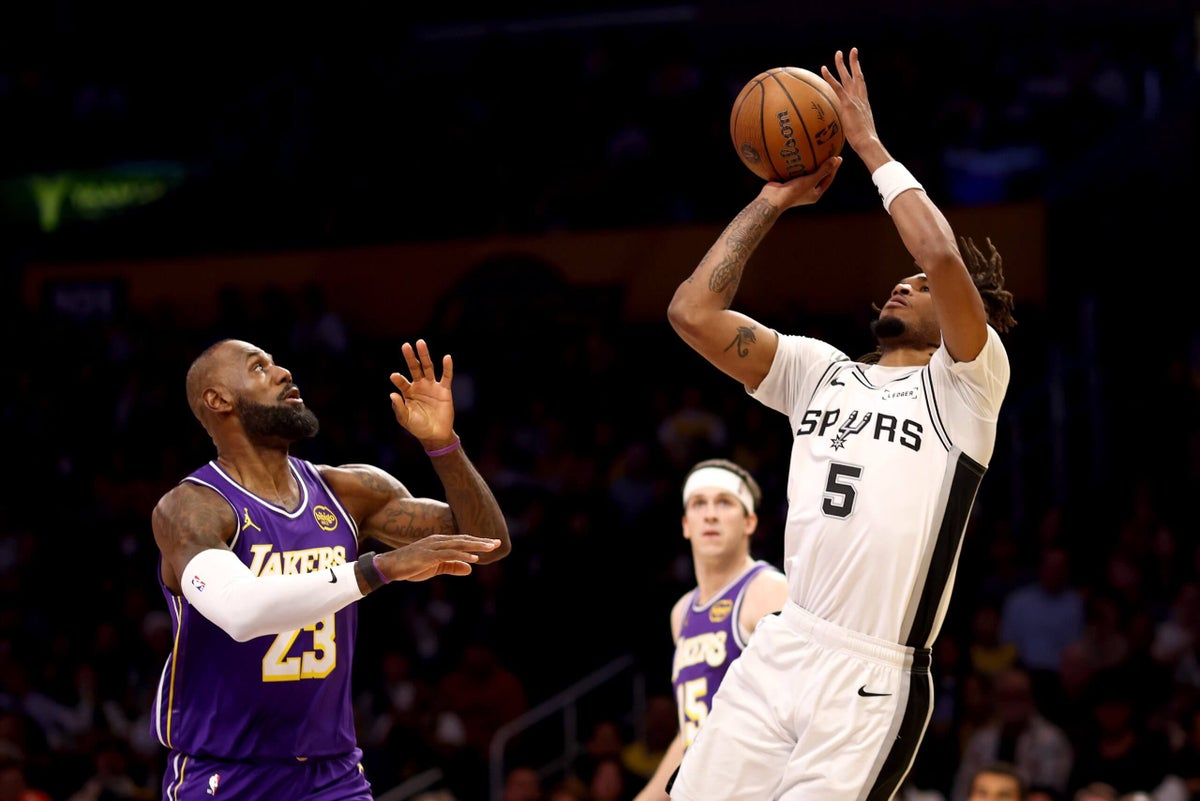
LOS ANGELES — As JJ Redick sat in front of a microphone Wednesday night, his frustration was obvious. His Los Angeles Lakers had just lost 132-119 to the San Antonio Spurs. Their opportunity to win the NBA Cup, to cash in on the half-million or so dollars in bonus cash, had been squandered.
The Lakers were outpaced, beaten too many times into the paint. The Lakers were outgunned from 3, too many open looks created from lagging rotations. They were out-punished, seemingly every misstep answered by a positive play from their opponent — the game playing out like an unending trudge up an incline.
This, undoubtedly, was a bad night for his team. And in a league where you take the floor 82 times, they happen.
But there was something else seasoning Redick’s words, his frustration maybe not so micro-focused. Big-picture problems — ones the Lakers need to solve — were highlighted. And again, the Lakers couldn’t overcome them.
“Very few teams don’t have something that you can expose,” Redick said. “And we typically, consistently, got exposed (for) the same things.”
And while Redick would love to see the Lakers be better crashing the glass and creating offensive advantages against teams that use deep drop coverage, the real problem is easier to isolate.
“I think being able to contain the basketball is probably the most difficult thing for our team right now,” Redick said.
This isn’t some grand revelation. Rival scouts and executives have often pinpointed LA’s lack of a point-of-attack defender as the team’s most glaring need. And in losses when the Lakers have gotten blitzed by teams playing at a pace too fast for them — losses like the ones to the Atlanta Hawks, Phoenix Suns, Boston Celtics and the Spurs — their inability to unleash a defensive stopper has been bolded and highlighted.
The answer, at least in a sweeping sense, doesn’t appear to be on the horizon via trade, as that part of the calendar unofficially begins Monday, when players who signed offseason deals are eligible to be moved.
The player most often linked to the Lakers as a target by rival scouts and executives is New Orleans wing Herbert Jones, who cannot be traded until Jan. 14 because he signed a three-year extension with the Pelicans in July.
While Lakers fans can fantasize about some all-out liquidation of the three-win Pelicans’ roster, team and league sources tell The Athletic that New Orleans is not interested in moving Jones. And considering what LA would have to offer in a deal, expiring contracts and a single first-round pick, the Pelicans almost certainly wouldn’t engage at that price point.
According to league sources, that future Lakers pick, which could be in 2031 or 2032, is less valuable than it was viewed both before the Luka Dončić trade and since Mark Walter’s acquisition of the franchise. The belief is that since Walter has proven to be an effective owner with the Los Angeles Dodgers, that he and whoever he entrusts the franchise to will, at minimum, keep it from the kind of freefall that would truly make that future first-round pick less of a lottery ticket.
Maybe the view of the Lakers’ assets or the Pelicans’ view of Jones will change between now and the Feb. 5 NBA trade deadline, but as of now, sources point out, New Orleans would need a whole lot to be convinced otherwise.
The market for point-of-attack defenders hasn’t really developed to date, in part because, not surprisingly, the teams near the bottom of the league’s standings perceived to be the most willing sellers aren’t exactly overflowing with two-way talent they’re looking to move.
Even someone like Keon Ellis, who has an uneven role with the struggling Sacramento Kings, is valued enough that he won’t come cheaply.
It’s why, at this point, there doesn’t seem to be some kind of magic-bullet solution to the Lakers’ defensive issues, forcing them to figure things out internally. They are still getting LeBron James back into rhythm after he missed the entirety of the preseason and the first month of the year. The team’s best individual defender, Marcus Smart, has already missed 10 games and played with James for just the fourth time this season.
Asked how long it takes for a group to build out a team defense, Dončić quipped, “Two weeks.”
“We know in the NBA it’s 82 games. So, I would say we got time, but we need to figure it out pretty quickly,” he said. “Our record is pretty good, 17-7, that’s pretty good to start. But I feel like we can be so much better.”
For now, the Lakers are forced to deal with some real questions. Can they continue to use Austin Reaves as the primary on-ball backcourt defender in starting lineups without wearing him down? Will a less-rusty James quarterback the defense and keep them on a string as he did a year ago? Are the problems big enough that the Lakers have to sacrifice the shooting they covet because of the offensive advantages it creates for more lineups with defenders like Jarred Vanderbilt or rookie Adou Thiero?
“We’re young in the season for us, and we’re gonna continue to get better,” James said. “I think defensively, we understand that on-ball attack is very important. But first, get back in transition; we can’t give up a lot of transition points as we did tonight. And then we gotta contain guys off the dribble. So we will continue to get better with more film, more communication … just help each other out.”
It all seems kind of hefty for a team that’s 17-7, but these losses feel like referendums on the Lakers’ ability to truly contend, both in a vacuum and especially in a world in which the Oklahoma City Thunder lose once a moon cycle. Getting better on defense, especially on the perimeter, is the only real shot of closing that gap even slightly.
“That’s a weakness we got to be better at,” Reaves said. “And the spirit’s still high in here. We know we can do it. But we have to be a group that guards with five people. And once again, like Bron said, we got to be on a string and know rotations and just play hard on that end.”