
Despite their strong 17-7 record, there is trepidation surrounding the Lakers for the first time this season.
This is not just due to being 2-3 in their last five games. Yet rather, it’s how eerily similar the wins and, more specifically, the losses have looked.
With an airtight average margin victory of only 3.5 points and an alarming margin of defeat of 17 points during this stretch, year-long trends are quickly becoming the norm. Déjà vu this is not.
So for the second time, let’s open my notebook and see what’s going on.
Stephon Castle kept running.
After hounding Luka Dončić around a screen during the first quarter of the Lakers and Spurs NBA cup matchup, Castle’s contest forced Dončić‘s step-back trey to rim out.
Once De’Aaron Fox corralled the miss, and before Dončić could even put his shooting hand down, Castle was already in the Lakers’ paint. The hit-ahead pass was made. Castle scored an and-1. And the possession took just four seconds.
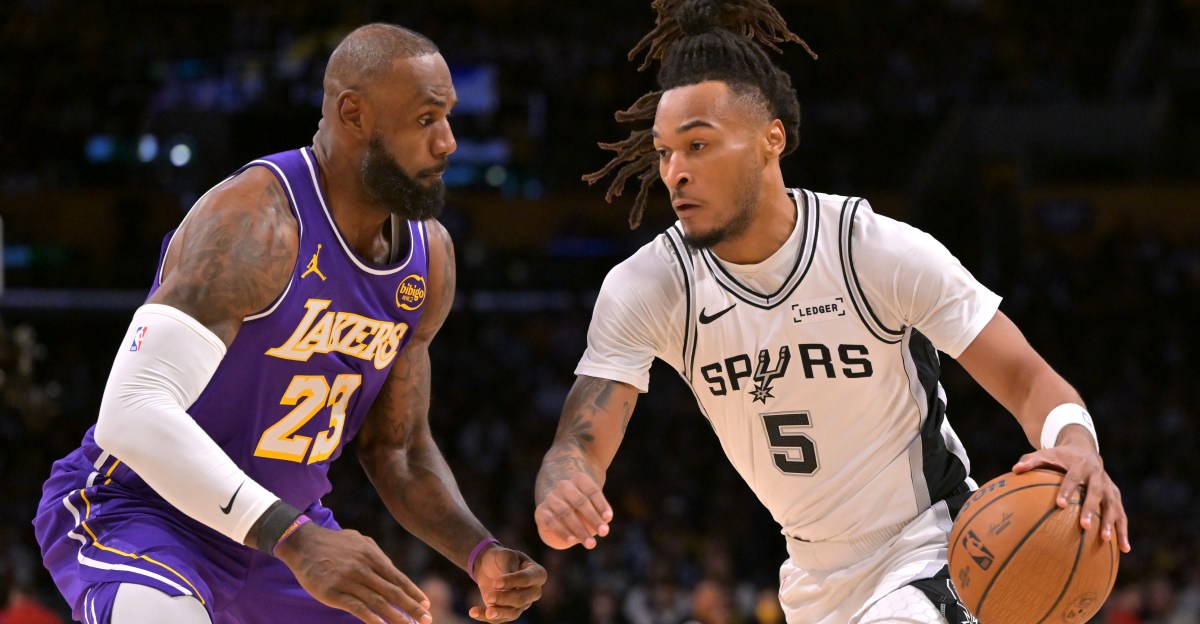
It was not only a sneak preview of what San Antonio’s young legs would do to the creaky Lakers’ defense all night, but a game plan that has exhausted Los Angeles all year.
As of this article, the Lakers are allowing the 10th-highest transition frequency in the league. They are also surrendering the fourth-most transition points. To paint a picture of how dire it’s been, the only teams currently worse are the Pelicans, Clippers and Wizards.
Perhaps more concerning is that there is not one clear cause. They turn it over a lot. They crash the offensive glass at ill-advised times. Their pick-and-roll-heavy attack makes them susceptible to getting beaten down the floor. They don’t always get back. When they do, they can’t keep the ball in front. And the collective quickness of the roster is just flat out too slow.
According to the league’s tracking data, the Lakers are last in average speed on defense, feet covered and in miles run per game. Whatever your metric of choice is, they all spell out the team moves like current-day Hiroshi Tanahashi.
While the long-term solution to the team’s transition woes is likely personnel-based, the coaching staff has to find short-term answers, or else they can expect more nights to look like most of their losses this season.
Although it is not uncommon for teams’ starting lineups to shoulder the lion’s share of the scoring load, the extreme degree to which the Lakers’ starters have to is.
The players classified as “starters” for the Lakers this season are averaging an incredible 93.9 points. That not only leads the league, but it would be the second-most since the 1996-97 season (when the NBA made the data public).
This is the benefit that comes with surrounding Luka Dončić, Austin Reaves and LeBron James with two of the most efficient scorers at their positions in Rui Hachimura and Deandre Ayton. The downside, though, is having a defanged bench because of it.
Due to JJ Redick’s decision to front-load all of the team’s best offensive players into the starting lineup, the drop-off when their mostly defensive-oriented reserves come in is staggering.
On average, the Lakers’ bench is yielding the fewest points per game (24.5) and the fewest shots by a wide margin. Their 18.9 attempts are 6.3 fewer than the next closest team. And when strictly comparing their output compared to what they allow to their opponents’ second units, the Lakers are losing the bench battle by 12.5 points nightly.
It is difficult to determine how high their lack of bench points should be on their laundry list of concerns given their record and other glaring weaknesses. But it is becoming clear that the rotation is in need of realignment.
With the starters not setting the world on fire in the aggregate (more on that to come), balancing out the lineups with a mesh of offensive and defensive versatility instead of going all in in either direction seems like a worthwhile experiment, even if the roster is not flush with options.
How important is point differential?
While there is little argument that the Lakers’ 17-7 record is impressive, where they stack up among other teams with title aspirations could depend on how you interpret the number 1.8.
That is their current point/efficiency/net rating differential (points scored per 100 possessions vs. points allowed) when filtering out garbage time. It is modestly the 13th-best mark in the league.
A glass-half-empty perspective may view the slightly positive point differential as a sign of a team that has overperformed compared to its actual talent. And according to Cleaning to Glass, they have. The site lists the Lakers as having the highest win differential in the league thus far, as their current point differential should have accounted for only 13 wins up to this point.
Beyond what the data says or projects, what it’s looked like on the court hasn’t painted much of a different picture. Their wins have rarely come easy and their losses have often been gruesome. Their margin for error feels paper-thin, and that could have long-term ramifications with their stars having to log high and taxing early-season minutes.
A glass-half-full perspective may view their average-ish point differential as a sign of resilience. The Lakers have had to endure countless injuries thus far and have yet to have their key rotation players all available in consecutive games. And despite that, they still have the record that they do.
Their tendency to find themselves in close games and emerge victorious may also be a sign of a good clutch team, a potentially encouraging trait come playoff time. The Lakers are the only undefeated team left in the NBA in clutch games this season (8-0) and also have the third-best net rating in those minutes.
There is also the existential question of how important point differential actually is in terms of title odds. Recent history suggests it is actually one of the best indicators.
Among the last ten NBA champions, eight finished the regular season with a top-five point differential or better. And no champion this decade has finished lower than seventh.
Regardless of which viewpoint you have, like most things, the truth about the Lakers’ real ability likely falls somewhere in the middle. But one thing is for sure, there’s plenty of room for improvement still to be had.
All stats courtesy of Cleaning the Glass unless otherwise stated. You can follow Alex on Bluesky at @alexregla.bsky.social.