
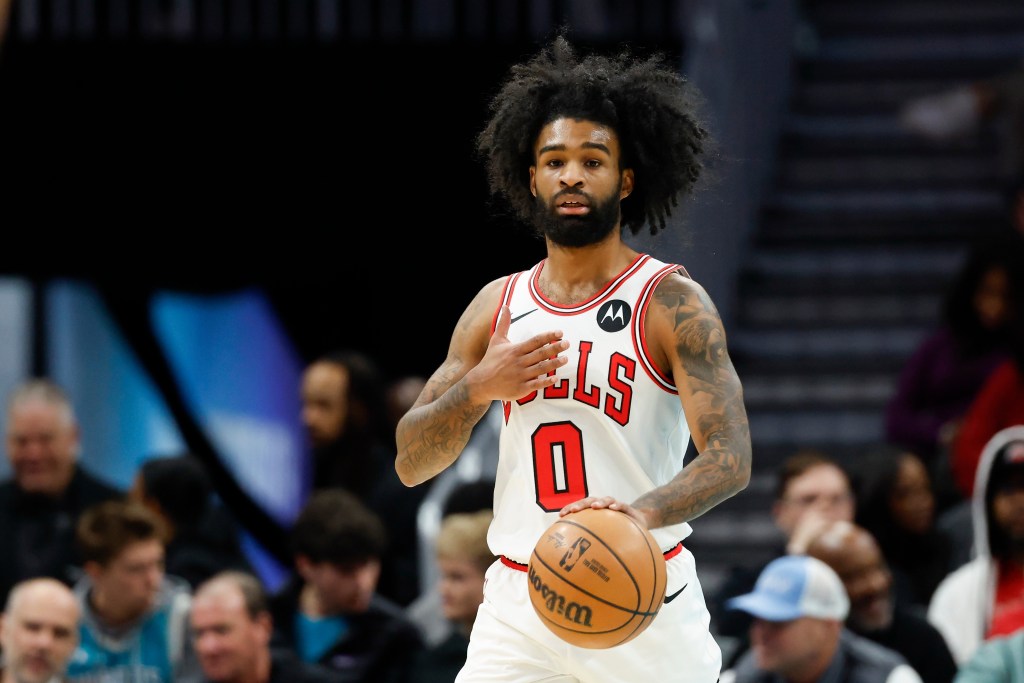
It’s speculation season in Chicago.
The Bulls are in a rut. It’s more than their 10-15 record. They haven’t won consecutive games in four weeks and struggle to compete with even the bottom-rung teams in the league.
This was always meant to be a transitional season. Now it’s clear that the most the Bulls can get out of this season is a restructuring of the roster to speed along progress toward the flexibility the front office so deeply prizes.
With seven expiring contracts on the books, there’s plenty for vice president of basketball operations Artūras Karnišovas to work with as the Feb. 5 trade deadline nears. Let’s look at some of the biggest questions facing the Bulls in the two months before the deadline.
Is it time to trade Coby White?
The Bulls may have run their course with White, now the longest-tenured player on the roster. Although Karnišovas has said publicly they plan to keep White for the long term, there’s internal uncertainty about whether the Bulls can or will pay the 25-year-old guard when he enters unrestricted free agency this summer.
The Bulls have been fairly upfront about their realignment around guard Josh Giddey. While neither player has reached the level of consistent All-Star-caliber play that should be a requirement for a roster centerpiece, that’s currently beside the point.
If the Bulls don’t plan to give White a similar deal this summer to the four-year, $100 million contract Giddey received in September as a restricted free agent, then it’s time to pick up the phone and start shopping White far and wide. Although his season was delayed and then limited by an offseason calf injury, White is a career 36.7% 3-point shooter whose handles and playmaking have developed to where he could be a strong third or fourth option on a contending team.
Teams in the Western Conference especially will be looking to load up on offensive weapons to make a run — and White should be the answer for someone in the league. Finding a trade partner should be Priority No. 1 for the Bulls in the next two months.
Should the Bulls (finally) move Nikola Vučević?
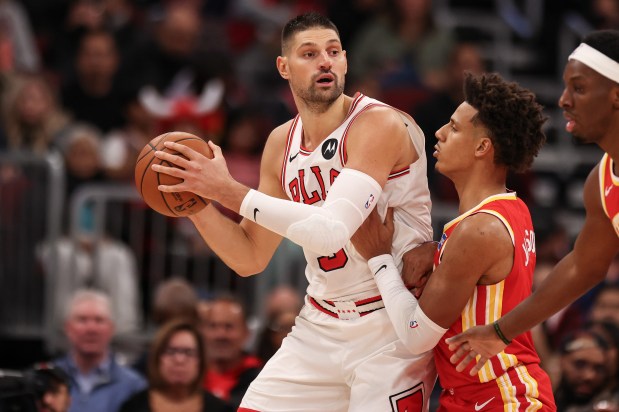 Bulls center Nikola Vučević keeps the ball away from Hawks forward Jalen Johnson on Oct. 27, 2025, at the United Center. (Dominic Di Palermo/Chicago Tribune)
The best time to trade Vučević would have been last January, when he was at the tippy-top of a resurgent season while shooting 39.4% from 3-point range.
The second-best time is, quite literally, any day now.
The Bulls waited too long. Sure, Vučević never drew the offers they wanted for their starting center. But they had an opportunity to maximize his value and do right by a longtime veteran before moving on to their youth movement.
Now the Bulls and Vučević are stuck together like a recently broken-up couple with four months left on their shared lease. It’s awkward. And it’s making for some pretty rough basketball.
The risk in waiting too long to move a veteran is Vučević, whose contract is up at the end of the season, is now a tough sell on the trade market. His rebounding numbers and shooting efficiency have fallen back to earth, and the Bulls’ inability to defend at the perimeter has exposed Vučević’s weaknesses as a rim defender. A team looking to add a shooting big to its bench could view Vučević as an option at the deadline, but he’s considerably less tempting this winter than he was a year ago.
If the Bulls really wanted to part with Vučević, they could opt to buy him out. But that path typically requires a hard push from the player, something Vučević — who has been reliably resigned to his fate despite the frustration of this season — is unlikely to request.
Could the Bulls make a bid for Giannis Anteto… (yanked off stage by a massive vaudeville hook)
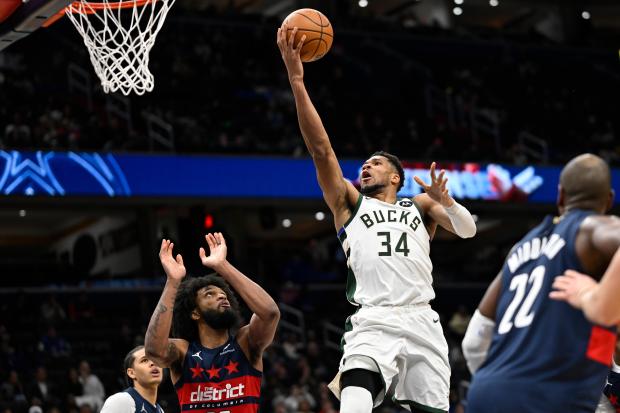 Bucks forward Giannis Antetokounmpo goes up to score against the Wizards on Dec. 1, 2025, in Washington. (AP Photo/John McDonnell)
This is the longest of long shots for the Bulls, who aren’t considered to be even remotely near the top tier of potential suitors. If Giannis Antetokounmpo really wanted to come to Chicago, and if the Milwaukee Bucks were prioritizing a trade that sent him to his preferred market, then maybe the Bulls could figure out a deal. But there’s zero evidence either of those possibilities is true.
And even if they fully bankrupted their future draft stock, the Bulls don’t have the additional assets necessary to pry that caliber of star away from Milwaukee. The Bulls have been wary of offering up players such as Giddey and Matas Buzelis in trade packages. And even if they did, would that pairing outweigh a trade package from a suitor such as the Miami Heat involving an All-Star like Tyler Herro?
It also has become fairly clear from national reporting that the initial flurry of urgent trade speculation — which suggested Antetokounmpo might be moved by the deadline — has calmed down. Antetokounmpo is reportedly “uncomfortable” with the rumors surrounding his future, according to NBA insider Chris Haynes, and the complexity of securing a trade partner midseason could make both sides pump the brakes.
Wait — will the Bulls actually do anything?
This is actually the most pressing question of the season — which is concerning, right?
The Bulls haven’t inspired any confidence in their ability to pull the trigger at the trade deadline. This is a front office that went three years without making a single midseason move before dealing Zach LaVine last February.
In his limited media availability, Karnišovas has continued to emphasize the flexibility the roster will offer next summer after clearing out those seven expiring contracts, but he hasn’t shown a particular interest toward flipping any of those players this season into potential future value.
History suggests the Bulls could sit out yet another trade deadline, let all of their expiring contracts walk off into the sunset and then tout their “flexibility” after wasting the trade value of players such as White, Vučević, Ayo Dosunmu, Zach Collins and Kevin Huerter.
There’s an argument against letting the Bulls roster become a dumping ground. The team wouldn’t benefit from taking on bad money — i.e. sending out expiring contracts to take on an aging or injured or devalued star from another team — for no reason. And for this reason, it’s not realistic to expect all, or even most, of these expiring deals to get moved.
But complete inaction would be just the latest misstep by the Karnišovas-led front office, whose hesitancy has been its downfall for the last five years.