
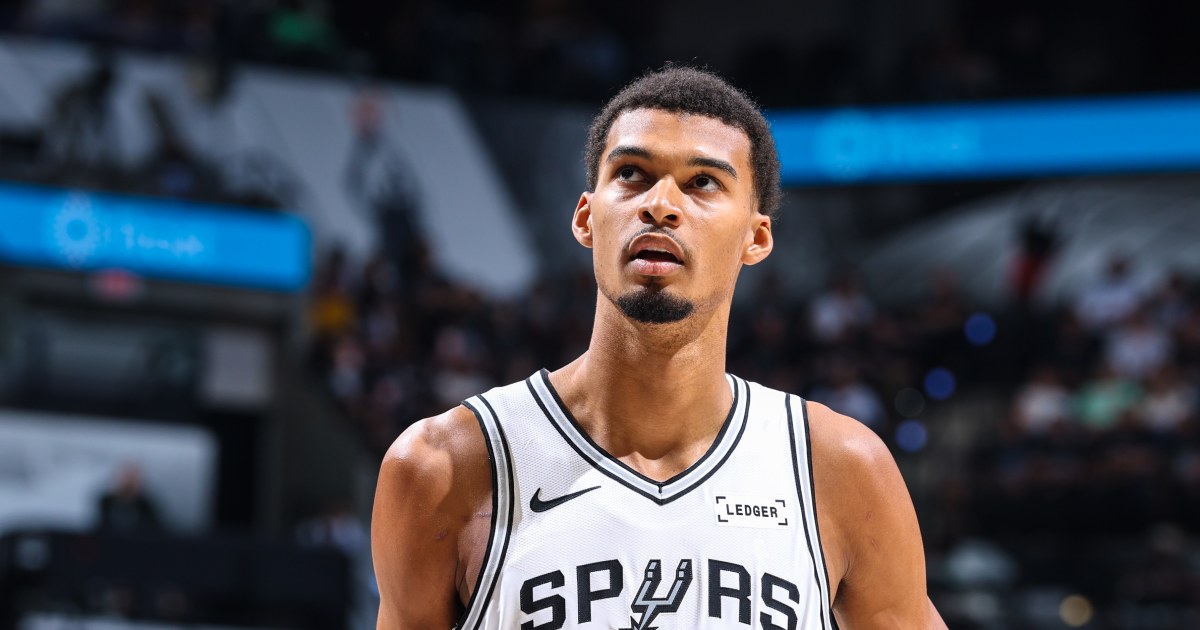
Longtime NBA coaches and scouts are hardened by nature. They’ve observed thousands of players and have just as many ideas for how to stop them. Rarely do they concede awe.
But on the very first night of the new NBA season in October, a scout watching San Antonio Spurs big man Victor Wembanyama raised a proverbial white flag as the 21-year-old from France completed a 40-point highlight reel of body-contorting dunks, blocked shots, crossover dribbles and deep 3-pointers.
“At one point I thought, ‘There’s nothing we can do here,’” the scout said. “There was no center, no power forward, no man [defense], no zone that could do it.”
When Wembanyama, who is listed at 7-foot-4 but has long been rumored to be taller, retreated on defense, his long strides and wingspan allowed him to cover ground like no other defender. Ball handlers would dribble close to the basket, only to meekly back away, sensing him looming.
“Incredible to watch,” said one team’s assistant coach who, like the scout, wasn’t permitted to speak publicly by the team. “Unlike anything I’ve ever seen.”
For any other player, pronouncements like that might come off as hyperbole. For Wembanyama, they have become routine, because the idea that he might one day stand head and shoulders above his NBA peers because of his skill, and not because of height alone, have been whispered around the league even before he entered it.
In 2020, when Wembanyama was 16, a video of him swishing midrange jumpers against Rudy Gobert, a 7-foot-1 French compatriot and one of the NBA’s top defenders, went viral. In 2022, Wembanyama dazzled executives from all 30 NBA teams with his ball handling and playmaking skill while he was on a French club team during a U.S. exhibition.
Yet this season, even as reigning champion Oklahoma City has started 24-2 behind star Shai Gilgeous-Alexander, while three-time MVP Nikola Jokić, two-time MVP Giannis Antetokounmpo and the Los Angeles Lakers’ Luka Dončić could create an all-time MVP race, it’s the larger-than-life Wembanyama who has become the NBA’s biggest attraction. Even though Wembanyama missed nearly half this season because of a calf strain, his highlights have drawn 708 million views on social media, the second most in the league.
The Wembanyama effect has affected the league’s bottom line. With the exception of games played on Christmas Day and in Paris, no regular-season game in NBA history has ever been watched in Europe more than San Antonio’s Oct. 26 win over Brooklyn. In France, subscribers to League Pass — the NBA’s streaming platform — were up 54% two weeks into the season, according to the NBA.
During Wembanyama’s 22-point return from his 12-game absence Saturday, San Antonio outscored Oklahoma City — which has become this season’s unstoppable force — by 21 points in his nearly 21 minutes. “WemVP” chants could be heard as the Spurs advanced to Tuesday’s NBA Cup final in Las Vegas.
They lost that final to the Knicks, with Wembanyama subdued as he scored 18 and left the postgame news conference early saying he had “just lost somebody” earlier in the day.
That defeat will do little to dim Wembanyama’s rising star status.
“Everything about him,” Spurs coach Mitch Johnson said in October, “is outside the box in terms of anatomy, skill set, the things he can do on the court.”
What Wembanyama is no longer doing on the court partly explains his rise. During his first two seasons, he had a habit of settling for long jump shots; last season, the average Wembanyama shot was taken from 17 feet. Of all the shots he took last season, 47% were 3-pointers.
That Wembanyama could make 3s didn’t mean it was always the shot he should take. This season, his average shot comes from 12.3 feet as the Spurs have nudged him to take advantage of his length near the basket.
That more disciplined shot selection and a noticeably tighter handle on his dribble have led Wembanyama to career bests in points (25.8), rebounds (12.6) and shooting accuracy (50.4%). In October, he became the first player in NBA history to score 100-plus points and block 15-plus shots in a season’s first three games; in November, he became the first player with 35-plus points, 10-plus rebounds and five or more assists, blocks and 3-pointers in a single game.
But those who spend time around Wembanyama are convinced that his time away from the court this year is even more responsible for why he has taken a size-20 sneaker length’s step toward fulfilling his vast potential.
The time away began abruptly in February, with the discovery of deep vein thrombosis in his right shoulder. He didn’t play the final two months. Blood clots have ended other athletes’ careers, notably that of All-Star forward Chris Bosh in 2016.
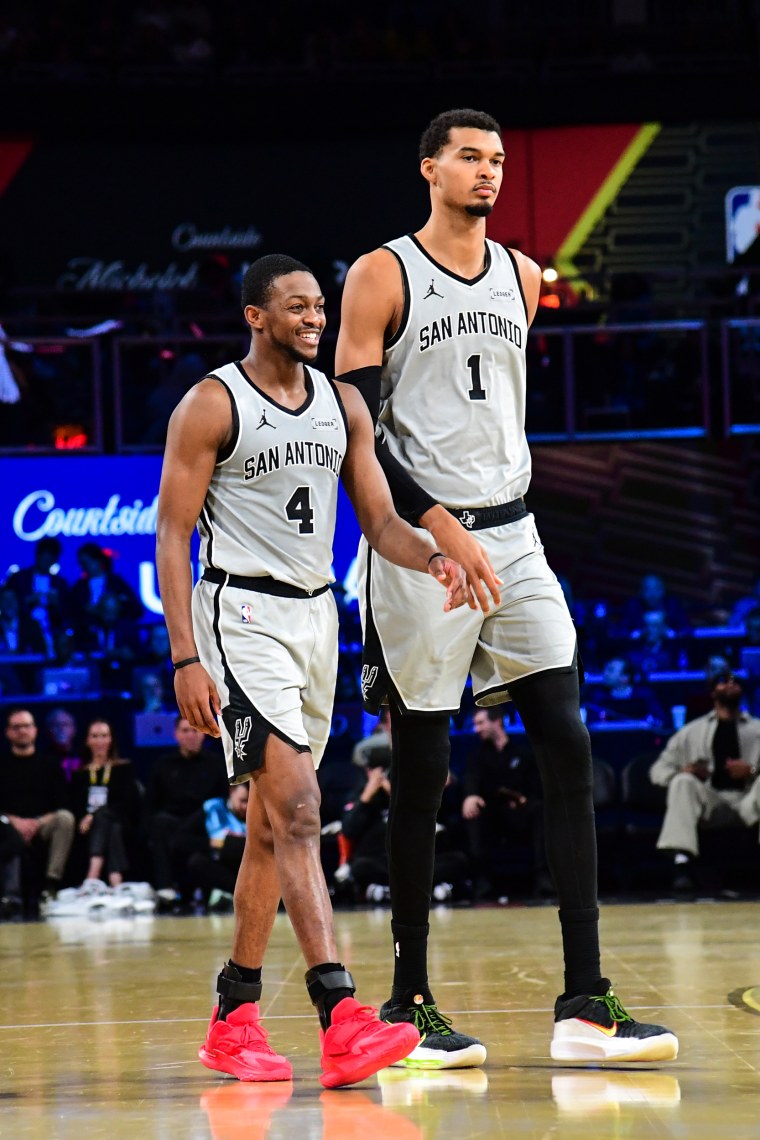 De’Aaron Fox and Victor Wembanyama of the San Antonio Spurs during a game against the Oklahoma City Thunder in an NBA Cup semifinal in Las Vegas on Saturday.Adam Pantozzi / NBAE via Getty Images
“I saw what it’s like to be confronted with potentially losing a lot, whether it’s your career or your health,” Wembanyama said after his season debut. “So I’m not taking this for granted anymore.”
Cleared in July to return to basketball activities, Wembanyama didn’t immediately run to a court. Instead, he began what Hall of Fame forward Kevin Garnett described as a philosophical “journey to seek knowledge.”
Meeting with Garnett, whose lanky, near-7-foot frame and position-bending skill set resembled an early 2000s forerunner of Wembanyama, was one stop. Garnett, known for his famous intensity, said on his podcast last month that what he took away from their nearly three-hour conversation was that Wembanyama “wants mentality.”
“How do I get stronger? How do I get better? … And then we went through it,” Garnett said. “He never blinked.”
Many players profess to want mentorship from their NBA peers or past greats; few, in reality, expend the time or money to follow through. Wembanyama, however, “wants to be something outside of the box,” Garnett said. “He’s about to be something different that we have never seen.”
Another visit was paid to Hakeem Olajuwon, the Hall of Fame center whose Texas ranch has become a pilgrimage site for players, including LeBron James and Dwight Howard, seeking to learn from the post moves and footwork that helped Olajuwon win two titles with Houston in the mid-1990s.
Olajuwon asks clients the same opening question: What are you trying to accomplish? He said Wembanyama answered that he wanted to work on “every aspect.”
“Today’s game has encouraged big guys to go outside, to shoot 3s, to have the ball, to post up, and he’s the ideal icon for that kind of style of basketball,” Olajuwon said last month.
Wembanyama, Olajuwon added, is the only player he believes can break his NBA record of 3,830 blocked shots. Olajuwon’s career average was 3.1 blocks per game; Wembanyama is averaging 3.7.