
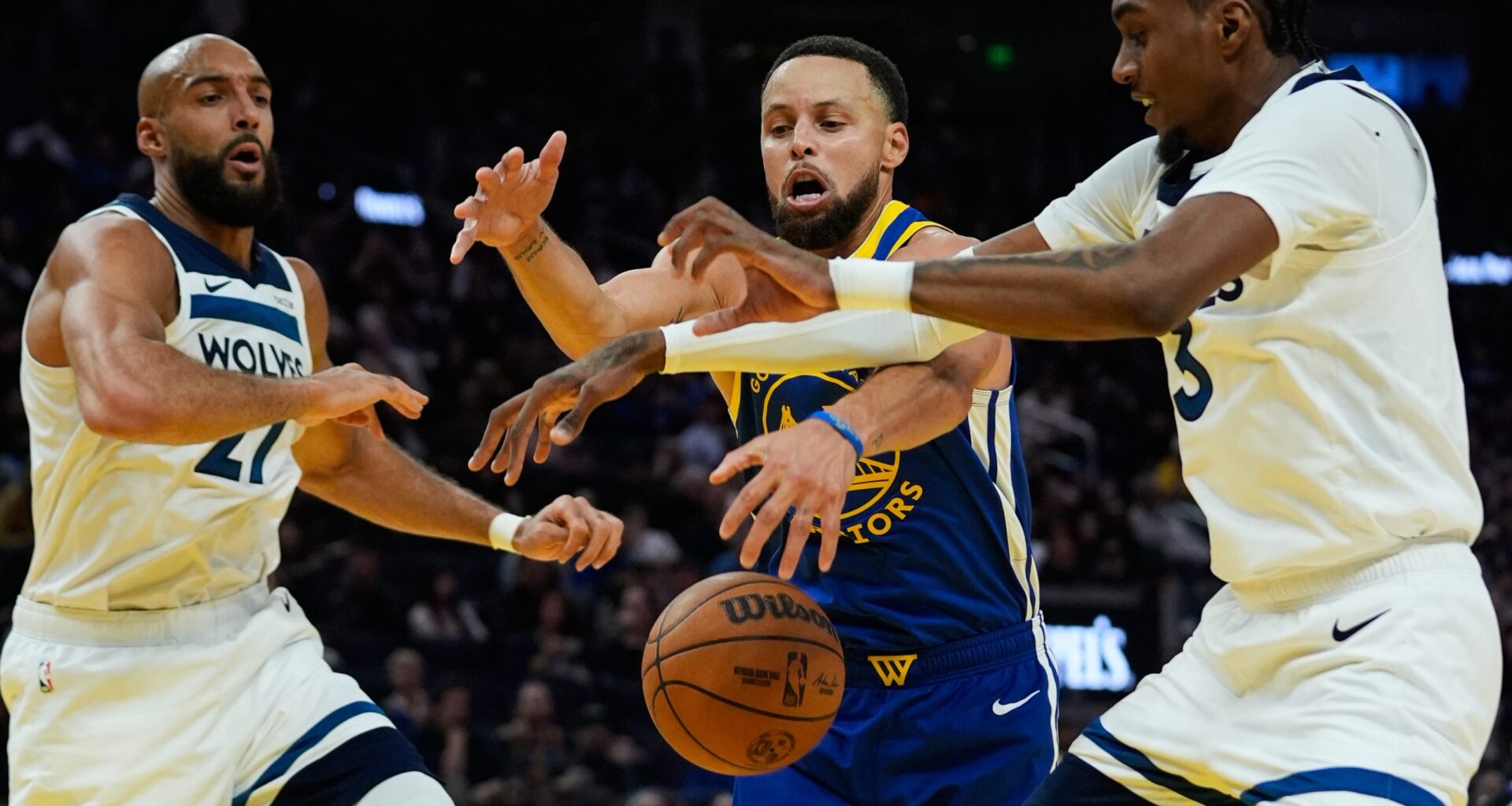
The Minnesota Timberwolves took one step forward and one step sideways last weekend, going on the road to vanquish a Golden State Warriors team bolstered by the return of their superstar, Steph Curry, Friday night, then coming home and allowing a hapless Sacramento Kings team that had lost 14 of their past 17 games to hang around for three quarters before finally putting them, and the Target Center fans, out of their misery in the final period.
There is a fact-based rebuttal to the above description. The Wolves have now won seven of their past eight games and currently own a record of 17-9, a pace that would put them between 53-29 and 54-28 by the end of the season. These past two victories were accomplished without their superstar, Anthony Edwards, their veteran point guard, Mike Conley, and, for the second half of the Kings game, without their defensive stalwart, Rudy Gobert.
After two straight trips to the Western Conference Finals, the Wolves have reached a level where they can be criticized on style points as they continue to redecorate their reputation with the pelts of their opponents.
Nevertheless, their achievements thus far this season simply haven’t been that admirable. Coach Chris Finch and the players know it — they use words like readiness, intensity and focus to describe the attributes that wax and wane with annoying regularity. They are talking about a collective mindset that permits mediocrity, that shuns the rigor required for excellence.
Regular readers know that I have beat this drum before, while knowing that the gaudy but inconclusive won-lost record won’t be legitimized, or exposed, until the parade of cupcakes dominating a ridiculously easy early-season schedule gives way to more formidable opposition.
Fortunately, that reckoning is arriving as the Wolves finish off their longest homestand of the season with four games over the next week. Wednesday night the Memphis Grizzlies come to town having won eight of their last eleven after a slow start. Although they, too, have been feasting on an assortment of cupcakes in that span, their defensive rating (points allowed per possession) has been second-best in the NBA, and their offensive rating (points scored per possession) has been ninth.
Two nights later, the NBA’s goliath, the Oklahoma City Thunder, is the foe. The defending champions have a 24-2 record and a historically stingy defense thus far this season. Sunday the Wolves catch a break as it is unlikely that superstar Giannis Antetokounempo will have recovered from his calf injury in time and his Milwaukee Bucks are 2-8 without him. But on Tuesday, the 18-7 New York Knicks bring Karl-Anthony Towns to Target Center for the only time this season to close out the homestand, then the Wolves go to Denver to play the 18-6 Nuggets on national television Christmas night.
Related: The Timberwolves have the easy schedule blues
It is the most rugged gauntlet of games the Wolves will have faced thus far this season, a belated litmus test that will demand more sustained readiness, intensity and focus than the team has mustered thus far. It should provide more clarity on the character of this ballclub.
As we eagerly anticipate the elevated level of play that will likely be summoned from that reckoning, let’s ease off the cynicism and focus on a couple of players whose seasons are fun to dwell on for different reasons.
Jaden McDaniels finds offensive chemistry
The refined offensive package of skills Jaden McDaniels has showcased at various points throughout the season has been teased for a few years now, especially in those memorable moments McDaniels has ascended in the playoffs. But he has been afforded — and more importantly, taken — enough opportunities to establish a complete game at that end of the court this year.
Begin with the three-point shooting. On a per-minute basis, McDaniels has been shooting them less frequently than in any of his five previous NBA seasons — and making them more often than ever. His current accuracy is 41.8%, above his next-best season of 39.8% in 2022-23 and well ahead of his career mark of 35.3%. It’s a crucial improvement — his clanking from long-range sabotaged last year’s starting lineup at the beginning of the season, especially since it was his primary role in the offense.
The sample size is still small — and slumps like his existing 2-for-17 from long distance over his past three games have a particularly ominous significance — but the obvious difference in three-point shooting and every other aspect of McDaniels’ offense this season has been the potent chemistry of confidence and agency motivating his decisions. At age 25 in season six, he’s less encumbered by role restrictions, willing to bear the responsibility and trust the consequences of more overt playmaking.
For example, McDaniels will still catch-and-shoot from behind the arc. But he’s also more apt to sidle over with a dribble to utilize a screen, or face down the defender closing out to him, then blow by him off the bounce or deke the drive and rise up for a contested trey, having created enough space for a mostly clean look.
These complexities complicate life for the defender, and McDaniels is reveling in his options. Last year his go-to bucket was a “rocking chair” midrange jumper, a pull-up exaggerated into a fadeaway, with a soft, sweet arc that is nearly impossible to block. This season he’s built wings on to that foundation: Fancy footwork that can pivot around or through the defender biting on the jumper, or an upfake that puts the coverage helplessly into the air, especially those chasing him down in transition. His floater game is still good, but he’s also shown that his spidery length is layup-friendly.
And then there is the passing. McDaniels has become the best interior passer the Wolves have had for Rudy Gobert since Kyle Anderson left the team. Their mutual respect as defensive stalwarts who have too frequently been ignored on offense enhances their awareness to enable each other. Be it in modified transition or in the half-court sets, Gobert moves in ways that make him ready for the pass without clogging the lane. McDaniels rewards both considerations.
The pinnacle of this thus far was last Friday night in San Francisco when McDaniels fed Gobert for four slam dunks. The first was a straightforward pick-and-roll out by the left arc, where Gobert set the screen, split the two defenders and was hit in stride by McDaniels as a closing defender fouled for an and-1. The second was the two running parallel down the floor in transition, until McDaniels cut in front of Gobert toward the hoop, taking defenders with him as he made a small shovel pass, practically a hand-off, to Gobert for the flush. The third happened when McDaniels turned on the jets getting a pass just past midcourt, while Gobert, up for a screen, suddenly barreled toward the cup but again with parallel spacing. McDaniels flicked the pass to Gobert’s chest, again in stride, again with a thunder-dunk conclusion.
The fourth dime was the most artful. McDaniels dribbled by one defender and turned it into a crab dribble with his back to the basket on the left block when the help defender arrived. With the shot clock at five he spun left. Gobert’s man rotated hard for the double-team that seemed to pin McDaniels by the baseline next to the hoop. His wraparound pass with the left hand found Gobert on the doorstep and dunk four registered on the scoreboard.
Related: Timberwolves rediscover rhythm, but search continues for winning blueprint
Only Julius Randle, who has the ball in his hands far more frequently, has issued more dimes to Gobert than has McDaniels.
Jaden’s banner season thus far includes career highs in assists and accuracy from the three-point arc and free throw line. He also remains the team’s primary wing-stopper — he guarded Curry’s perpetual motion most of his minutes against Golden State while scoring 17 and getting 5 assists. The team’s net rating (points scored minus points allowed per 100 possessions) with him on the court has never been better — a +7.6 via 119.2 points scored minus 111.6 allowed in his 820 minutes on the floor. In the 438 minutes he sits, the net rating is zero — 112.5 points both scored and allowed per 100 possessions.
Best of all for the Wolves, McDaniels is currently the 79th highest paid player in the NBA, a ranking that is certain to drop in the future, as the Wolves have locked him up for the next three years — prime time between ages 26-28 — at approximately $28 million per season.
Hats off to bench surprise Bones Hyland
At a listed salary of $2.296 million, Bones Hyland is tucked just inside the top 400 on that list. Yet you’d be hard-pressed to find a more upbeat and effervescent player on the Wolves roster.
Just two weeks older than McDaniels, Hyland has already been on four teams if you count the Atlanta Hawks, who waived him last February a day after acquiring him from the Clippers. It was the nadir of a checkered career.
After being drafted by current Wolves president of basketball operations Tim Connelly back when Connelly held a similar position with the Denver Nuggets in 2021, Bones enjoyed a moderately good rookie year but then pouted his way out of Denver during their championship season, leaving the bench in the fourth quarter in frustration for a lack of playing time. Shortly after suspending him for five games, the Nuggets dealt him to the Clippers, who later traded him to Atlanta.
Less than three weeks after the Hawks let him go, the Wolves signed him to a two-way contract in late February, then a one-year deal just before training camp this season.
Hyland was humbled in just the right manner. His connection with Connelly is clearly a boon — on Media Day in September he said the bond started when he rapped out one of his own songs in front of him at the draft combine. “He’s always had my back. I’m just really thankful,” he said.
During his time with the Clippers, Hyland said he “matured more” and “turned into a man more,” watching the way star veterans worked so hard at their craft. “I don’t take things for granted.”
During his partial season on the two-way deal, Bones became somewhat of a mentor for Rob Dillingham, who has had to endure his own frustrating learning curve after the initial high of being a ballyhooed draft pick. Describing Dillingham as “being like a little brother — he kind of reminds me of myself a lot coming into the league,” Hyland dispensed the wisdom that has helped him earn a surprise niche on the team, ironically at Dillingham’s likely expense.
“Everything is patience. Every day try to get 1% better,” Hyland advised. “Come in here with a smile on your face. Be a good person to yourself first and then a good person to others and everything else will take care of itself.”
In a season where Mike Conley has suddenly got old and Dillingham has stubbornly stayed young, a void has opened at point guard behind starting combo guard Donte DiVincenzo. Finch, who played Bones in a bit role 13 of the team’s first 15 games, but then for just a mop-up 89 seconds total in the eight games and 17 days since then, put him into the regular rotation against Phoenix on Dec. 8.
“After 24 games, it was time to try something different,” the coach explained. “(Bones) has been patient, playing really well in practice, doing everything we asked him to do. We need a spark there.”
He started Hyland the next game versus Golden State, but a knee contusion knocked him out of action less than five minutes into the first quarter. Two days later, he logged 35:41 of playing time at home against the Kings, getting 18 points and 5 assists. The Wolves were +10 during his time on the court.
Afterwards, Finch raved. “He’s got a ton of game. He’s super smart, he’s a pass-first guy that can really score rather than a score-first guy who can pass. He just gives us that point guard mentality and he’s got quickness and tricky shot-making.”
Some of that is true. But Bones has always been a bucket, a “hooper,” which happens to be Tim Connelly’s favorite kind of player. (Rob Dillingham is a hooper.)
Finch obviously watches Bones in practice all the time; his praise for Hyland as a pass-first player with a point-guard mentality may be more than wishful thinking. If so, kudos to Bones for absorbing the licks taken for an immature start to his career, and for molding his skill set in an attempt to fill a glaring need on the Wolves roster.
But even if Bones isn’t all what Finch dreams him to be, hats off to a player who has fully inhabited an attitude that makes him a beneficial presence in the locker room and on the court. Be it pass-first or shoot-first, Bones plays uptempo, a pace that suits a key bench piece like Naz Reid. The Wolves have played at a pace of 101.44 offensive possessions per game during their 17 wins, which would rank between 12th and 13th if done in every game. They have played at a 98.80 pace in their nine losses, which would rank between 26th and 27th in pace in the 30-team NBA.
When Ant and Conley return from injury, Hyland’s minutes will be reduced, perhaps dramatically. But on a team that can occasionally be annoying for its lack of sustained engagement, the resurrection of Bones Hyland is an elixir.
Related