
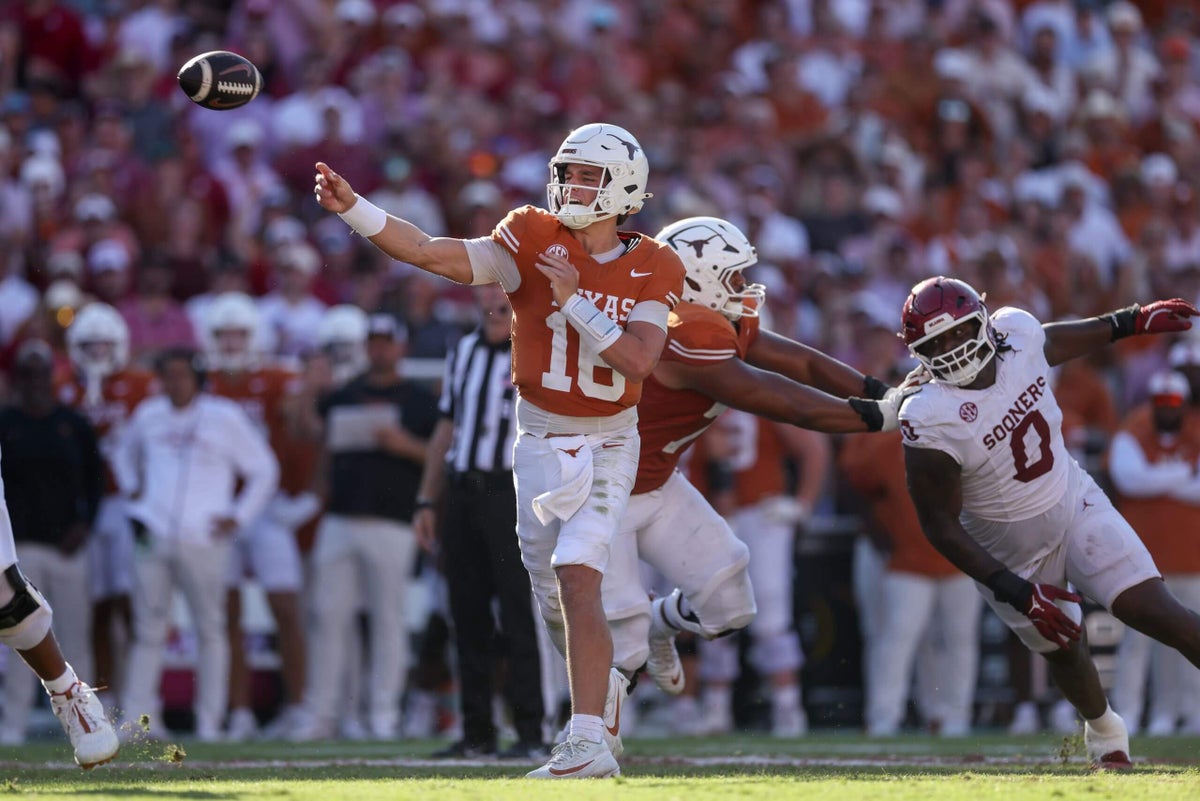
Turns out we were wrong entering this season about Arch Manning being one of the 2026 NFL Draft’s top prospects.
However, if we take everything into account, what still holds true is that Manning has the potential to be not only a first-rounder, but the No. 1 pick. It just won’t happen in April.
Manning, who announced he’ll return to Texas for the 2026 season, entered his redshirt sophomore year with unmatched hype. He — and his team, ranked No. 1 preseason — struggled to capitalize on it. That Manning starred in an opening-week Warby Parker commercial, which ran as he was digging himself into quicksand at Ohio State, didn’t help. Frankly, neither did the enticing glimpses of what could be that he gave scouts and NFL decision-makers as a redshirt freshman in 2024, because he failed to turn those into more consistent performances.
But if you fell asleep on Manning this year, you missed a lot. And if you didn’t, then you know how much better he played during the second half of October and throughout November.
Even with the early-season problems he put on tape, Manning still likely would have been a first-round pick had he declared for the draft. Instead, he’ll enter next season as a contender to be QB1 on big boards.
Manning finished the 2025 regular season 277-for-370 passing (61.4 percent) for 2,942 yards, 24 touchdowns, seven interceptions and 244 rushing yards (with eight rushing scores). Among Power 4 quarterbacks, only Heisman winner Fernando Mendoza and Heisman runner-up Diego Pavia scored more touchdowns for their team.
However, Manning also finished 107th in off-target rate (13.8 percent) and 59th in EPA per dropback (.16). When pressured, especially early in the year, he was a mess. Like so many young quarterbacks, many of those pressures were Manning’s fault, for one reason or another.
Everything needs context, though. As with South Carolina’s LaNorris Sellers (another potential No. 1 pick candidate for 2027), Manning’s offense let him down quite a bit in 2025. Texas had a young football team, which showed up plenty. Opposing defenses pressured Manning 158 times this season (three fewer than Sellers), the sixth-highest number in the FBS. Manning also had 22 passes dropped, tied for fifth most among Power 4 quarterbacks.
Manning’s season began to improve on a more consistent basis after a rocky 16-13 win over Kentucky on Oct. 18. Manning was 12 of 27 for 132 yards during that rough outing in Lexington, then was a bit shaky during the first half at Mississippi State the following week before eventually finding a rhythm in the second half.
The biggest difference?
He settled down.
So many of Manning’s problems early this season happened because he was playing too fast — his drops, his process in the pocket. Often, even when he was protected, Manning was out of his drop a full beat before any of his receivers had come close to finishing their routes. He was, in some ways, reacting to pressure before it happened. If he saw a blitz pre-snap, odds are his process sped up.
You can see a little bit of everything happening at once here …
Manning is getting pressured, and he feels it. But his drop is awkward, and when he comes up ready to throw, none of his targets are at their break points.
This sort of combination has led to Manning running himself into sacks or forcing awkward, ill-timed downfield throws before his receiver was ready.
In his first seven games this season (including matchups against UTEP and Sam Houston State), Manning was pressured on 53.9 percent of his dropbacks. From the second half of the Mississippi State game on, he was pressured on just 30.5 percent of his dropbacks. A lot of that improvement has come because of how much more settled Manning has been in the pocket and throughout his entire process.
Manning’s off-target rate has followed a similar trajectory. It was a gaudy 15.7 percent during Texas’ first seven games of the year, but it dropped to 12.4 — below the national average of 13.6 — during that aforementioned closing stretch of the regular season.
When Manning slows down his feet and plays on time, everything generally looks great. You can see his arm talent, quick release, athleticism in the pocket and all he could be as an NFL player.
The erratic play from early this season was a great reminder of how inexperienced Manning is, though, as this was his first (and only) college season as a starter. He had sloppy feet, abandoned mechanics on the move and failed to step into throws over the middle — all stuff talented players can get away with in high school, but not college.
Still, in every one of those early-season games, even the nightmare versus Ohio State, Manning made elite throws. But he also made panicked decisions and often dug deeper holes than necessary for himself.
Over time, Manning turned into a more consistent player. He was hardly perfect, but he started playing much closer to the level scouts had hoped to see when the year began.
Manning returning to Texas is no surprise, as his family has been pretty clear about not rushing him to the NFL. He will be a fourth-year junior next year, meaning he could delay further and play a fifth college season.
Manning still has to even out his game before we can seriously look at him as a future NFL starter, or as a high-first-round draft choice. Right now, the former can be an expectation, but it’s not a certainty.
What is clearer, though, is how talented a quarterback Manning is. None of that is fake, and both he and Texas could be in for a huge 2026 season.