
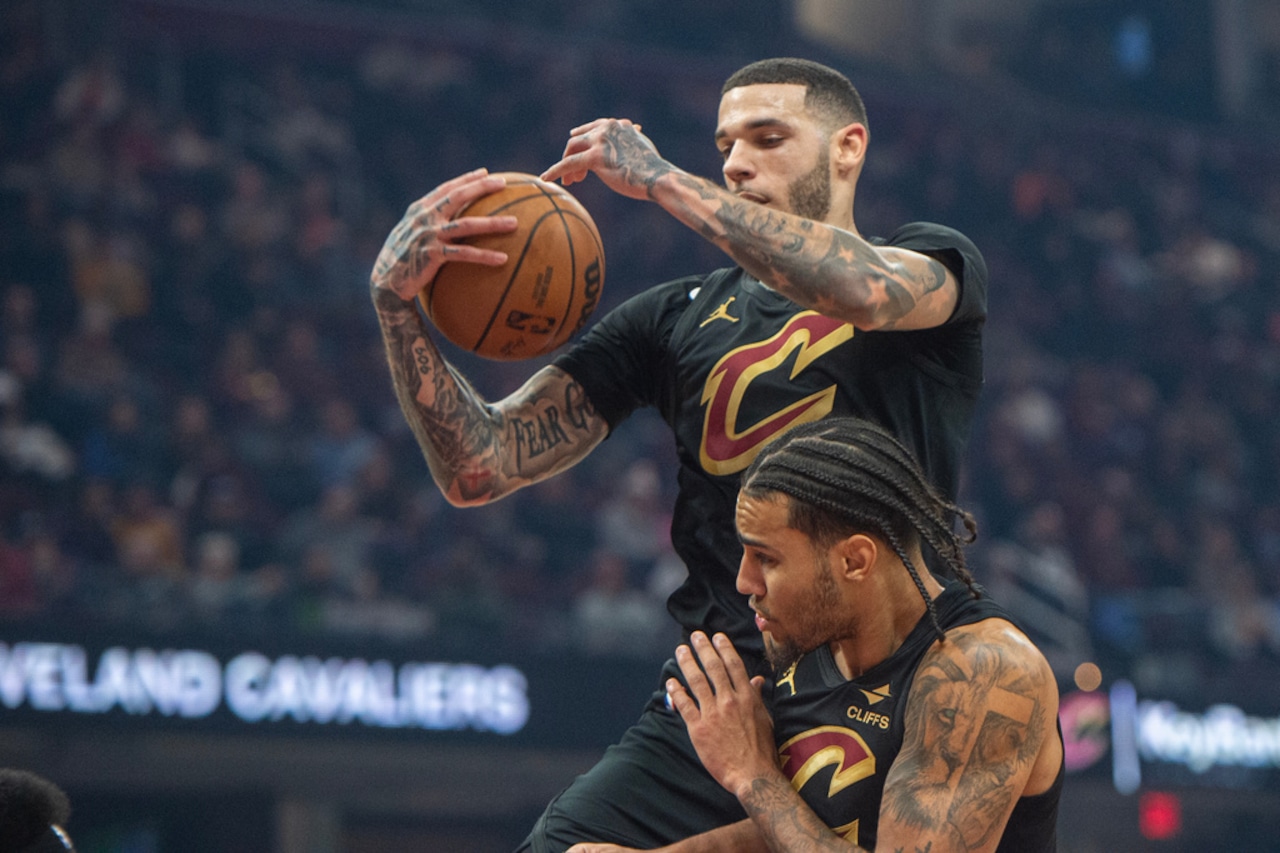
CLEVELAND, Ohio — The Cavs are playing a dangerous game of basketball math.
They are second in the NBA in total possessions. They are also one of the league’s worst teams at defending in transition. Those two facts are not coincidental. They are causally linked by a philosophical commitment that has become increasingly costly, increasingly exploitable and increasingly difficult to justify against the evidence.
The Cavs believe in attacking the offensive glass. They believe the extra possessions matter. They believe it helps dictate terms. And in theory, they are right.
In practice, it is hurting them.
Cleveland ranks in just the 31st percentile in transition defense, per NBA.com. Their overall defensive rating sits 15th in the league, far outside an internal goal of reestablishing themselves as a top-five defense under new principles designed to increase aggression at the point of attack.
Instead, that aggression has widened driving lanes, pulled bigs away from the rim and left the Cavs vulnerable in the exact area where the modern Eastern Conference is most ruthless.
Atlanta. Toronto. Chicago. Miami. The identities of these teams are no secret. They run. They sprint. They hunt advantages before defenses are set. And increasingly, they are circling Cleveland.
The Cavs’ answer has been to double down on offensive rebounding. The problem is that the return on that investment has not been nearly strong enough to offset the damage on the other end.
Cleveland grabs the sixth-most offensive rebounds in the NBA. That sounds impressive until context intervenes. Their offensive rebound percentage ranks 15th at 31.0 percent. League average efficiency, achieved through above-average commitment.
That gap is the story.
Offensive rebounding is not just about desire. It is about shot profile, floor balance and geometry. The Cavs attempt the second-most 3-pointers per game in the league at 43.7. They also own the fourth-worst 3-point percentage at 33.9 percent. Long shots create long misses. Long misses turn rebounding into track meets.
Even when Cleveland commits bodies to the paint, those bodies are often crashing empty space.
The Cavs send at least three players to crash the offensive glass on a significant portion of their shots. That leaves only two players responsible for getting back defensively, and one of them often being Darius Garland. That math alone creates a mismatch waiting to happen.
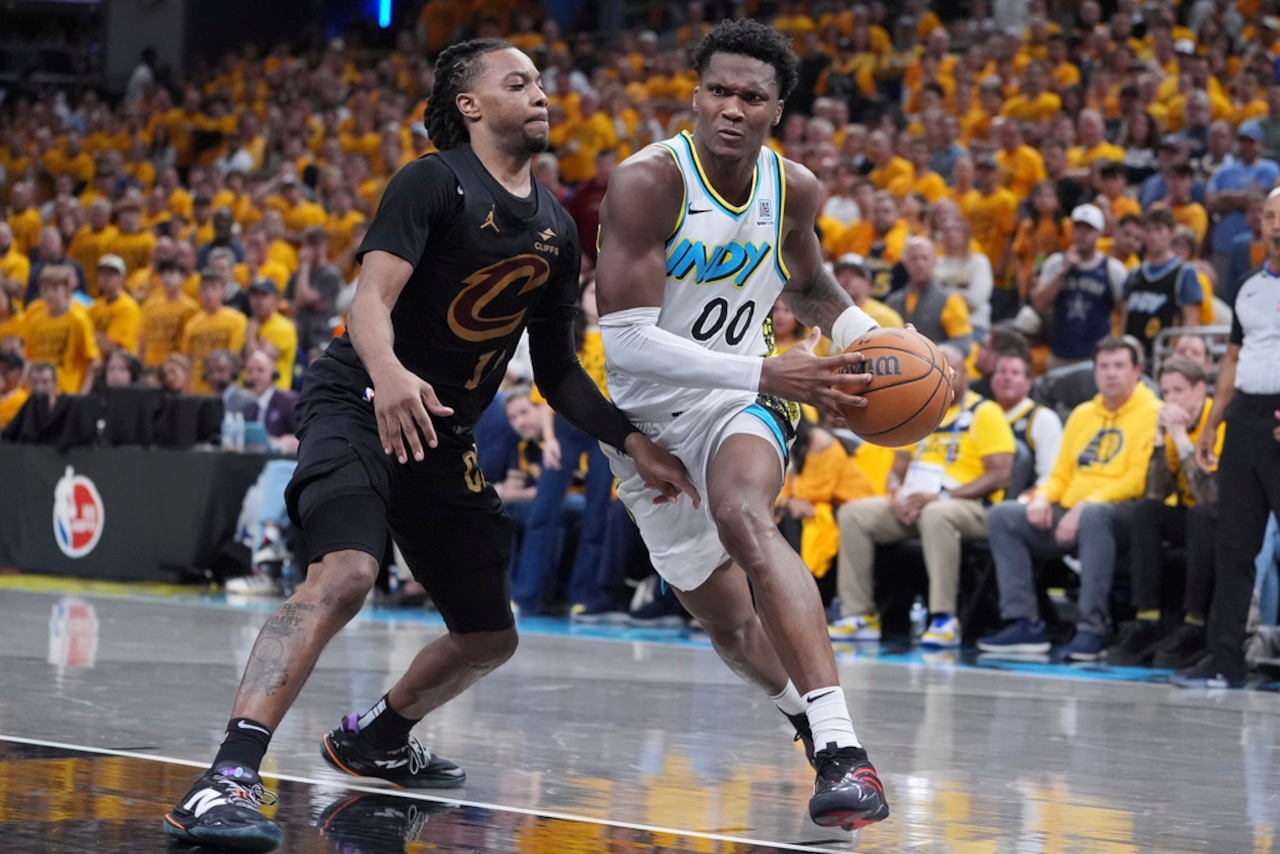 Darius Garland, one of the few Cavaliers back in transition, tries to slow down Bennedict Mathurin on the drive. Garland’s quickness can’t fully compensate for guarding bigger wings at full speed, a mismatch Cleveland faces too often when crashing the offensive glass.AP
Garland is not built to stop downhill wings in space. He is also navigating a recurring toe injury that has limited his burst and recovery speed.
But any two-on-one or three-on-two situation is already a defensive loss, regardless of who is involved. Cleveland is creating those situations for itself with alarming regularity.
Friday’s loss to Chicago offered a clean snapshot.
Nikola Vucevic repeatedly functioned as a trailing threat, pulling Jarrett Allen to the perimeter and opening the lane behind him. That is the downstream effect of a team arriving late, disorganized and mismatched because it is still trying to finish an offensive possession that has already ended.
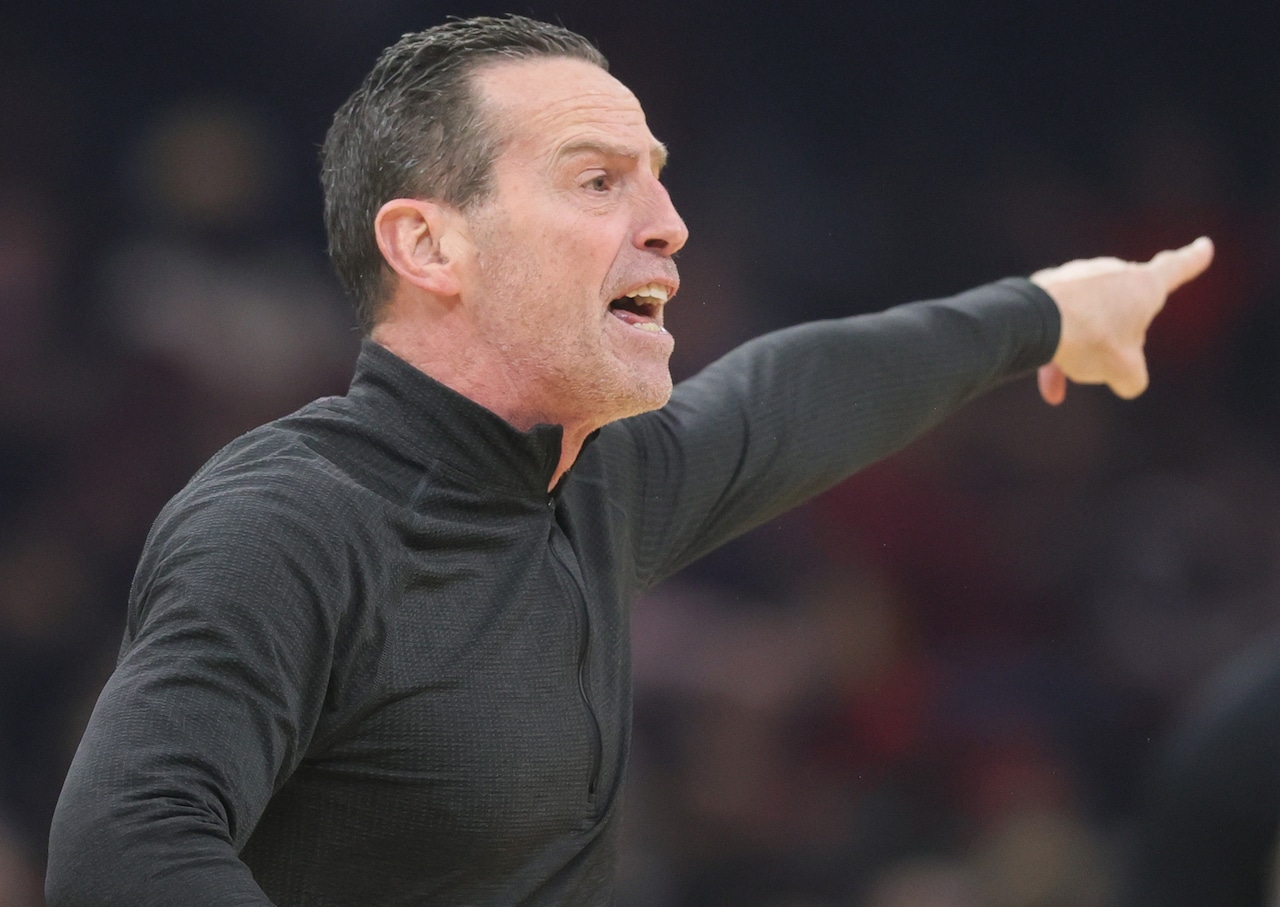 Kenny Atkinson gestures furiously for his players to get back on defense, but his own commitment to crashing the offensive glass leaves them scrambling, outnumbered, and vulnerable — turning theory into a costly real-world mismatch.John Kuntz, cleveland.com
Head coach Kenny Atkinson understands the tension.
“We’re losing too many of those sprint battles,” Atkinson said after the loss to the Bulls. “And it’s the zero-second reactions. Even after a turnover, it’s like these teams are just going.”
Atkinson does not believe conditioning is the issue. He believes awareness is. He believes they can both crash and recover.
“You can do both,” he said. “It’s been proven.”
The problem is that Cleveland is not proving it right now, and Atkinson’s logic is internally consistent.
“If teams are going to leak out and run out, you punish them by being on the offensive boards,” Atkinson said on Nov. 15 ahead of their game against the Memphis Grizzlies. “I think we’ve done that. … We’ll continue to do that. That’s our identity.”
But identity without situational adjustment becomes inertia.
The Cavs are second in the league in possessions because they play fast, miss shots and chase those misses.
Yet, per Cleaning the Glass, they are allowing elevated points per play in transition (3.2 points added per 100 possessions), especially off live rebounds (1.5 points added per 100 possessions). Those are not acceptable tradeoffs for league-average offensive rebounding efficiency.
What makes this more telling is that the players feel it.
After Friday’s loss to Chicago, Garland offered a clear distinction that the scheme itself refuses to make.
“Some teams like Chicago, Indiana, people that really run really hard with some athletic guys,” Garland said, “I think we should get back a little bit more and just load to the ball and just have them play against our half-court defense.”
Cleveland’s half-court defense, while inconsistent this season, is still far more functional than what they are showing in scramble situations.
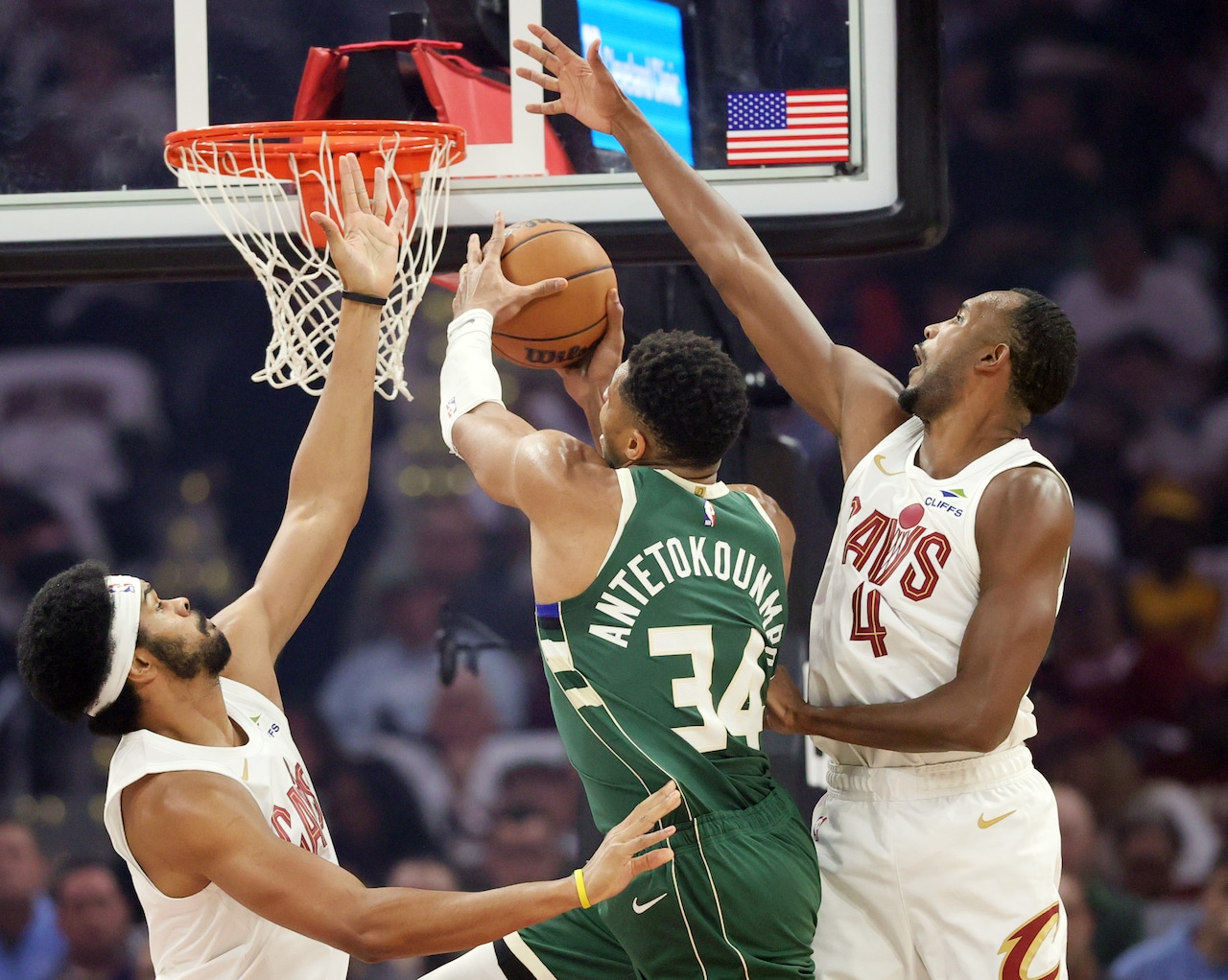 Evan Mobley and Jarrett Allen rise to challenge Giannis Antetokounmpo at the rim, showing why the Cavs are better off as a halfcourt defense team than in transition — where their two rim protectors can stay at their own rim instead of getting caught under the opponent’s basket while the rest of the team races back.John Kuntz, cleveland.com
In the halfcourt, the Cavs at least get their deterrents set. When healthy, Allen and Evan Mobley can occupy space, shrink the floor and influence decisions even when they aren’t recording blocks. Rotations are simpler. Responsibilities are clearer. Matchups are defined.
In transition, none of that exists. The Cavs are not defending concepts. They are defending chaos. Scrambling to locate shooters, pointing at assignments, switching on the fly and trying to recover while already trailing the play turns every possession into a communication test rather than a defensive stand.
For a team without a true point-of-attack stopper on the perimeter, that tradeoff is deadly.
“Very difficult,” Allen added when asked about balancing offensive rebounding and transition defense. “Especially against a team like Chicago … against a team like that, we probably should have got back more, but it’s ingrained in our heads to try to go to the basketball.”
Read that again. Ingrained.
Scheme does not exist in a vacuum. It lives inside bodies, habits and matchups. When a philosophy becomes ingrained to the point where it overrides context, it stops being an advantage.
This does not require abandoning offensive rebounding. It requires redefining it.
Situational rules would immediately reduce the bleeding. Two crashers instead of three against elite transition teams. Automatic guard retreat on above-the-break threes. Miss-location triggers that dictate who goes and who sprints.
That also means making harder, more uncomfortable personnel decisions. Even players who are effective rebounders for their size may need to sacrifice that strength for the sake of the defense behind them.
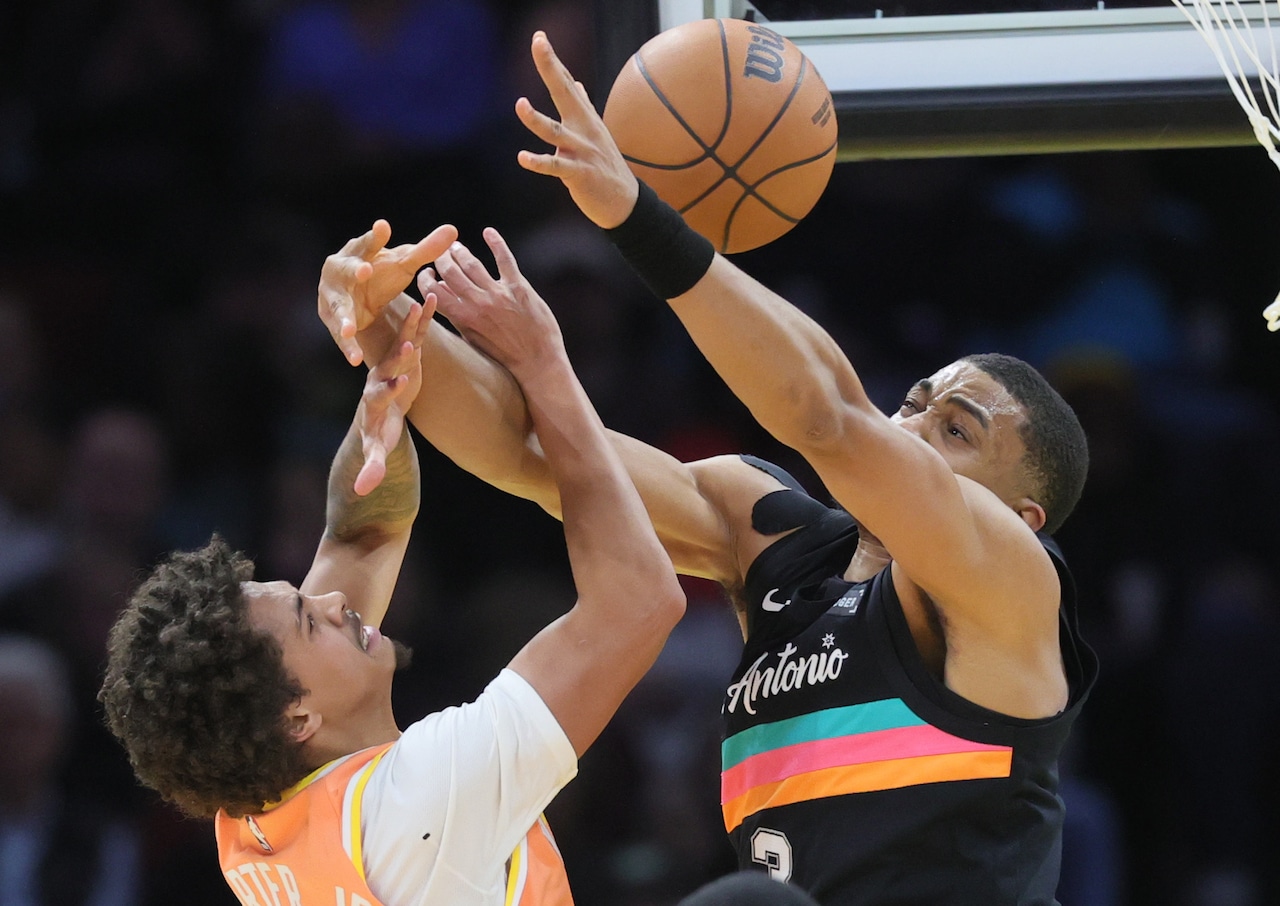 Craig Porter Jr. battles Spurs forward Keldon Johnson for a rebound, showcasing his elite instincts on the glass. Even with Porter’s timing and effort, Cleveland’s coaching staff may need to rethink how they balance crashing the boards with protecting against fast-paced attacks.John Kuntz, cleveland.com
Craig Porter Jr. — who owns the third-highest offensive rebound rate on the team — and Lonzo Ball are both capable, instinctive rebounders relative to their frames. But against teams that weaponize pace, that skill may not be worth the downstream cost.
Ball rarely lives in the paint anymore, and his straight-line speed is not what it once was. Porter, for all his physicality, is still being placed into sprint situations where one delayed step turns into a numbers disadvantage.
Identity should not be binary. It should be conditional.
The league is not slowing down. It is accelerating. The Pacers showed that last postseason when their pace dismantled Cleveland in five games. That series was not an anomaly. It was a preview.
Eastern Conference teams are watching the tape. They see a philosophy that does not bend easily.
The Cavs are not being punished for crashing the offensive glass. They are being punished for crashing it the same way every night, regardless of opponent, personnel or context.
Extra possessions only matter if they do not create extra problems. Right now, Cleveland is losing that equation. And until the scheme adjusts, no amount of effort on the glass will fix what is breaking behind it.