
It hasn’t been a fun brand of basketball as of late in the A.
Despite the loss of Trae Young and Kristaps Porzingis for long stretches this season, the Hawks’ offense has held their heads above water.
Young and Porzingis, the two highest-salaried players on the team, have only shared the court for 51 minutes through 30 games. Somehow, the Hawks have managed a 114.8 offensive rating, good for 12th as of the end of play on December 21 despite their respective health setbacks.
But I’m not going to put lipstick on a pig: the Hawks’ defense as of late has been an unmitigated tire fire.
It’s the main reason that the Hawks have gone from 13-8 to 15-15, and it’s something that threatens to torpedo their season if they can’t find some solutions quickly. The team may have reached a breaking point after giving up 152 points to the Chicago Bulls in regulation on Sunday afternoon, but maybe that experience will inspire change.
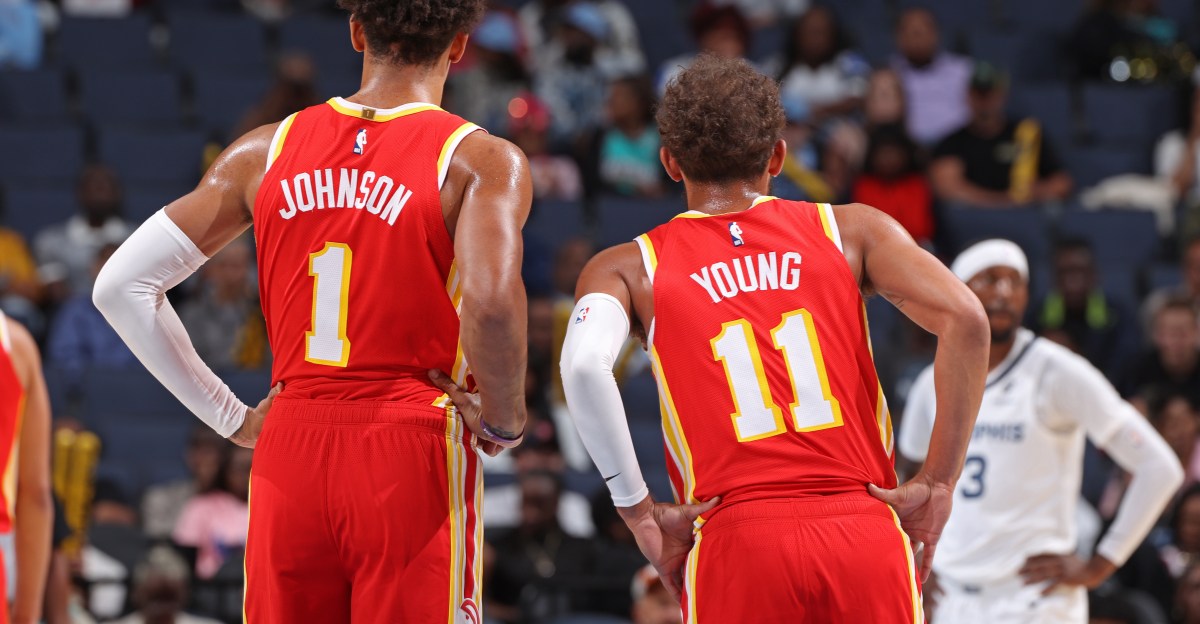
It’s been clear for years that Trae Young is an easy target for opponents to attack. But even more alarmingly this season, Jalen Johnson — for as huge a breakout as he’s having offensively — is a target for defenses as well. He’s providing next to no weakside rim protection (a career-low 0.5 blocks per 100 possessions), and he’s gotten lost in rotations much more frequently than in years past.
But the team needs that duo in order for the offense to hum, and while the team’s defensive issues don’t stop there by any means, it will take the right lineup balance around those two to make things work.
Make no mistake — defense takes all five players being in rhythm, and every rotation player for the Hawks could stand to do their jobs a bit better towards team success. Everybody owns a part of the collective fault here — but similarly a spark to a better performance there can start with anyone.
So, let’s go through the three biggest issues damaging their defense — and the three biggest issues that threatens any hope of a playoff appearance in 2026.
Beyond good old-fashioned talent level, this is often the one biggest decider between a good defense and a bad defense. With so much space to cover in the modern game, the entire defense needs to be on the same page at all times when it comes to screen action coverages and abiding by help principles.
How a five-man unit communicates to navigate these difficulties that modern offenses pose is the difference between a well-defended possession and a blown assignment.
The Hawks have a 115.5 defensive rating so far this season, 18th in the NBA — identical to their finish among the league a season ago. But they were supposed to take a step forward on that end with the core of their team a year older and wiser and the additions of Kristaps Porzingis, Nickeil Alexander-Walker, and others.
Most concerning has been the slump in defense over the past month and change. Since the Hawks were pasted by the moribund Washington Wizards on November 25, that defensive rating has ballooned to 119.6 — 27th in the NBA over that span.
Opponents have shot 40% from three against Atlanta over that stretch — partially due to bad luck and partially due to leaving open too many shooters. The Hawks have ceded tied for the fifth most open threes (defined as the nearest defender being between four and six feet away) in the NBA over this same time span.
These types of breakdowns are far too common. Onyeka Okongwu is defending at the level of the Cunningham-Duren ball screen here. Nickeil Alexander-Walker does the right thing to help at the nail on the roll, but there’s a clear miscommunication as to who should jump out to Cade Cunningham after Dyson Daniels switches onto Alexander-Walkers’ previous man:
Against the Clippers, they handled looks with multiple people in the same corner poorly. First, Vit Krejci and Okongwu can’t handle the low man pass off well. Krejci anticipates stepping up from the baseline to stop a drive, and once a cut occupies Okongwu as well, Nic Batum is left in the corner alone:
The very next defensive possession, Zaccharie Risacher and Keaton Wallace engage in a similar tangle. You can see Risacher direct Wallace to take the Kobe Sanders to allow him to stay low and tag the cut, but Wallace is a beat late:
And during a 132-point blitzing from the Charlotte Hornets, the Hawks looked even more out of sorts. Off a Spain pick-and-roll where Ryan Kalkbrenner screens the screener Brandon Miller, Young switches off onto Miller even as Dyson Daniels continues to track him. That leave Okongwu between both Kalkbrenner and a wide-open LaMelo Ball:
A similar thing happens off a double staggered screen for Miller. Mouhamed Gueye sinks to cut off the drive, but you can see Okongwu gesturing for someone to pick up Tidjane Salaun. Nobody does:
These miscommunications have been more and more evident in recent games. Some of it seems to be due to the shuffling of lineups, including incorporating Trae Young back into the fold. But this deep into the season, they simply shouldn’t be happening with this frequency.
There’s too much ball watching, too much waiting to react to the play unfolding in front of their eyes, and too hand gesturing and visible frustration. Most of the other competitive teams around the league looked dialed in on their defensive principles while the Hawks look stuck in mud too often of late.
The team played pretty inspired defense for a stretch during November, so it’s evident they have that ability in them. And so, they need to find that form again in a hurry, or else this season will quickly get out of hand.
Turnovers (with a dash of missed shots)
Trae Young’s return should help this area. Whenever Trae Young is on the floor over the past two season, the team as a whole turns the ball over less.
Per pbpstats, the Hawks turn the ball over on 14.4 possessions per 100 with Young and 15.9 possessions per 100 without him. Young’s ball handling and quick decision making takes the pressure off others to have to shoulder a big offensive load.
Since October 20, the date of Young’s knee injury, the Hawks have turned the ball over on 15.1% of their possessions. Until last game against the Bulls, Atlanta had committed at least 14 turnovers in every game dating back to the Wizards blowout loss — a stretch of 11 games where they coughed the ball up an average of 16.8 times a game.
Needless to say, the majority of these are live ball turnovers which lead to fast break opportunities for opponents. Of course, you can still push off a miss as well, so a Young-led more efficient offense should help in that regard as well.
Here is what that looks like over the past 12 games in reverse chronological order to better illustrate how these things affect winning:
26 Chicago fast break points off 10 turnovers in an Atlanta loss24 San Antonio fast break points off 17 turnovers in an Atlanta loss20 Charlotte fast break points off 15 turnovers in an Atlanta loss12 Philadelphia fast break points off 12 turnovers in an Atlanta win30 Detroit fast break points off 20 turnovers in an Atlanta loss5 Washington fast break points (!) off 15 turnovers in an Atlanta win26 Denver fast break points off 14 turnovers in an Atlanta loss25 Los Angeles Clippers fast break points off 14 turnovers in an Atlanta loss21 Detroit fast break points off 15 turnovers in an Atlanta loss14 Philadelphia fast break points off 23 turnovers in an Atlanta overtime win17 Cleveland fast break points off 14 turnovers in an Atlanta win28 Washington fast break points off 19 turnovers in an Atlanta loss
Any game when they give up fewer than 20 fast break points, they win and vice versa. Clearly when the Hawks suppress turnovers and fast break opportunities, positive things happen. It’s not always that cut and dry over the course of a season, but this recent stretch is illuminating as to how important one side of the floor is towards influencing the other side.
Rebounding is often the forgotten area of basketball wedged between offense and defense. It’s the special teams of basketball. But it can be the difference between giving the opponent, say, ten or even more extra possessions every game to score. It’s something you usually don’t notice until things have gone very wrong.
For the Hawks, things have gone very wrong this season.
Despite investing in size and length over the past few seasons, Atlanta is now one of the worst rebounding teams in the league. As of December 22, the Hawks rank 24th in defensive rebounding, capturing just 68% of available defensive boards. This comes after they were 10th last season at 71.5% defensive rebounding percentage.
What’s the cause of this backsliding in my opinion? There is definitely an element of personnel at play. The inexperience of this year’s Hawks (especially the young big men) plus the fact that they’re a pretty slightly built team at all positions is part of it.
The Hawks lost an elite (albeit rapidly declining) rebounder in Clint Capela and replaced him with a shaky rebounder in Kristaps Porzingis (who can’t stay on the floor anyway). The young, healthy players they have on this team too often get pushed out of good rebounding position.
There has to be an amount of want to when it comes to defensive rebounding. The willingness to sacrifice your body for a box out even if it means that don’t secure the rebound for yourself. Based on my watching of tape, there’s a bit too much eagerness to hunt for the ball as opposed to performing the fundamentals of team rebounding.
This rebound attempt encapsulates that. Vit Krejci loses track of Kawhi Leonard and can’t reestablish position as the shot goes up. Both he and Mouhamed Gueye lunge at the ball, but Leonard just ends up with the ball for an easy paint fallaway shot.
The Hawks really struggle with burly centers like Nikola Jokic (who doesn’t?), Jonas Valanciunas, and Ivica Zubac. In this clip, Nickel Alexander-Walker doesn’t even come close to knocking Zubac off his spot when the shot goes up.
Quin Snyder was asked by Brad Rowland of the Locked on Hawks podcast ahead of the Clippers game earlier this month about the poor rebounding performance so far this season. He answered, in part, “a tremendous amount of emphasis. Guys seeing film as a team to understand that and own it. Guys seeing film individually about what more they can do. Are they missing a block out? Are they not being aggressive enough when they get a block out?”
Before the Nuggets game, Snyder was posed a similar question. This time, he pulled back the curtains on the coaching staff’s attempts to analyze things, saying “on the defensive glass, we keep track of missed block outs. We keep track of when you get a block out but it’s not effective. And all those things are calculated and tallied. We just gotta keep grinding at that. There are times when we’re not 7’2”, 6’11”, 6’8” across the front line. And even when we are big, the question there is competing physically. If you’re giving up height or you’re giving up weight, we have to rebound in a pack. And that’s how we gotta get it done together. And that means everybody’s got a job to do.”
There are just so many examples of the team just not doing enough to seal off opponents on the glass. Against Charlotte below, Zaccharie Risacher misses a box out on Miles Bridges. At the same time, Jalen Johnson tries a little shoulder push on Ryan Kalkbrenner, and both Hornets combine for a tip out. Trae Young recovers to no man’s land after being sent to the floor, and Brandon Miller gets an open gym three.
The Hawks can’t afford these kinds of breakdown with the way the team is built. In the rotation are multiple perimeter targets that do a poor job of stopping drives and navigating screens. They also lack an elite rim protector to put out fires and deter shots at the rim when faced with driving opposition.
In theory, Kristaps Porzingis was supposed to provide some level of rim protection with his height and reach, and his absence has been felt — even as his mobility has waned in recent years. Onyeka Okongwu has come into his own with his shooting, passing, and overall versatility, but it too much to ask of him to drop and protect the rim at the level the Hawks need.
Maybe the solution is shaking up the personnel, but that likely wouldn’t happen until sometime near the trade deadline. For the moment, the Hawks needs to find solutions from within. Because if they don’t, by the team we even get to the trade deadline, we might be looking at yet another lost season.