
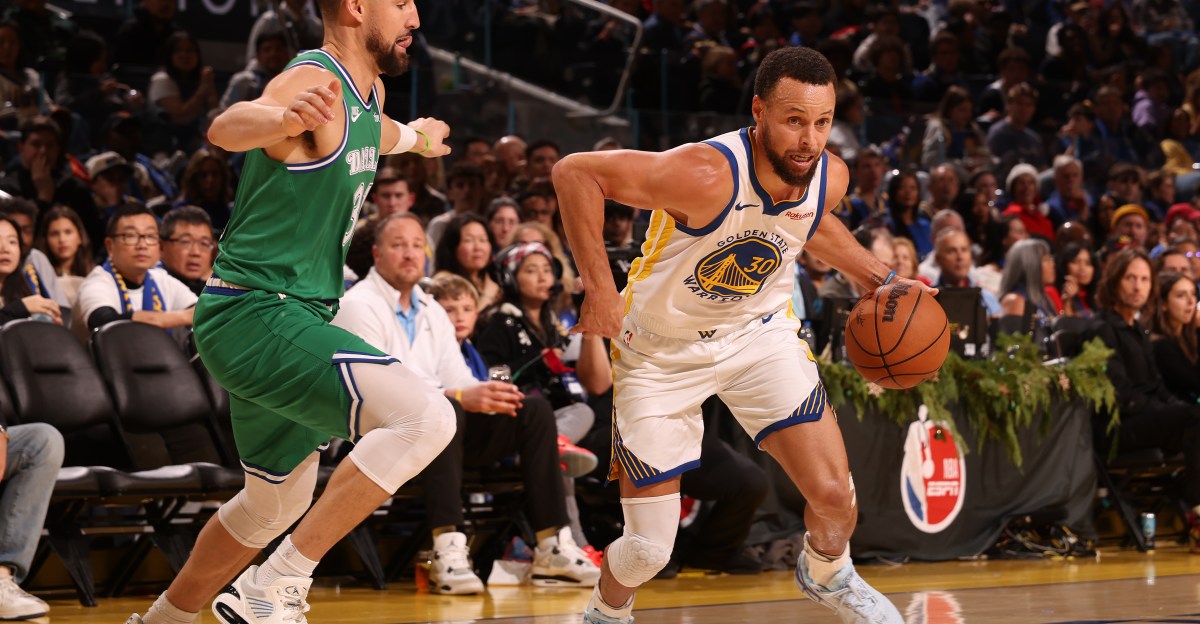
Recently, the NBA debuted a new proprietary statistic measuring a player’s “gravity” — that is, according to their definition, a stat that “quantifies how much a player pulls defenders toward them above expected, essentially measuring how much attention they draw compared to what the spacing on the floor predicts.” As one would expect, the current league leader in this gravity metric is none other than Steph Curry, widely considered to be responsible for making the term “gravity” be part of basketball vernacular.
If there is a more apt definition of what gravity is, it can be described as the manner through which a player can bend the defense and warp the geometry of the floor through both their shot making and the threat of potential shot making. Curry generates gravity simply by being present on the floor, with defenses being reticent to detach themselves from him, lest he breaks free for an open three-point shot.
Curry’s gravity manifests itself in both overt and subtle ways, the latter of which can be exemplified in one particular possession that ended in an Al Horford three — one of four the returning center drilled in his 14-point performance against the Dallas Mavericks on Christmas Day. Starting off with an empty-side pick-and-roll between De’Anthony Melton and Trayce Jackson-Davis, it can be easy to miss what happens on the other side of the floor, where help typically originates against an empty-side ball-screen action:

Brandon Williams is practically glued to Curry on the weak-side corner, which renders him unable to step up on the empty-side action to help. Cooper Flagg, therefore, is the sole extra defender who can help, which he does with his help at the nail — resulting in Horford being open on the trail three:
While it may not be one of Curry’s flashier displays of off-ball pull, I’d argue it’s as effective as him actively causing chaos and confusion with his seemingly never-ending well of cardiovascular energy. It provides further empirical evidence behind Curry leading the league in the “gravity” metric, with an average gravity number of 20.0 — nearly three points higher than second place (Kevin Durant with his 17.2 average gravity).
As expected, Curry’s gravity off the ball is what sets him apart from the rest of the field. His 28.6 off-ball gravity on the perimeter is 9.4 points higher than second place in that category (Shai Gilgeous-Alexander), as exemplified by how he creates four-on-four situations like the one above through his mere presence.
But of course, it’s possessions like the one below that have become a trademark Curry-gravity sequence:
Curiously, Curry does not lead the league in on-ball perimeter gravity. Four of the top five in that category all have similarities in the manner of their usage and how their teams’ offenses are structured around it:
Luka Dončić – 19.8 (80.2 on-ball-gravity minutes)Anthony Edwards – 18.9 (67.0)Kevin Durant – 16.5 (62.2)James Harden – 16.4 (115.4)Curry – 14.3 (44.7)
Especially with regard to Dončić and Harden, on-ball perimeter gravity seems to favor heliocentricity and heavy on-ball creation. While Curry still qualifies as the Warriors’ most prominent on-ball creator, the fact that the Warriors’ offense isn’t built solely on his on-ball exploits has tempered how long he has had the opportunity to create gravity on the ball, with his 44.7 on-ball-gravity minutes being the lowest of the top five. Additionally, per Databallr, he spends only 28.9% of the Warriors’ offensive possessions with the ball in his hands — 42nd percentile.
It may also have to do with the fact that some of Curry’s gravity sequences have involved him coming off of a screen, touching the ball for a few seconds (if not fewer) and immediately dishing the ball to a teammate in anticipation of drawing two to himself:
In the Warriors’ “Head Tap” set above, Curry has his pick of choosing either the cross-screen option underneath the rim or lifting up to use Trayce Jackson-Davis’ screen on the “zipper” cut. Curry chooses the latter (by virtue of being top-locked away from the cross screen), draws two around the screen, and immediately funnels the ball to the rolling Jackson-Davis for the dunk.
Another example — one where Curry’s off-ball mastery combines with his quick decision making on the ball:
In setting up the away action — stepping inside the arc to draw his defender in with him, before turning around to curl off of Gary Payton II’s away screen — Curry automatically draws two to him on the pass. Instead of passing to the rolling Payton, Curry anticipates Flagg “tagging” Payton’s roll and sprays the ball to Moses Moody in the corner, who drills the three against Flagg’s help-off.
Of course, Curry will almost always attract two-to-the-ball coverages regardless of how long he touches the ball. When he starts possessions with the ball in hands in traditional ball-screen actions, a quick roll or slip of the screen can be enough to trigger four-on-three advantage situations. Payton’s usefulness on offense has always been tied to how quickly he can establish rapport with Curry on screening situations, such as on the possession above.
Likewise, Payton as the ball screener unlocks his underrated skill as a roll-man passer, fueled by Curry’s on-ball gravity:
And while Payton’s passing in that regard shines mostly as on direct screening action, his ability to slip screens and get to the middle of the floor allows him to flourish during Curry’s off-ball gravity sequences. Attempting to create an easy way to score, Steve Kerr draws up the Warriors’ patented “5 Out” action, more commonly known as split action, below:
Similarly to how Curry creates initial window dressing to set himself up to draw two to the ball (such as on the away action with Payton), the window dressing in the split action above involves Curry setting a “rip” screen for Jimmy Butler. The Mavs switch the action, with Klay Thompson having to chase Curry around the split-action screen set by Payton. Thompson being switched onto Curry’s top side means he falls behind on the chase, compelling Flagg to step up toward Curry. Payton responds by slipping inside, receiving the pass, drawing a defender, and dumping the ball to Butler for the bucket.
These are but a few of the extensive amount of evidence as to why Curry leads the league in the gravity metric. But truth be told, numbers aren’t necessary to see how Curry continues to be a gravitational force unlike any other. The most striking part of Curry’s ability to warp the floor is that he continues to be defended like the most dangerous player on the floor at the ripe old age of 37.