
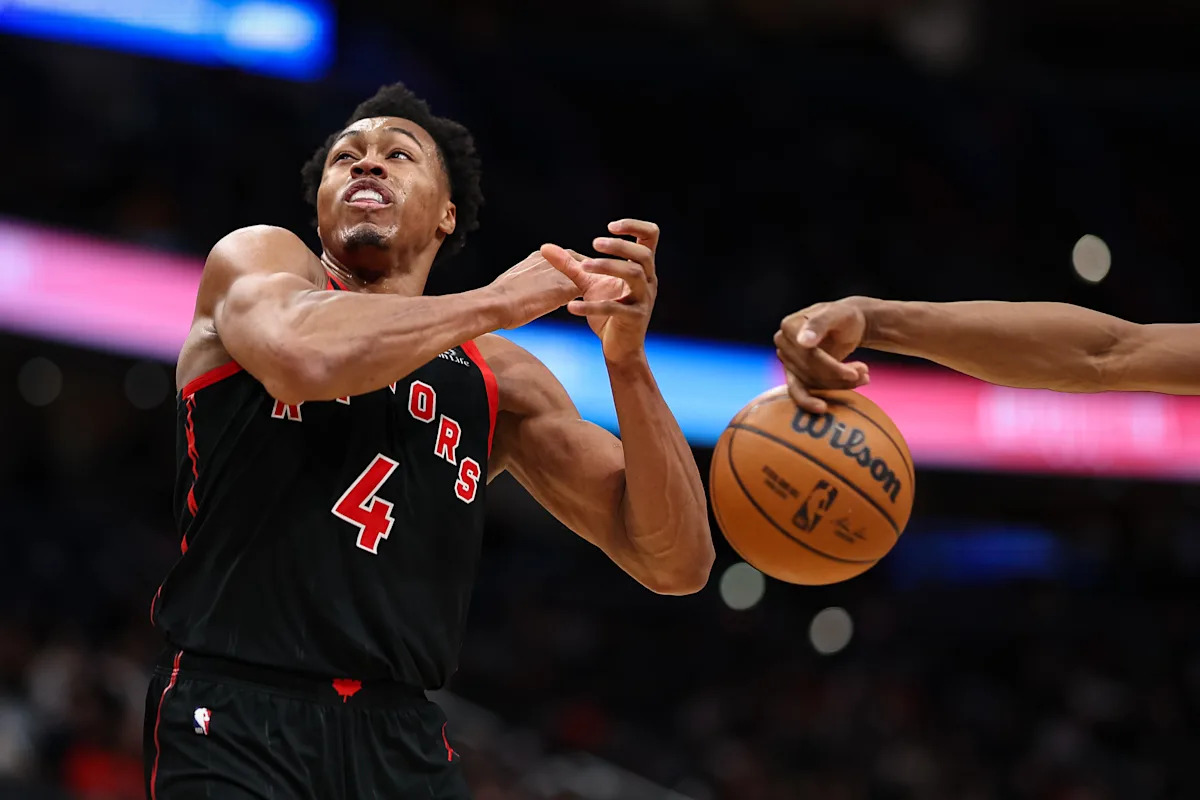
The Washington Wizards played a true team game and blew open a close game with a fourth quarter onslaught to beat the Toronto Raptors, 138-117, and earn their sixth win of the season.
The Wizards rode red hot offense and not completely bad defense to an 11-point lead at halftime. The Raptors sliced the lead to just two points at the end of the third period, driven by the offensive production of Brandon Ingram (12 third-quarter points), Immanuel Quickley (11), and Ja’Kobe Walter (9).
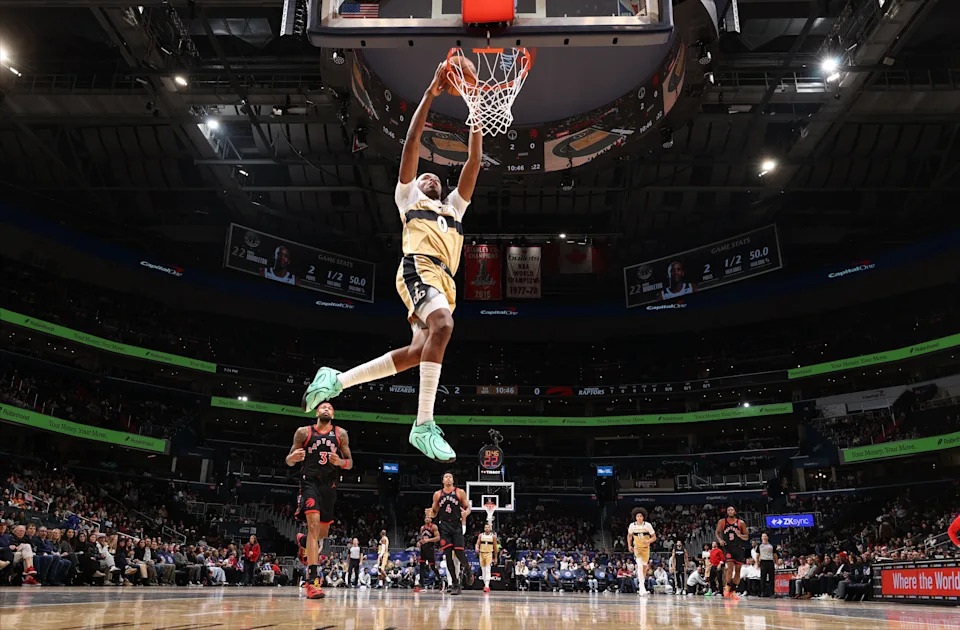
Wizards wing Bilal Coulibaly dunks in the team’s win over the Toronto Raptors.
In the final period, Washington opened with an 18-4 run and didn’t let up. They outscored Toronto 36-17 in the fourth. Washington’s high scorer in the quarter was Bub Carrington with just six points. Three Wizards (Kyshawn George, CJ McCollum, and Bilal Coulibaly) each had five.
Advertisement
While Washington’s offense will receive deserved praise — a 132 offensive rating (points per possession x 100) and 67.6% effective field goal percentage, I was impressed with their defensive perforamnce. After a debaculous defensive outing against the Charlotte Hornets, they returned to a protect the paint strategy, and they executed it reasonably well.
The game plan was evident early — Alex Sarr dropped to the paint on one possession in the game’s opening minutes, which gave his Toronto counterpart Sandro Mamukelashvili a wide-open look from three (he missed).
Later in the first quarter, the Wizards were called for a defensive three-second violation when the weak-side help defender parked himself in the perfect help position but the Raptors struggled to get something going on the perimeter. That positioning of weak-side help is a staple of the Oklahoma City Thunder defense.
That defender (in this case, Carrington) needs to be aware of the count and “clean” himself by either touching an offensive player or stepping outside the lane. He could also do like OKC players, and shout, “Two-point-nine!” as they’re clearing the lane.
Advertisement
One of my favorite possessions came midway through the fourth quarter. Toronto threw a post-up entry to Ingram, who was being defended by the much smaller McCollum. Coulibaly sprinted from the weak-side wing to double. He got there so fast that he surprised Ingram and got a steal (which he took to the other end for a coast-to-coast and-one layup.
Even better, Khris Middleton perfectly zoned up behind the play, positioning himself between wing and baseline shooters — cheated a bit baseline to cut off a pass to Quickley in the corner — and ready to close out.
If Coulibaly had missed on the steal, the next offensive and defensive moves were laid out — Ingram would pass to the wing, Middleton would close out hard, the Toronto player on the wing would swing to the corner, and McCollum would be sprinting to close out on that shooter. Coulibaly made it moot by pilfering the ball from Ingram.
Is this standard NBA defense — the type seen routinely all around the league? Yes. Is it good to see the Wizards execute it properly? You bet.
Advertisement
Washington’s strategy paid off — they were +18 for the game on points in the paint.
Thoughts & Observations
This is the version of Coulibaly the Wizards (and Wizards fans) want to see regularly — 21 points (on 14 field goal attempts), 8 rebounds, 3 steals and a block in 26 minutes.
Carrington was excellent — 15 points, 4 rebounds, 4 assists. He figured prominently in Washington’s fourth quarter steamrolling — a superb thread the needle pick-and-roll pass to Marvin Bagley III for a layup, an alert hit-ahead pass to George for a 117-104 lead, and a three to push the margin to 20.
Justin Champagnie continues to produce when he gets minutes — 8 points, 7 rebounds in 22 minutes. He also had a couple assists. In sum, he had an offensive rating of 166 on 8.0% usage. That’s making the most of every opportunity.
The key to Washington’s effort to the protect the paint is the presence of Alex Sarr, who’s one of the game’s better rim protectors this season. He finished with 15 points on 9 shots, plus three blocks and several other shots changed.
Superb bounce-back performance from George. He pumped in 23 points in 28 minutes, to go with 6 rebounds, and 3 assists. He had three turnovers (two on reckless passes, another on a good pass to Coulibaly who came open in the paint on a routine clear-out cut but wasn’t looking for the ball.
The Brian Keefe offensive system asks players to read what the defense is doing and react. It worked as planned in the early going — Ochai Agbaji was overplaying passing lanes in aggressive ball denial and got burned on backcuts Coulibaly and George.
Speaking of backcuts, Keefe’s out-of-bounds plays (baseline and sideline) are pretty good. The design of player alignments, action sequencing, and fake screening actions reliably produce lobs and at-rim field goal attempts. Announcers tend to credit the players with alert cuts or good reads, but these plays are carefully designed and practiced.
Will Riley could use some practice with his footwork. He got his feet tangled on a good pass to him in the corner that should have resulted in an open look from three. Because his feet were crossed, he had to turn down the shot. His attempt to drive the closeout was slowed by the same issue, and he ended up missing a heavily contested two instead of getting a good look from the corner or creating an advantage.
One thing I’d like to see George improve upon is cutting back on his defensive ball-watching and zeal to help on the perimeter. In both instances, he loses track of his man, which leads to open shots.
Four Factors
Below are the four factors that decide wins and losses in basketball — shooting (efg), rebounding (offensive rebounds), ball handling (turnovers), fouling (free throws made).
The four factors are measured by:
eFG% (effective field goal percentage, which accounts for the three-point shot)
OREB% (offensive rebound percentage)
TOV% (turnover percentage — turnovers divided by possessions)
FTM/FGA (free throws made divided by field goal attempts)
FOUR FACTORS
RAPTORS
WIZARDS
LGAVG
eFG%
50.5%
67.6%
54.0%
OREB%
16.7%
19.4%
26.3%
TOV%
10.6%
12.5%
12.9%
FTM/FGA
0.275
0.165
0.217
PACE
104
100.0
ORTG
112
132
115.7
Stats & Metrics
PPA is my overall production metric, which credits players for things they do that help a team win (scoring, rebounding, playmaking, defending) and dings them for things that hurt (missed shots, turnovers, bad defense, fouls).
PPA is a per possession metric designed for larger data sets. In small sample sizes, the numbers can get weird. In PPA, 100 is average, higher is better and replacement level is 45. For a single game, replacement level isn’t much use, and I reiterate the caution about small samples sometimes producing weird results.
Advertisement
POSS is the number of possessions each player was on the floor in this game.
ORTG = offensive rating, which is points produced per individual possessions x 100. League average so far this season is 115.1. Points produced is not the same as points scored. It includes the value of assists and offensive rebounds, as well as sharing credit when receiving an assist.
USG = offensive usage rate. Average is 20%.
ORTG and USG are versions of stats created by former Wizards assistant coach Dean Oliver and modified by me. ORTG is an efficiency measure that accounts for the value of shooting, offensive rebounds, assists and turnovers. USG includes shooting from the floor and free throw line, offensive rebounds, assists and turnovers.
Advertisement
+PTS = “Plus Points” is a measure of the points gained or lost by each player based on their efficiency in this game compared to league average efficiency on the same number of possessions. A player with an offensive rating (points produced per possession x 100) of 100 who uses 20 possessions would produce 20 points. If the league average efficiency is 114, the league — on average — would produced 22.8 points in the same 20 possessions. So, the player in this hypothetical would have a +PTS score of -2.8.
Players are sorted by total production in the game.
WIZARDS
MIN
POSS
ORTG
USG
+PTS
PPA
+/-
Bilal Coulibaly
26
56
122
29.3%
1.1
215
5
Bub Carrington
22
48
183
18.2%
5.8
252
17
Kyshawn George
28
62
136
26.1%
3.3
165
16
Alex Sarr
24
52
156
17.5%
3.6
195
11
Justin Champagnie
22
48
213
8.3%
3.9
189
10
CJ McCollum
31
67
128
23.8%
2.0
133
8
Marvin Bagley III
22
47
166
8.0%
1.9
83
7
Will Riley
16
35
119
20.4%
0.2
100
6
Tre Johnson
20
43
115
26.5%
-0.1
70
3
Khris Middleton
19
42
86
17.2%
-2.2
56
10
Jamir Watkins
3
5
0.0%
0.0
291
3
Malaki Branham
3
6
131
33.3%
0.3
223
3
Tristan Vukcevic
3
5
50
24.7%
-0.9
-147
3
AJ Johnson
3
5
0
19.8%
-1.3
-237
3
RAPTORS
MIN
POSS
ORTG
USG
+PTS
PPA
+/-
Immanuel Quickley
33
71
149
24.0%
5.7
207
-4
Sandro Mamukelashvili
33
71
141
13.6%
2.5
134
-7
Brandon Ingram
33
72
118
30.6%
0.5
128
-14
Ja’Kobe Walter
18
39
157
20.9%
3.4
155
0
Scottie Barnes
29
63
96
27.6%
-3.3
55
-29
Gradey Dick
18
40
100
14.8%
-0.9
69
-2
Jonathan Mogbo
11
24
#DIV/0!
0.0%
0.0
39
0
Ochai Agbaji
26
56
75
14.5%
-3.3
12
-10
Jamal Shead
19
42
85
20.1%
-2.6
2
-27
A.J. Lawson
7
15
122
11.2%
0.1
110
-7
Jamison Battle
10
21
24
12.6%
-2.4
-102
-4
Garrett Temple
4
8
20
37.9%
-3.0
-163
-1