
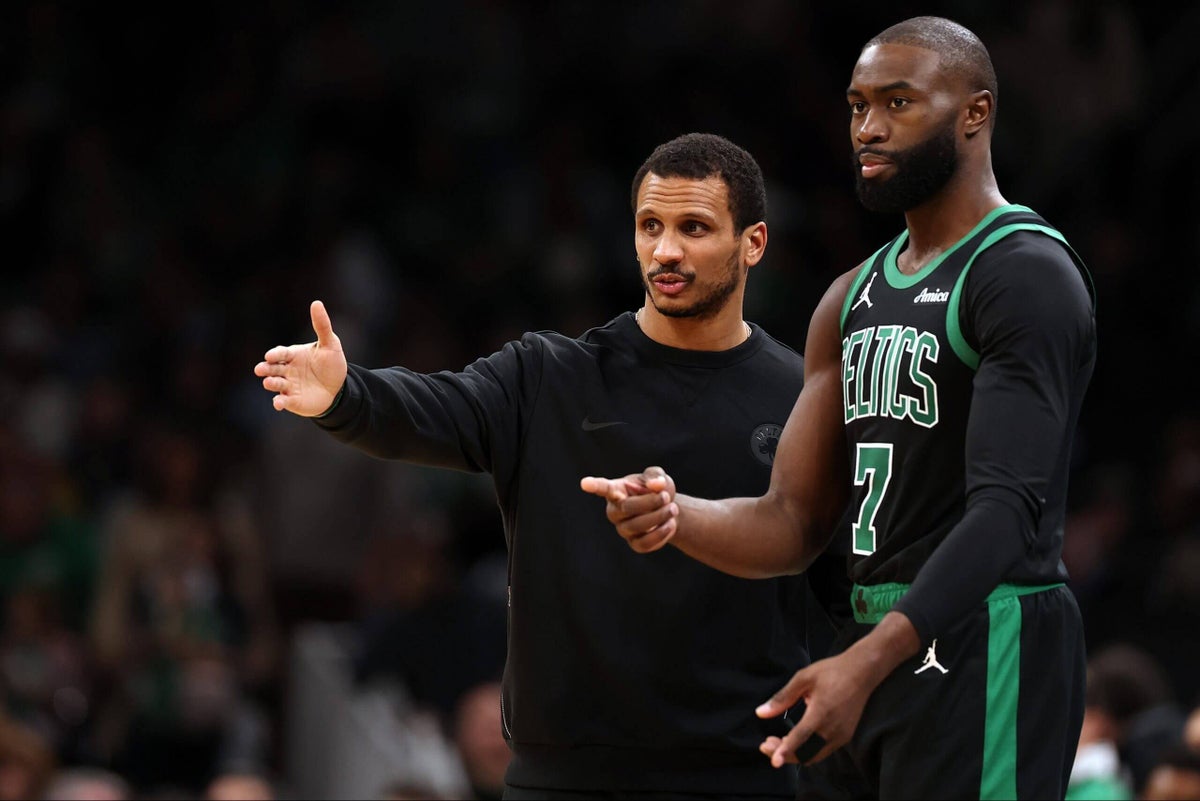
INDIANAPOLIS — Jaylen Brown calls it “Celtic University.” Joe Mazzulla said a radical roster transformation during the offseason forced his team to place a bigger emphasis on basketball education.
Payton Pritchard can feel the shift during film sessions, when Mazzulla used to lash out more at his players, but now takes a more measured approach to his instruction.
“Now,” Pritchard said, “it’s more teaching. It’s not just getting on guys. Obviously, there’s times he’ll get onto us, but it’s just like we keep learning as we go and keep getting better and better in certain situations.”
How much has Boston learned already? After starting the regular season with three straight losses, Mazzulla’s team has climbed to third place in the Eastern Conference at 19-11. By beating the Indiana Pacers 140-122 on Friday, the Celtics won for the 14th time in their last 18 games.
As much as they have ridden the strong play of returners like Pritchard, Brown and Derrick White, that type of success has only been possible because the team’s inexperienced supporting cast has grown up quickly.
From the start, Mazzulla understood the importance of speeding up his team’s basketball development. It wasn’t difficult to identify the challenge ahead of him when the Celtics parted ways with much of their rotation over the offseason. The Celtics were saying goodbye to several former All-Stars who had played significant roles in the 2024 championship run.
For as much as the team would need to replace in pure basketball ability, Mazzulla recognized the need to make up for far more than just that.
“Everyone looks at the talent that we lost,” Mazzulla said, “but we lost cerebral (players), we lost mindset, we lost continuity. And, so, how quickly can you replicate that as fast as possible?”
In an attempt to solve the problem, Mazzulla decided the Celtics would need to change parts of their daily approach. No longer able to rely on a veteran-laden supporting cast, they would need to accelerate the learning process for their young players, many of whom had never logged significant NBA minutes.
Mazzulla couldn’t just snap his fingers and produce another Jrue Holiday or Al Horford. Still, day by day, the coach could do more to develop his team’s collective basketball IQ.
“I think that was the number one point of emphasis this offseason,” Mazzulla said. “After losing all that experience that we had, all that continuity that we had, just creating a better learning environment throughout the building, creating a better learning environment in the film room, on the road.
“Just different ways to make sure that our language and system philosophies are getting across. At the same time, guys are able to retain information at a fast level so that we can get to the best version of ourselves as fast as we can to get better.”
The Celtics believe they have not yet produced their best version. Still, 30 games into the regular season, they boast the Eastern Conference’s top net rating (plus-7.0), which ranks fourth in the NBA.
With Jayson Tatum sidelined all season by a torn Achilles, they have done that while leaning on a supporting cast filled with players who rarely stepped on the court last season.
Neemias Queta and Jordan Walsh have stepped into starting roles. Teenage rookie Hugo Gonzalez, who only played spot minutes in Spain last season, has quickly proven himself capable of handling the most challenging defensive assignments. Josh Minott, Baylor Scheierman and Luka Garza have all had helpful stretches after receiving minimal playing time earlier in their careers. The Celtics’ depth, expected to be a significant problem, has become a strength instead.
Brown said the team’s progress can be traced back to the coaching staff.
“There’s been a lot of education,” Brown said. “We call it — well, me and Joe call it Celtic University, where it’s like you’re in class and you’ve got to pay attention. Sometimes you’ve got to clap your hands — like, ‘Wake up, Josh,’ or something like that. But it’s like being in school where we’re going through, breaking down the footage and trying to really expand our knowledge for the game.”
Already, Brown has seen those lessons pay off.
“We’ve been saying it from the beginning, and sometimes it doesn’t look like it, but we look at how to approach each and every game from a strategy, tactics standpoint,” Brown said. “And I like from the start of the season to the point we’re at now, our basketball IQ has increased, our poise has increased, our understanding of the game has increased, and that’s really what it’s about.
“Continue to grow and get better. And I feel like I’ve watched these guys become better basketball players in a matter of three months.”
The Celtics were at a different point in their development last season. Their veterans had seen just about everything throughout their careers. They had won a championship together. They didn’t necessarily need to focus on the basics.
Recognizing he couldn’t coach his new, much younger team the same way, Mazzulla tweaked some details of how his players receive information.
“I think the way you watch film, the process of how the coaches communicate during film, the way guys process information, taking notes, their ability to answer questions in real time,” Mazzulla said. “So I think a lot of different things that go into it, but a lot can be learned from the education system, the classroom setting, things like that.
“So just trying to get better at that. That’s a credit to the guys. They’ve bought into it. They’ve had an understanding that learning is the most important thing, retaining stuff is the most important thing. And I think that helps us play the way we need to (play) in a game with so many variables and so many things changing throughout a game.”
The lessons include X’s and O’s, of course, but go beyond that.
Minott, who played in Minnesota last season, said the Celtics “put way more stress on pace” than his previous team. Since training camp, he said, the coaches have rewired the team mentally “to understand that we’re trying to play faster than every team on any given night.”
“And even when we’re missing shots or we might not necessarily be playing the best game,” Minott said, “just our speed and sense of urgency should carry us across the finish line.”
Minott said he has learned the importance of personnel and defensive playmaking. He said the Celtics are taught to “have each other’s backs out there (on the court), whether that be defense or rebounding — no matter what it is.”
“Celtics basketball, that’s just it,” Minott said. “From what I’ve learned, it’s just playing tougher than the other team, playing harder, being mother——-. Just trying to wear the other team down mentally, emotionally, physically.”
The Celtics still have a lot to learn, but they have already proven to be quick studies.
“We’re not where we need to be,” Mazzulla said. “But we’re getting better, and it’s because the guys do a great job of just buying into learning at a high level. And it’s a credit to them.”