
Throughout the longest playoff drought in the NBA, the Charlotte Hornets’ past regimes have sold fans visions of what could be. If this player signs or if the lottery luck finally hits, things will change.
When the organization hired championship-winning assistant Charles Lee to be its head coach in May 2024, he promised a legitimate modern NBA offense. For much of his first season, that vision felt like another empty pitch. Charlotte finished in the bottom 10 in both offense and defense last year and appeared headed in the same direction through the first 20 games of this season.
Now, Lee’s promise is unfolding in real time. Over the past two weeks, the Hornets have played some of the most aesthetically pleasing and efficient offensive basketball this franchise has produced in years.
The ball is pinging around the floor. Skip passes and kickouts have become smooth and routine. Charlotte is passing up good shots for great ones, and the offense has become an extremely fun watch for anyone who loves ball movement.
Lee has preached that once an advantage is created, the next player must make the correct read within a second or two. That principle is what has unlocked this offense. It is how great NBA teams put defenses into rotation and keep them there, turning solid possessions into elite ones analytically.
For Hornets fans, the obvious question is where this offensive leap has come from.
Charlotte’s big three
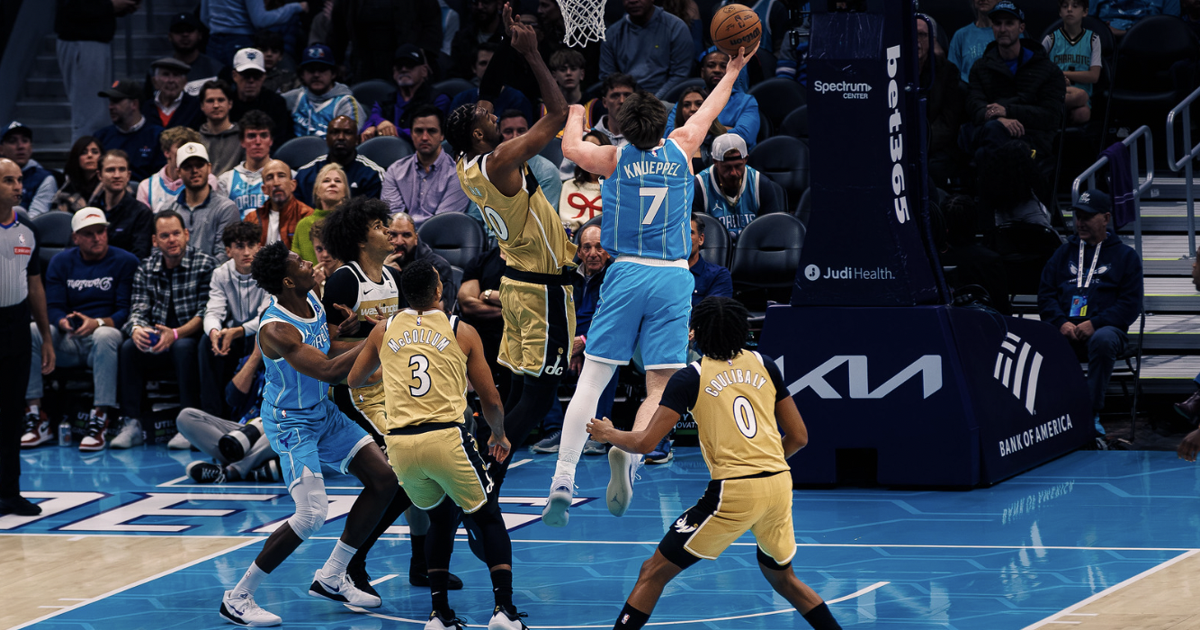
Over this stretch, Charlotte has finally had its core trio on the floor together with star guard LaMelo Ball, forward Brandon Miller and rookie guard Kon Knueppel.
In 340 possessions with Ball, Miller and Knueppel sharing the court, the Hornets own a 130.3 offensive rating, according to Cleaning the Glass. That figure places them among the best offensive groups in the league. They also carry a plus-14.1 net rating and are 7–4 when all three play.
This is the primary reason the offense suddenly looks the way it does and why the Hornets are functioning better as a unit.

Star guard LaMelo Ball drives in the Dec. 23 matchup against the Washington Wizards.
Wyatt Bullock/Niner Times
Lee can stagger those three or play them together and always have someone capable of creating advantages and starting the action. That structural stability simply did not exist in past seasons.
This is the most talented trio Charlotte has had in some time, and the key is that all three are unselfish players. Miller has taken a real playmaking leap this season, and it is difficult for defenses to guard three players who can all pass, shoot and get downhill.
Mixed with the creative off-ball usage of Knueppel and others, Charlotte becomes a special offensive group when everyone is available.
In-house improvement
Basketball is still a team game, and the internal growth of Charlotte’s rotation has fueled this offensive spike alongside the return of its stars.
Coming out of Creighton University, center Ryan Kalkbrenner slid in the draft partly because he was not viewed as a strong processor with an advanced offensive feel. Fewer than 30 professional games later, he is already making quicker reads from the nail and in the short roll, kicking out on time and keeping possessions alive.
Forward Moussa Diabate has always been a solid decision-maker, but in his second season under Lee, everything looks cleaner. He is more decisive in dribble handoffs and quicker to find teammates after offensive rebounds.
Second-year forward Tidjane Salaün also deserves mention. He looked lost for much of last season and early this year, but after a stint with the Greensboro Swarm, he has returned with a simplified role and a noticeably sharper understanding of what is being asked of him. Since rejoining the rotation, he has been solid on both ends and has helped Charlotte win games.
The entire roster is learning how to play this style of basketball and buying into the scheme.
Knueppel summed it up after the Dec. 23 win over the Washington Wizards, saying, “That’s how the game was designed to be played. Obviously, great players are going to dominate the ball sometimes, but the game is designed to be played together as a team against another team. I think when the ball is moving, it is the most fun for everybody. I definitely feel that way.”
Buy-in also shows on the defensive end. Over the last 10 games, Charlotte owns a 115.1 defensive rating, roughly league average. That is the blueprint. Be dynamic offensively and good enough defensively.
Getting guard Josh Green back has helped, along with rookie guard Sion James as legitimate point-of-attack defenders. Charlotte’s transition defense has quietly improved as well.
The Hornets are not loaded with defensive-minded players, but effort and understanding of individual assignments have kept them competitive on that end.
The fit test
This season is about evaluation, and when the operation is running at this level, the players who do not fit this style stand out.
When the ball sticks with forward Miles Bridges or guard Tre Mann, it is glaring. Neither is a natural fit for quick decision-making, and the offense becomes choppy with the ball in their hands.
They simply do not match this scheme, and it would not be surprising to see those roles reshaped in the near future with players who better reflect how this roster is built to operate.
Even with the setback of Knueppel’s injury on Dec. 26, the Hornets have found something real. If they stay committed to this style and to Lee’s scheme, Charlotte can continue to play winning basketball and remain ahead of schedule heading into the new year.