
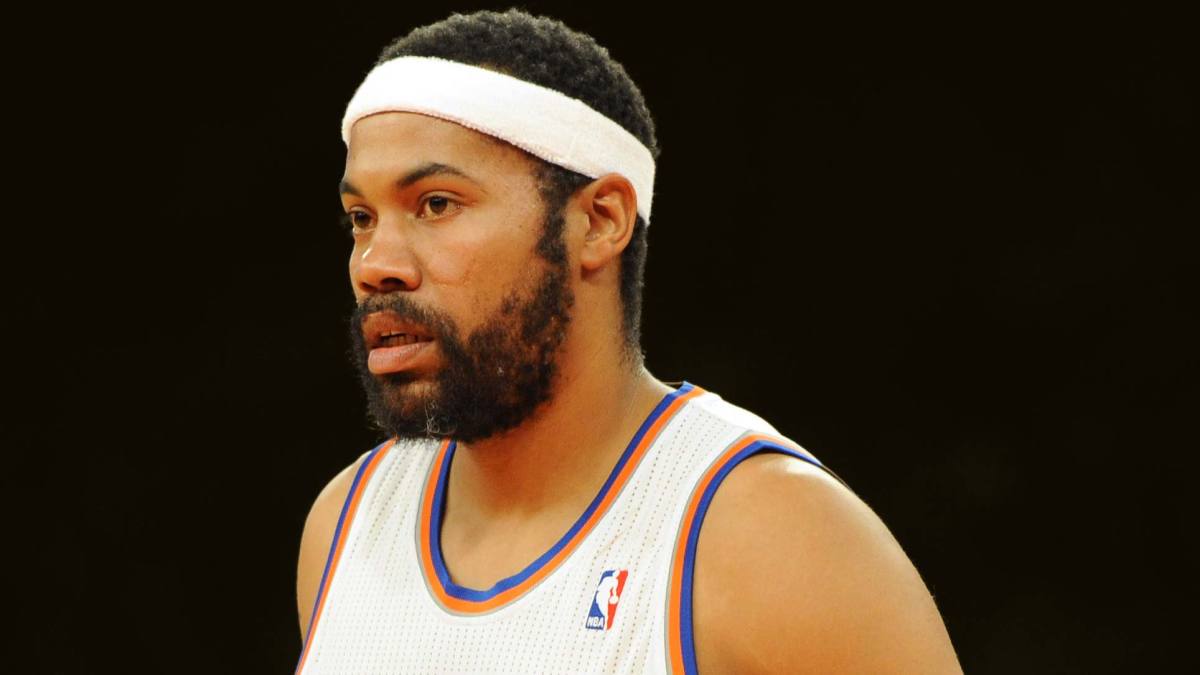
There’s an unmistakable edge that always followed Rasheed Wallace around. A force of personality that walked into arenas long before he checked into a game. He carried a reputation like a badge — brash, defiant, emotional.
But buried under the headlines, the viral outbursts and those endless referee whistles was a player of rare instinct and relentless grit. Two decades after his heyday, Wallace isn’t running from the noise. He’s owning it.
Wallace’s tech legacy
Rasheed doesn’t wince at his past. He smiles at it. He knows the cost of the career he carved out and more importantly, he knows the weight of what he achieved being constantly called by the referees.
Advertisement
“I’m happy to say I got two NBA records that’ll never be broken,” he said. “One is got 40-something technicals in one season. I doubt that will ever be broken.”
During the 2000-01 NBA season, Wallace racked up 41 technical fouls, a record that still stands. It will likely continue to stand as the NBA is currently in an era where on-court behavior is scrutinized by cameras from every angle. Technicals are handed out with regularity, so Wallace’s total remains an outlier in every sense.
It wasn’t just how often Rasheed clashed with officials but how unapologetically he did it. He was a player obsessed with winning, with doing things the right way — even if his delivery scorched everything around him. Wallace’s technicals weren’t always petulant. Many of them came from defending teammates or challenging calls he believed warped the integrity of the game.
And even with those 41 techs, Wallace wasn’t a liability. He remained one of the most feared defensive bigs of his generation. That same season, he averaged 19.2 points, 7.8 rebounds and 1.8 blocks per game with the Portland Trail Blazers, carrying the franchise into the playoffs and establishing himself as the emotional compass of a chaotic locker room.
Advertisement
He was as volatile as he was valuable — and that line was never clean.
Defensive force
If Portland gave Wallace a stage to build his identity, it was the Detroit Pistons that turned him into a champion. Traded to the Pistons in February 2004, Sheed arrived like jet fuel poured on a slow-burning flame. What followed was one of the most iconic defensive stretches in NBA history — he was proud of his involvement.
“That defensive stint that we had when I was with the Pistons, when we had like seven or eight games and held high-scoring teams under 70 points,” Wallace recalled. “And I swear, the last two games that we did it, we tried to do it. But the first five or six games we did it, we were just playing.”
Advertisement
This was during a time when Allen Iverson, Kobe Bryant and Tracy McGrady were torching scoreboards nightly. With him and Ben Wallace, Detroit’s defense became something close to religious. Rotations were crisp. Help came instinctively. Opposing big men got outmuscled. That Pistons unit, under coach Larry Brown, was built on discipline and violence — the kind that played out between the elbows and the rim.
The Pistons’ 2004 NBA title — won over a star-laced Los Angeles Lakers squad featuring Shaquille O’Neal, Bryant, Karl Malone and Gary Payton — remains one of the league’s greatest upsets.
Wallace elevated that system. In that series, he averaged 13.0 points, 7.8 rebounds and 1.8 blocks and his presence inside dismantled the Lakers’ offensive rhythm.