
The ball has dropped and 2025 is in the rearview mirror. Three months have passed since the beginning of training camp, and three months from now we’ll be knee-deep in playoff seeding and, potentially, the return of Jayson Tatum.
So this is a good time to reevaluate what this team really is. We have enough information to feel good about what’s real and what’s not, while there’s enough time to work through some of the rougher spots. With that, here’s a player-by-player look at where they are. I’m going to sort the list by total minutes played.
Payton Pritchard (1051): One of three players to play all 32 games this season (Anfernee Simons, Sam Hauser). Pritchard is struggling from 3 because his catch-and-shoot 3-pointers have cratered. He’s shooting 34.4% on catch-and-shoot 3s this season compared to 44.5% last year. He’s getting almost as many wide-open looks, but his percentages on those mirror the drop on the catch-and-shoots.
The question is why. Is it the added responsibility? Is he rushing? Is it all the stuff he’s doing before he sets up behind the line? Is it that he’s going against starters more often instead of bench players?
It’s hard to say. He’s found a new home in the paint non-restricted area, where he’s one of the most efficient scorers in the league. His drive, nudge, turnaround fadeaway is as automatic as anything anyone shoots. Everything else he does is very typical for Pritchard. If he can figure out his 3-point shooting, then he could be due for a big 2026.
Derrick White (1043): White’s struggles from the field are confusing, too. His true shooting percentage, which accounts for 2s, 3s, and free throws, is at 53.9%, the lowest of his career. His three full seasons in Boston were nearly 61% true shooting. His usage rate is currently at 24.3%, the highest rate of his career, while is 2-point shooting is nearly 12% worse than last season and his 3-point shooting is 4% worse.
So it begs the question of whether this much Derrick White is a good thing. Or at least, this much of THIS Derrick White. According to Synergy Sports, he’s spending 34.8% of his time as the pick-and-roll ball handler, scoring .946 points per possession, while spotting up 23.7% of the time at 1.014 PPP. That’s a flip from last season when he spotted up 34% of the time at 1.288 PPP and was a pick-and-roll ball handler 22.8% of the time at .964 PPP.
White is still considered very good in the pick-and-roll. Shai Gilgeous-Alexander is the standard in that role, and he’s at 1.187 PPP. Jaylen Brown is 1.060. Being up over 1 PPP is where players typically want to be.
The change in role is necessary, but likely temporary considering Tatum’s eventual return. So on one hand, this is not ideal for him and he seems to be struggling with the switch in responsibilities. It’s leading to more pull-up jumpers, which he’s hitting at 42% this season. But he’s already taken 169 of them, whereas last season he took 208 the whole season. He shoot 38.9% on those, so the 42% is actually an improvement, but they make up so much of his shot profile that it feels much worse.
White can change this evaluation by simply making more shots, but I think the stats really show that heavy pick-and-roll and pull-up jump shooting is not where White is at his best. He’s a spot-up guy who thrives in the wake of the stars. I thought he might have been an All-Star who scaled back his game because of the circumstances, but White is more of a third option who can produce some All-Star-type nights under the right circumstances. He’s still a very good basketball player, and his defense remains elite, but what he’s being asked to do this season does not suit him nearly as well as what he’s done in the past, and what he’ll do next season.
Jaylen Brown (1014): He’s on his way to an All-NBA season. Now with Nikola Jokić missing four weeks and likely dropping below the 65-game threshold for postseason awards, Brown finds himself even more in line for a first-team nod.
His 1.060 PPP as the pick-and-roll ball handler is a huge jump from the .867 last season. His 52% field goal percentage in that role is a 10% jump from last season. He’s also shooting about 10% better in isolation and on spot-ups. My only logical explanation is that Brown hired a witch doctor to siphon White and Pritchard’s shooting ability while they were asleep on the team plane.
Whatever work Brown has put in this past summer has paid off in a big way. He’s been itching for this role and he’s thriving in it. His scoring is way up, but not by sacrificing other parts of his game. His assist percentage is 4.4% higher than last year’s career-high of 21.4%. His usage rate is up more than 7% but his turnover rate is only up 1.4% and his total turnovers are in line with other high-usage stars like Jokic, Cade Cunningham (side note: SGA at 1.9 turnovers per game might be the most amazing stat out there). His rebounding and block percentages are up and his steal percentages are level.
However you slice it, Brown is having the best season of his life by far. It’s so incredible that one has to wonder how sustainable it really is. Everything I’ve listed here is an outlier, so the next thing Brown has to prove is that it’s real.
My only fear in that regard is that he’s being asked to do so much for this team, and that he will fade at some point just because his legs will get tired. But I guess that’s what all the pool work was for this summer. If he can maintain this level of play all season, and if the Celtics can stay near the top of the standings, I’ll be the first person to write the “Jaylen Brown for MVP” column. Taking a team that many thought would be play-in bound and raising them, almost single-handedly, to the top of the conference, would demand that kind of attention.
And Drake Maye agrees, so who am I to argue with him?
Anfernee Simons (758): Anyone else surprised Simons is fourth in minutes played?
It’s safe to say Simons has had an up-and-down season.
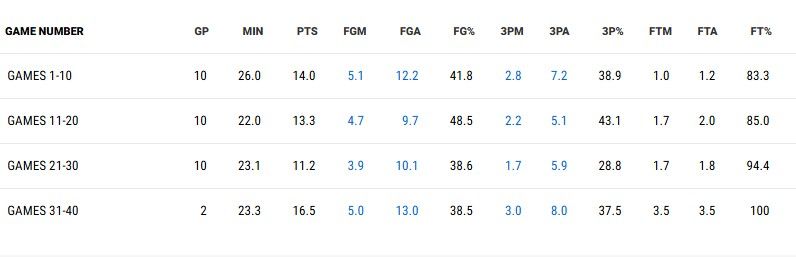
This is typical for a guy Simons’ age trying to adjust to a better than 25% drop in minutes and having to come off the bench.
“It’s for sure an adjustment,” he recently said. “You’re starting, teams are guarding you aggressively from the jump. Now you gotta take your time and read the game and see the best way you can attack it. That was my thought process going through and each and every game. Now everything is kind of flipped. It’s just a change of how you’re going to approach each and every game. It’s kind of how you’re going to do the small things, as well, with what Joe wants me to do and the whole coaching staff wants me to do. And also just being myself, as well.”
He has shown an improved defensive acumen, fighting through screens a little better than he did in the preseason. There are plays he’s fought through where in the past he’d give up and pass the offensive player on to someone else.
The 2026 portion of the schedule could be very informative for Brad Stevens when it comes to Simons. If he can spend the next month demonstrating his value, and willingness, as a sixth man the Celtics will either have a new selling point for a team to acquire him via trade or for the Celtics to keep him themselves.
The argument is simple: a team with Simons’ Bird Rights (which transfer in trades) can sign him to a mid-level deal without having to use a mid-level exception. That means he can remain on the roster as a sixth man at appropriate value, but also be traded more easily because teams can use their MLE to acquire him in a deal. So a team with a center but looking to maybe restructure the roster… oh, let’s just say the LA Clippers … could look to Simons as a better fit for how they want to move forward.
Or Boston can keep him at that MLE number and carry a guy with elite scoring potential into next season. I’ve said that before but I think there’s value to keeping him in that role because there’s no chance at getting that kind of scorer any other way.
So the next few months are really important for Simons and the Celtics. It could change how we thought about him coming into the season.
Neemias Queta (742): A pleasant